October 15th, 2024 | 07:15 CEST
Volkswagen and Bayer with problems – 123fahrschule, on the other hand, with great growth potential
As the German economy undergoes a profound transformation, traditional industries are facing significant challenges. Giants like Volkswagen and Bayer are experiencing difficult times with shrinking margins and structural changes. Volkswagen, Europe's leading automaker, is struggling with falling profits in its core brand despite high group earnings and is planning rigorous cost-cutting measures that could jeopardize jobs. Similarly, Bayer is being forced to make extensive job cuts and reorganize. However, in the midst of these crises, new opportunities are also emerging: companies like 123fahrschule are using innovative strategies to thrive in the education sector. Today, we take a closer look at these three companies.
time to read: 4 minutes | Author: Armin Schulz
ISIN: 123FAHRSCHULE SE | DE000A2P4HL9 , VOLKSWAGEN AG VZO O.N. | DE0007664039 , BAYER AG NA O.N. | DE000BAY0017
Table of contents:
Author

Armin Schulz
Born in Mönchengladbach, he studied business administration in the Netherlands. In the course of his studies he came into contact with the stock exchange for the first time. He has more than 25 years of experience in stock market business.
Tag cloud
Shares cloud
Volkswagen - Struggling with challenges
Volkswagen is currently facing noticeable challenges. Despite a stable leading position in the European market for battery electric vehicles (BEV), the sales situation in 2024 remains under pressure. In the first nine months, the Company recorded a 2.8% decline in global vehicle deliveries compared to the previous year. Particularly weak sales figures in Europe and the especially critical Chinese market are weighing on the result. In addition, BEV sales are also below the previous year's figures, although order numbers in Western Europe are increasing slightly.
Despite the global challenges, there are also positive developments within the Company. The commercial vehicles division, represented by the subsidiary TRATON, was able to post a 5% increase in sales in the third quarter, which highlights strong sales in South America. Nevertheless, sales over the first nine months of the year show a marginal weakening. Particularly encouraging is the penetration of new international markets, which were previously affected by production bottlenecks. These developments underpin Volkswagen's efforts to broaden its base and achieve new successes outside its core markets.
Volkswagen faces the challenge of optimizing its cost structure to secure its market position in the long term. The focus is on measures to increase efficiency and achieve more cost-effective production in order to counter the intense competitive pressure. The Company remains optimistic about the recovery of sales dynamics, particularly through strategic partnerships and investments in new technologies. Nevertheless, the success of these measures remains crucial to achieving the targeted market goals and ensuring the Company's future viability.
123fahrschule – On its way to becoming a market leader
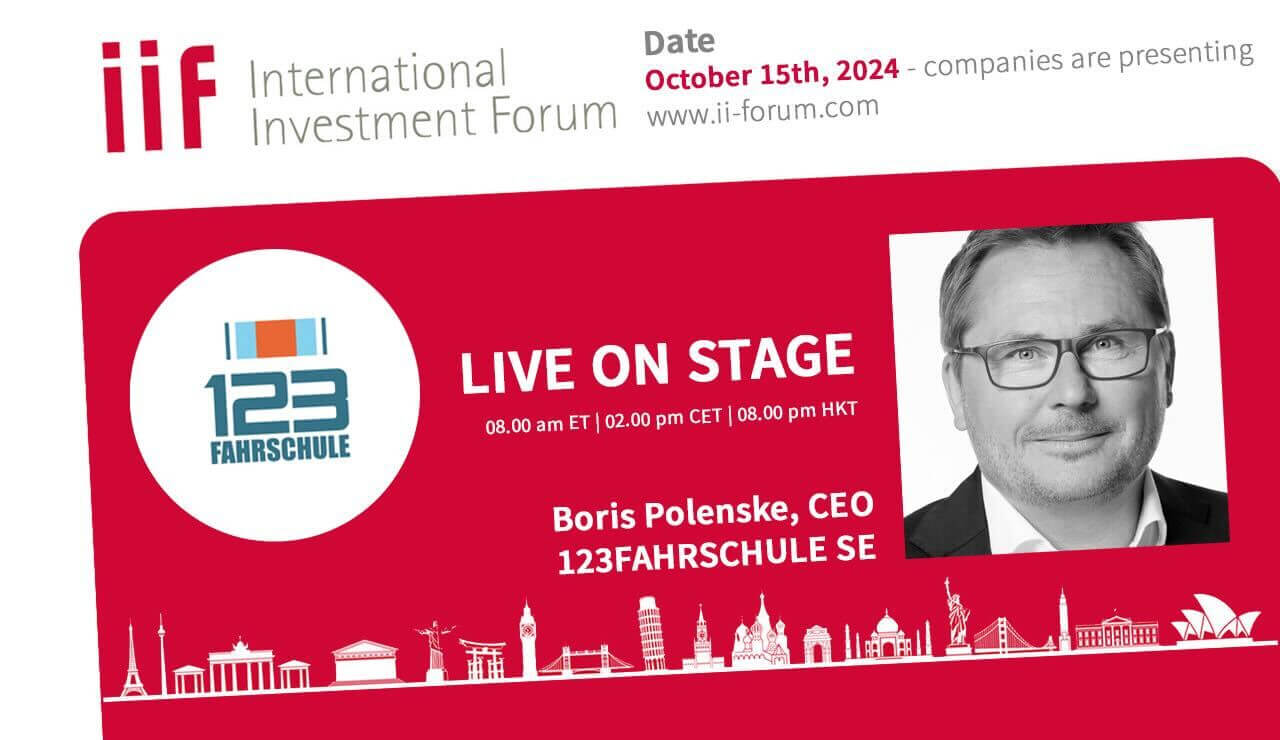
123fahrschule, Germany's largest national driving school, relies on a comprehensive vertical integration strategy. The Company covers the entire value chain: from driving school training to the training of driving instructors and the production of driving simulators by the recently acquired Foerst GmbH. The proprietary software, an important part of this strategy, enables efficient operational management and innovative digital services and is a key to success in the highly fragmented market. Digitization plays a central role not only in the internal organization but also in the range of services offered to students.
On October 14, the German Federal Ministry for Digital and Transport invited industry representatives to discuss the upcoming reform of driving school training in Germany, including the introduction of online theory lessons and the increased use of driving simulators. The Company is ideally positioned to benefit from these changes and to further expand its market position by providing digital learning tools and self-produced simulators. The planned implementation from January 2025 underlines the urgency of the strategic direction and promises significant efficiency gains. The Company's flexibility allows it to pass on some of the higher margins to customers, thereby increasing its market share.
The German driving school market, with a volume of around EUR 2.75 billion and growth of over 16% in recent years, offers considerable potential for consolidation. Many small driving schools with no successors are takeover candidates. 123fahrschule is taking advantage of this opportunity through targeted acquisitions and is benefiting from the increasing attractiveness of regional driving schools as takeover targets. The recently completed and oversubscribed capital increase of 487,556 shares with institutional investors at a price of EUR 2.30 per share shows the high level of confidence in the Company and its growth strategy. The analysts at NuWays see a target price of EUR 7.20 within 12 months. The share is trading at EUR 3.22, well above the capital increase, which is also a positive sign.
Bayer – Renewed focus on litigation
Bayer continues to face extensive legal challenges that are placing a considerable burden on the Company. In particular, the lengthy glyphosate and PCB proceedings remain a financial burden. Despite a short-term victory in Philadelphia, where the US Court of Appeals supported Bayer's stance on warning labels, the Company still faces the threat of substantial compensation payments. Bayer recently lost another glyphosate case and has to pay USD 78 million. In Washington, a PCB case is being re-examined, which increases the uncertainties regarding the future development of these legal disputes. In addition to the lawsuits, the expiring patents in the pharmaceuticals sector are a challenge.
As part of a comprehensive restructuring plan, Bayer is strategically realigning itself to better meet the challenges. Under the leadership of CEO Bill Anderson, significant adjustments have already been made to the organizational model. 70% of the teams are already working under an optimized structure. By the end of the year, this figure is expected to rise to 80-90%. The focus is on streamlining administration and increasing the efficiency of decision-making processes. The aim is to save EUR 2 billion annually from 2025 onwards. The job cuts that have already begun should contribute to this. 6,400 jobs are to be cut this year alone.
One ray of hope for Bayer is the planned expansion of the possible uses for the prostate drug Nubeqa®. The Company has submitted an application for EU approval for a new indication based on the promising results of the Phase III Aranote trial. While Nubeqa® is already approved for several indications worldwide, Bayer hopes the new application will further boost sales and thus compensate for some of the economic challenges. At the same time, however, Bayer must continue to strike a balance between the pressure to innovate and the upcoming patent expiries. These uncertainties are also preventing the share from sustainably reclaiming the EUR 30 mark. Currently, the share stands at EUR 26.105.
Volkswagen and Bayer face significant challenges in a period of economic change, while 123fahrschule shines with growth potential. Volkswagen is struggling with declining sales and is planning rigorous cost-cutting measures to secure its market position. Bayer faces costly litigation and the pressure of expiring patents as it realigns its strategy and implements job cuts to increase efficiency in the long term. By contrast, 123fahrschule is using digital innovations and acquisitions to expand in the fragmented driving school market and to benefit from upcoming reforms.
Conflict of interest
Pursuant to §85 of the German Securities Trading Act (WpHG), we point out that Apaton Finance GmbH as well as partners, authors or employees of Apaton Finance GmbH (hereinafter referred to as "Relevant Persons") may hold shares or other financial instruments of the aforementioned companies in the future or may bet on rising or falling prices and thus a conflict of interest may arise in the future. The Relevant Persons reserve the right to buy or sell shares or other financial instruments of the Company at any time (hereinafter each a "Transaction"). Transactions may, under certain circumstances, influence the respective price of the shares or other financial instruments of the Company.
In addition, Apaton Finance GmbH is active in the context of the preparation and publication of the reporting in paid contractual relationships.
For this reason, there is a concrete conflict of interest.
The above information on existing conflicts of interest applies to all types and forms of publication used by Apaton Finance GmbH for publications on companies.
Risk notice
Apaton Finance GmbH offers editors, agencies and companies the opportunity to publish commentaries, interviews, summaries, news and the like on news.financial. These contents are exclusively for the information of the readers and do not represent any call to action or recommendations, neither explicitly nor implicitly they are to be understood as an assurance of possible price developments. The contents do not replace individual expert investment advice and do not constitute an offer to sell the discussed share(s) or other financial instruments, nor an invitation to buy or sell such.
The content is expressly not a financial analysis, but a journalistic or advertising text. Readers or users who make investment decisions or carry out transactions on the basis of the information provided here do so entirely at their own risk. No contractual relationship is established between Apaton Finance GmbH and its readers or the users of its offers, as our information only refers to the company and not to the investment decision of the reader or user.
The acquisition of financial instruments involves high risks, which can lead to the total loss of the invested capital. The information published by Apaton Finance GmbH and its authors is based on careful research. Nevertheless, no liability is assumed for financial losses or a content-related guarantee for the topicality, correctness, appropriateness and completeness of the content provided here. Please also note our Terms of use.