December 17th, 2025 | 07:30 CET
The Pentagon gets serious for Boeing and Co.: US government backs Korea Zinc and ignites the turbo for Antimony Resources
Antimony was long a metal that attracted little attention. But that has changed abruptly with China's recent export restrictions and geopolitical escalation. The semi-metal is indispensable for the defense industry, from ammunition to high-tech alloys used by Boeing. To break its dependence on Beijing, Washington is now digging deep into the state coffers and supporting the development of domestic capacities through the industrial giant Korea Zinc. This government intervention is fundamentally changing the rules of the market and bringing North American explorers, such as Antimony Resources, which could supply the urgently needed raw material in a few years, into the spotlight of strategic investors.
time to read: 3 minutes | Author: Nico Popp
ISIN: BOEING CO. DL 5 | US0970231058 , KOREA ZINC CO LTD | KR7010130003 , ANTIMONY RESOURCES CORP | CA0369271014
Table of contents:
Author

Nico Popp
At home in Southern Germany, the passionate stock exchange expert has been accompanying the capital markets for about twenty years. With a soft spot for smaller companies, he is constantly on the lookout for exciting investment stories.
Tag cloud
Shares cloud
The state as an anchor investor: Korea Zinc and the new US master plan
For a long time, the US left the supply of critical minerals to the free market, which led to almost complete dominance by China. But that era is over. The US government's decision to provide financial and political support for the construction of a Korea Zinc processing plant on American soil marks a historic turning point in raw materials policy. It is no longer about the cheapest ton of metal, but the safest. Korea Zinc, one of the world's leading specialists in this field, has the technological expertise to process complex ores. Washington's direct intervention here is the ultimate validation signal for the antimony sector. For investors, this means that the purchase risk for antimony has been virtually eliminated, as the state itself acts as a guarantor for the infrastructure, thereby fundamentally securing the market.
But what exactly does the deal entail? Korea Zinc will invest USD 7.4 billion in a refinery in Tennessee to refine raw materials for use by US industry. The project will be carried out by Korea Zinc, with strategic and financial support from the US government. Technologically, the plant is set to raise the bar, as it will not only focus on traditional base metals but will also serve as a complex recycling and processing hub for "complex materials." In addition to zinc and nickel, the plant will also process complex materials, potentially including strategic bottleneck raw materials such as antimony. This would make the plant a physical hub for Western independence from Chinese imports.
Why Boeing and the military are nervous
The reason for the rush in Washington can be found in the order books of the defense and aerospace industries. Antimony is not an optional additive, but a critical component of modern warfare and aviation. It is used in armor-piercing ammunition, night vision devices, and, most importantly, as a flame retardant in plastics and textiles. A company like Boeing cannot deliver aircraft without secure antimony supply chains, as the strict fire safety regulations of aviation authorities are virtually impossible to meet without this metal. Until now, China has controlled over 80% of the global processing chain. Beijing's export controls announced last year made Western buyers realize how fragile their just-in-time models are. The investment in Korea Zinc is therefore a direct measure to guarantee the operational security of key industries such as Boeing and to prevent a supply shock.
Antimony Resources: The laughing third party in the "onshoring" trend
However, a Korea Zinc smelter in the US is only as good as the ore that feeds it. Building a plant on US soil only to continue importing concentrate from China or Russia would defeat the strategic purpose. This is precisely where the window of opportunity opens for Antimony Resources. Since the US itself has hardly any antimony mines of its own, attention inevitably turns north to its closest ally, Canada. With its Bald Hill project in Canada, Antimony Resources is positioning itself as the logical answer to the question of where the raw material comes from. The Company benefits twice over: on the one hand, Korea Zinc's state-subsidized infrastructure ensures that there will be a local buyer for the concentrate in the future, which reduces logistics costs. On the other hand, Western end customers are willing to pay a premium for "NATO-compliant" antimony.
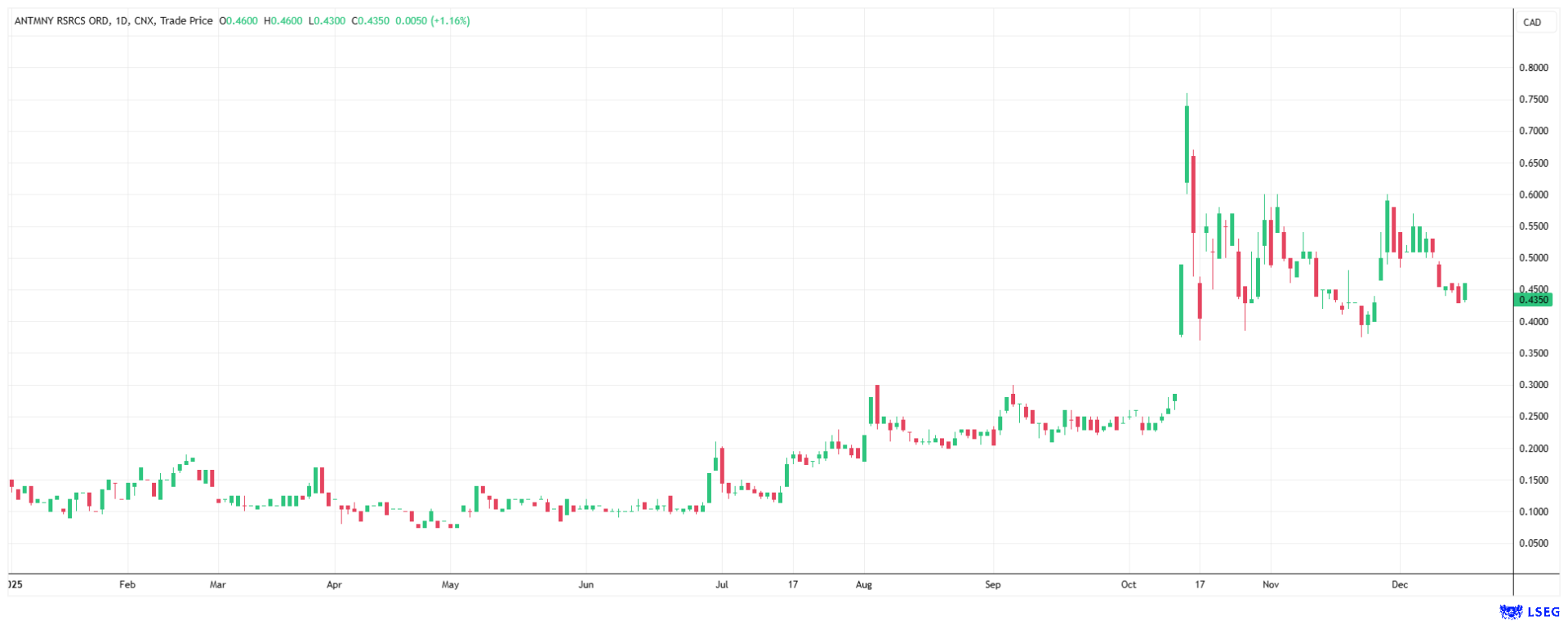
While Korea Zinc, with the support of the US government, is investing billions in complex processing, Antimony Resources offers the classic leverage at the beginning of the chain. In a market where supply is artificially constrained, and demand is rising due to government intervention, projects in secure jurisdictions such as Canada are the most valuable assets. For investors, the result is a clear cascade. The government's big money is flowing to Korea Zinc to build the infrastructure, but the largest percentage increase in value is likely to be for those who own the raw material, without which the new plants would stand idle. Antimony Resources could thus transform itself from a pure explorer to a strategic cornerstone of the North American defense industry. It is also possible that government funds will soon flow to emerging antimony producers.
Antimony Resources' stock has already shown promising performance in 2025. However, its market capitalization is still low. However, as Bald Hill has already scored points with high grades of 3-4% Sb, including significant upside outliers, the stock is high on the watch lists of many investors. Based on its current valuation of around USD 30 million, the chances are good that Antimony Resources will continue to take off in the coming year.
Watch YouTube videoConflict of interest
Pursuant to §85 of the German Securities Trading Act (WpHG), we point out that Apaton Finance GmbH as well as partners, authors or employees of Apaton Finance GmbH (hereinafter referred to as "Relevant Persons") currently hold or hold shares or other financial instruments of the aforementioned companies and speculate on their price developments. In this respect, they intend to sell or acquire shares or other financial instruments of the companies (hereinafter each referred to as a "Transaction"). Transactions may thereby influence the respective price of the shares or other financial instruments of the Company.
In this respect, there is a concrete conflict of interest in the reporting on the companies.
In addition, Apaton Finance GmbH is active in the context of the preparation and publication of the reporting in paid contractual relationships.
For this reason, there is also a concrete conflict of interest.
The above information on existing conflicts of interest applies to all types and forms of publication used by Apaton Finance GmbH for publications on companies.
Risk notice
Apaton Finance GmbH offers editors, agencies and companies the opportunity to publish commentaries, interviews, summaries, news and the like on news.financial. These contents are exclusively for the information of the readers and do not represent any call to action or recommendations, neither explicitly nor implicitly they are to be understood as an assurance of possible price developments. The contents do not replace individual expert investment advice and do not constitute an offer to sell the discussed share(s) or other financial instruments, nor an invitation to buy or sell such.
The content is expressly not a financial analysis, but a journalistic or advertising text. Readers or users who make investment decisions or carry out transactions on the basis of the information provided here do so entirely at their own risk. No contractual relationship is established between Apaton Finance GmbH and its readers or the users of its offers, as our information only refers to the company and not to the investment decision of the reader or user.
The acquisition of financial instruments involves high risks, which can lead to the total loss of the invested capital. The information published by Apaton Finance GmbH and its authors is based on careful research. Nevertheless, no liability is assumed for financial losses or a content-related guarantee for the topicality, correctness, appropriateness and completeness of the content provided here. Please also note our Terms of use.