February 19th, 2026 | 07:25 CET
The molecular revolution: Why A.H.T. Syngas wins where BASF invests billions and EQTEC paves the way
While policymakers preach electrification, practitioners in heavy industry know that process heat and chemical raw materials require molecules. This is where synthesis gas (syngas), an old acquaintance, is celebrating a spectacular renaissance. Syngas is the backbone of modern chemistry, a mixture of hydrogen and carbon monoxide without which neither fertilizers, plastics, nor synthetic fuels could exist. Market forecasts from research firms like MarketsandMarkets and Grand View Research paint a similar picture: the global syngas market is expected to grow at high single- to double-digit rates through 2030, expanding from several dozen billion US dollars today to a significantly larger market. Three parallel developments are currently taking place in this gigantic growth market. While chemical giant BASF validates the demand and EQTEC proves the large-scale feasibility, German technology specialist A.H.T. Syngas Technology (A.H.T.) is disrupting decentralized applications. We analyze the market and the key players.
time to read: 3 minutes | Author: Nico Popp
ISIN: A.H.T. SYNGAS TECH. EO 1 | NL0010872388 , BASF SE NA O.N. | DE000BASF111 , EQTEC EO-_001 | IE00BH3XCL94
Table of contents:
Author

Nico Popp
At home in Southern Germany, the passionate stock exchange expert has been accompanying the capital markets for about twenty years. With a soft spot for smaller companies, he is constantly on the lookout for exciting investment stories.
Tag cloud
Shares cloud
BASF: Proof that syngas is systemically important
To understand why A.H.T. Syngas' technology is so promising, we first need to take a look at BASF. The world's largest chemical company is investing heavily in modernizing its syngas production. According to company reports, BASF is working on new processes to produce syngas from recycled raw materials and with drastically reduced CO2 emissions, for example, at its Antwerp site.
For BASF, syngas is not a fuel, but a raw material and the starting point for ammonia, methanol, and all C1 chemicals. The fact that a corporation of this size is investing billions in securing and greening its syngas supply sends an unmistakable signal to the market that there is no industrial future without syngas. However, BASF solves this problem centrally in huge chemical parks that are out of reach for normal small and medium-sized enterprises.
EQTEC: Validating the waste-to-value logic
EQTEC is operating one step closer to the circular economy. The company specializes in converting large waste streams into syngas and then into electricity or biofuels. With projects in France, Italy, and the UK, EQTEC is proving that the gasification of waste materials is technically mature and financially viable. With its business model, EQTEC is a kind of "icebreaker" that shows banks and regulatory authorities that modern gasification has nothing to do with the dirty waste incineration plants of the 1980s. However, EQTEC also often focuses on large infrastructure projects that require enormous amounts of input material. This often leads to a logistical dilemma, as biomass and waste have a low energy density. Transporting them long distances to feed a large plant ruins the ecological balance.
A.H.T. Syngas: Decentralized independence as a unique selling point
This is exactly where A.H.T. Syngas Technology positions itself as a smart problem solver. The Overath-based company has recognized that the solution is not to bring the waste to the plant, but to bring the plant to the waste. A.H.T. builds compact, highly efficient gasification plants with a capacity range of 0.2 to 10 megawatts, which are installed directly at the customer's site. The technological spearhead is the patented double-fire process.
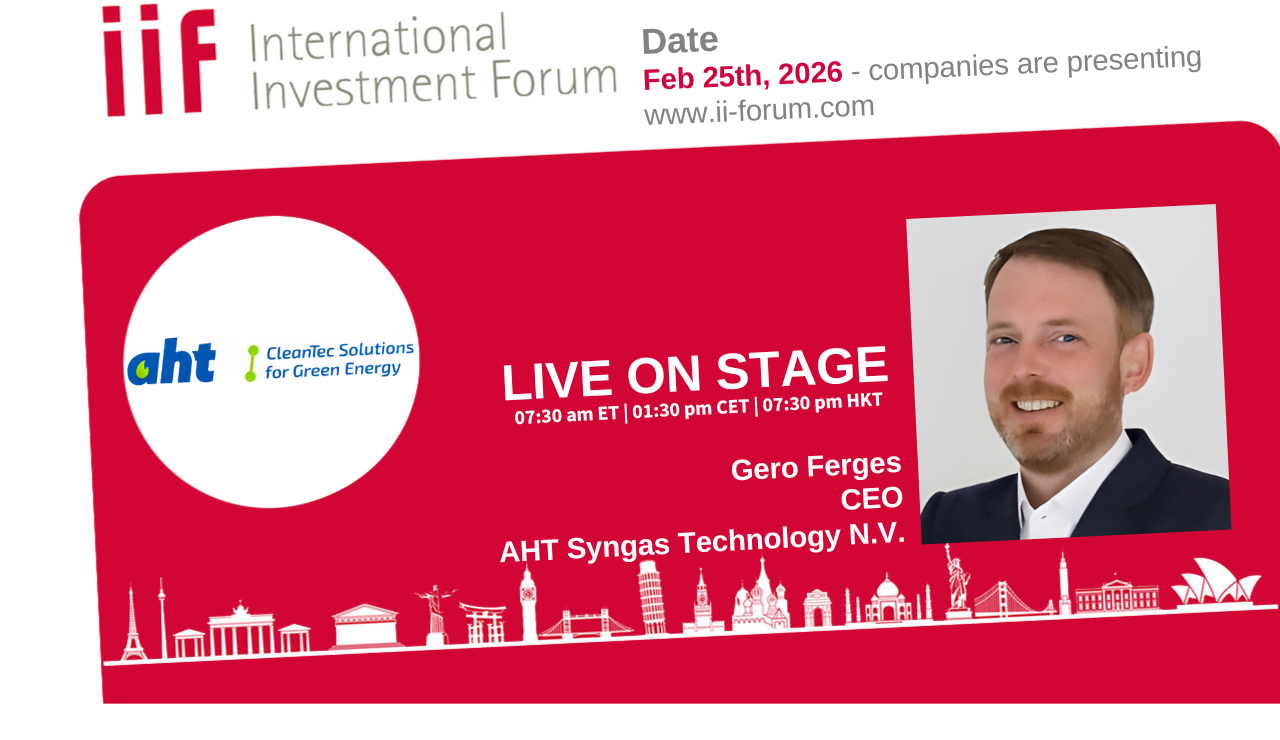
Unlike conventional gasifiers, this process produces an extremely clean gas that is almost free of tar and can be used directly in gas engines for power generation or as process gas. AHT's business model is as scalable as it is ingenious. A paper manufacturer or agricultural business often has huge amounts of waste materials, such as sewage sludge, wood waste, or crop residues, that it has to dispose of at great expense, while at the same time purchasing expensive natural gas for its process heat. The A.H.T. solution transforms this disposal problem into a source of energy, turning the customer from a gas buyer into a self-sufficient supplier. A.H.T. often acts as a technology supplier, providing the technology and core components, while local partners take care of the steel construction. This keeps the balance sheet lean and margins high.
The Japan coup: Proof of scalability
A glance at Asia proves that this is not just a theory. A.H.T. has successfully implemented a 2-megawatt plant in Japan. Japan is considered one of the most demanding markets in the world in terms of both technological standards and emission limits. The fact that A.H.T. has established itself there is tantamount to a knighthood. The plant uses local biomass to generate electricity and heat and demonstrates the flexibility of the technology when it comes to difficult fuels. While BASF and EQTEC think in terms of dimensions that require years of planning, A.H.T. delivers plug-and-play solutions for the acute problems of small and medium-sized businesses.
Conclusion: This gap in the market is worth its weight in gold
For investors, A.H.T. Syngas offers a classic niche opportunity with massive leverage. While BASF confirms the strategic necessity of syngas and EQTEC drives forward the acceptance of the technology, A.H.T. is the only company that is bringing this technology to the market. In a world where companies are desperately trying to reduce their carbon footprint and become independent of volatile gas prices, A.H.T. provides the solution. A.H.T. does not just sell equipment; it sells independence. Those who believe that the energy transition will be mastered in a decentralized manner will find A.H.T. Syngas to be one of the technological market leaders in the small and mid-scale segment.
Conflict of interest
Pursuant to §85 of the German Securities Trading Act (WpHG), we point out that Apaton Finance GmbH as well as partners, authors or employees of Apaton Finance GmbH (hereinafter referred to as "Relevant Persons") may hold shares or other financial instruments of the aforementioned companies in the future or may bet on rising or falling prices and thus a conflict of interest may arise in the future. The Relevant Persons reserve the right to buy or sell shares or other financial instruments of the Company at any time (hereinafter each a "Transaction"). Transactions may, under certain circumstances, influence the respective price of the shares or other financial instruments of the Company.
In addition, Apaton Finance GmbH is active in the context of the preparation and publication of the reporting in paid contractual relationships.
For this reason, there is a concrete conflict of interest.
The above information on existing conflicts of interest applies to all types and forms of publication used by Apaton Finance GmbH for publications on companies.
Risk notice
Apaton Finance GmbH offers editors, agencies and companies the opportunity to publish commentaries, interviews, summaries, news and the like on news.financial. These contents are exclusively for the information of the readers and do not represent any call to action or recommendations, neither explicitly nor implicitly they are to be understood as an assurance of possible price developments. The contents do not replace individual expert investment advice and do not constitute an offer to sell the discussed share(s) or other financial instruments, nor an invitation to buy or sell such.
The content is expressly not a financial analysis, but a journalistic or advertising text. Readers or users who make investment decisions or carry out transactions on the basis of the information provided here do so entirely at their own risk. No contractual relationship is established between Apaton Finance GmbH and its readers or the users of its offers, as our information only refers to the company and not to the investment decision of the reader or user.
The acquisition of financial instruments involves high risks, which can lead to the total loss of the invested capital. The information published by Apaton Finance GmbH and its authors is based on careful research. Nevertheless, no liability is assumed for financial losses or a content-related guarantee for the topicality, correctness, appropriateness and completeness of the content provided here. Please also note our Terms of use.