March 10th, 2026 | 07:20 CET
Iran and the oil dilemma – Alternatives on the rise! CHAR Technologies, Nordex, and Siemens Energy in focus
The geopolitical escalation in the Middle East has hit commodity markets with full force. At the beginning of the week, the price of oil surged above USD 115 per barrel as a result of the Iran crisis, but quickly fell back to around USD 105. Nevertheless, this remains a level that was last reached several years ago. The trigger has been major disruptions to supply chains around the Persian Gulf and the Strait of Hormuz, through which roughly one-fifth of global oil trade normally passes. Oil has thus once again become a symbol of a classic geopolitical shock: physical scarcity meets panic-driven hedging on the futures markets. For dynamic investors, alternatives are coming to the fore. What can replace oil in the long term, or at least partially substitute it? CHAR Technologies, Nordex, and Siemens Energy may provide compelling answers.
time to read: 4 minutes | Author: André Will-Laudien
ISIN: CHAR Technologies Ltd. | CA15957L1040 | TSXV: YES , NORDEX SE O.N. | DE000A0D6554 , SIEMENS ENERGY AG NA O.N. | DE000ENER6Y0
Table of contents:
Author

André Will-Laudien
Born in Munich, he first studied economics and graduated in business administration at the Ludwig-Maximilians-University in 1995. As he was involved with the stock market at a very early stage, he now has more than 30 years of experience in the capital markets.
Tag cloud
Shares cloud
Goodbye oil crisis – CHAR Technologies trumps with biocarbon and alternative gas
The recent escalation in oil prices has once again shaken the energy markets and shows how much geopolitical risks can increase the price of fossil fuels. For investors, this brings into focus the question of which technologies can serve as long-term substitutes for traditional energy sources. CHAR Technologies, a Canadian cleantech company that combines industrial decarbonization with a scalable business model, is positioning itself precisely in this area of tension. At the heart of its strategy is a proprietary high-temperature pyrolysis process that converts wood residues and organic waste into two usable products in the absence of oxygen. This produces a solid biocarbon that can replace fossil coal in the steel industry, for example, and an energy-rich gas that can be processed into renewable natural gas or even green hydrogen.
This dual revenue model increases the economic attractiveness of the plants, as income can be generated from both industrial material markets and energy contracts. Particularly important here is the modular design of the plants, which are not designed for individual projects but for a reproducible pipeline. A first milestone is the plant in Thorold, Canada, which is currently entering commercial operation and is expected to deliver several thousand tons of biochar annually in the future. The project serves as a reference plant and provides operational data that is crucial for the expansion of larger production sites. The next step is the significantly larger project in Espanola, Ontario, where a plant with an annual capacity of around 50,000 tons is to be built.
CEO Andrew White provided insights into the company's long-term strategy at the 18th International Investment Forum.
Strategic partners play a central role in building the company. In the case of CHAR Technologies, the BMI Group is involved both at the corporate level and directly in projects, and has recently committed additional funding. At the same time, an oversubscribed private placement was increased to approximately CAD 3.97 million at the beginning of March, with institutional investors and existing shareholders participating. The fresh capital will be used to further develop the project pipeline and expand the company's structure. The company has also made an important operational transition, producing commercial biocarbon for the first time and thus moving from the technology phase to revenue generation. CHAR is also making a name for itself in new technologies, such as the thermal destruction of PFAS chemicals, which are increasingly regulated worldwide. Long-term purchase agreements, some with terms of up to two decades, are important in this context. They ensure stable revenues and facilitate the financing of new plants. The business model is supported by industrial partners such as ArcelorMittal, which are testing or already using biochar as a climate-friendly substitute for metallurgical coal.
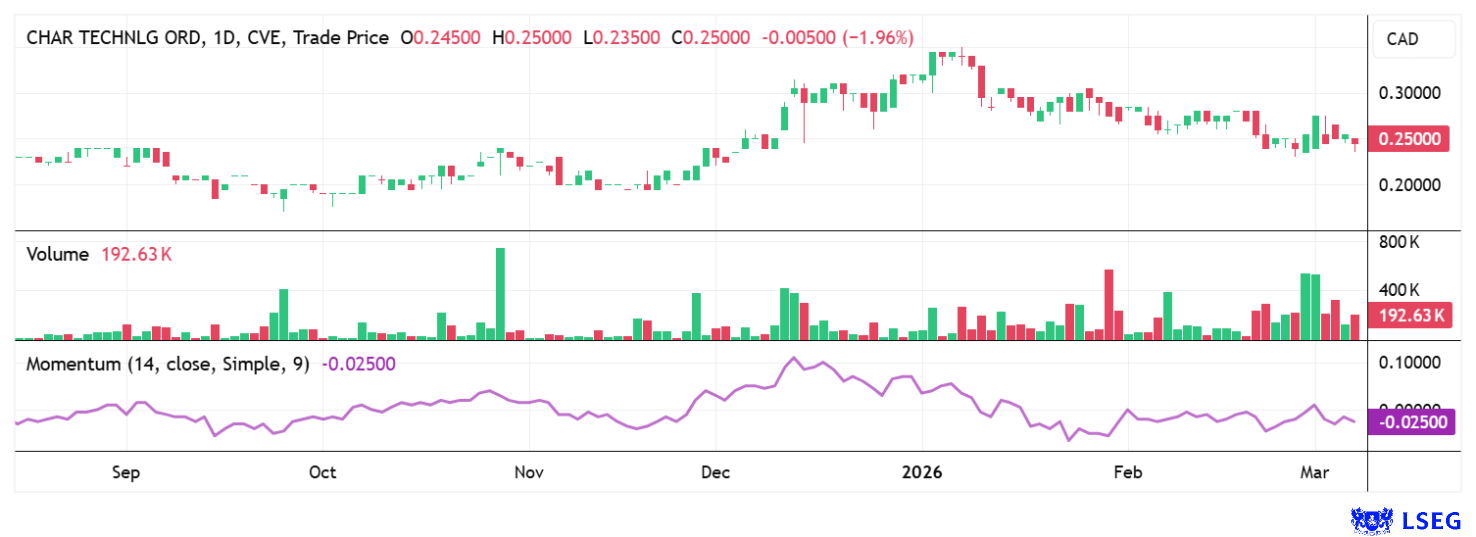
With a current market capitalization of only around CAD 38 million, CHAR Technologies is still in the early stages of capital market valuation. If the planned scaling of the plants succeeds, the company could develop into an attractive substitution play. Accumulate!
Nordex – New highs in a fragile environment
Nordex shares rose by a full 12% to just under EUR 45 following the 2025 annual figures. Was that it? The Hamburg-based wind turbine manufacturer grew strongly last year and even managed to multiply its profits. The forecast is also optimistic. Revenue increased by 3.5% year-on-year to EUR 7.6 billion, and with 10.2 GW of new orders on the books, the group also set a new record for order intake. EBITDA more than doubled to EUR 631 million, exceeding analysts' expectations. As previously forecast, the EBITDA margin rose from 4.1% to 8.4%. The group thus also achieved its medium-term margin target. Analysts were enthusiastic, but did not significantly adjust their price targets upwards. Deutsche Bank expects EUR 34, Bernstein starts with "Neutral" and a price target of EUR 40. Technically, the share price is down at the beginning of the week, but with a price-to-sales ratio of 1.3 based on estimated revenue of approximately EUR 8.6 billion in 2026, the valuation is now quite reasonable. There is therefore little room for imagination at present!
Siemens Energy – At some point, higher price targets are no longer useful
Even with the Siemens Energy share performing brilliantly, higher price targets no longer seem to have a direct impact on the price. On the contrary, JPMorgan caused a stir in recent days with a new price target of EUR 200. On the LSEG platform, there are 21 "Buy" recommendations out of a total of 30 analyses, with the 12-month price target average currently standing at EUR 162.50. The stock reacted sharply at the beginning of March, falling by more than EUR 30 to below EUR 140 after a February high of EUR 171.50. Yesterday, there were isolated attempts at stabilization up to EUR 145. Is this already a trend reversal? That remains to be seen. At the very least, the bulls were caught off guard and can now reposition themselves in the medium term. JPMorgan's price target also offers considerable potential of 37%. The announced share buyback of EUR 2 billion should provide support. Flip a coin, the price is hot!
High fluctuations in energy and commodity prices have become the new market reality in 2026. In this environment, the outlook for energy service providers and greentech suppliers is improving almost continuously, as expensive fossil fuels must be gradually replaced by more efficient technologies. This benefits not only specialists such as CHAR Technologies, but also established energy tech stocks such as Nordex and Siemens Energy, which are directly profiting from the modernization of the global energy infrastructure with their ongoing projects.
Conflict of interest
Pursuant to §85 of the German Securities Trading Act (WpHG), we point out that Apaton Finance GmbH as well as partners, authors or employees of Apaton Finance GmbH (hereinafter referred to as "Relevant Persons") currently hold or hold shares or other financial instruments of the aforementioned companies and speculate on their price developments. In this respect, they intend to sell or acquire shares or other financial instruments of the companies (hereinafter each referred to as a "Transaction"). Transactions may thereby influence the respective price of the shares or other financial instruments of the Company.
In this respect, there is a concrete conflict of interest in the reporting on the companies.
In addition, Apaton Finance GmbH is active in the context of the preparation and publication of the reporting in paid contractual relationships.
For this reason, there is also a concrete conflict of interest.
The above information on existing conflicts of interest applies to all types and forms of publication used by Apaton Finance GmbH for publications on companies.
Risk notice
Apaton Finance GmbH offers editors, agencies and companies the opportunity to publish commentaries, interviews, summaries, news and the like on news.financial. These contents are exclusively for the information of the readers and do not represent any call to action or recommendations, neither explicitly nor implicitly they are to be understood as an assurance of possible price developments. The contents do not replace individual expert investment advice and do not constitute an offer to sell the discussed share(s) or other financial instruments, nor an invitation to buy or sell such.
The content is expressly not a financial analysis, but a journalistic or advertising text. Readers or users who make investment decisions or carry out transactions on the basis of the information provided here do so entirely at their own risk. No contractual relationship is established between Apaton Finance GmbH and its readers or the users of its offers, as our information only refers to the company and not to the investment decision of the reader or user.
The acquisition of financial instruments involves high risks, which can lead to the total loss of the invested capital. The information published by Apaton Finance GmbH and its authors is based on careful research. Nevertheless, no liability is assumed for financial losses or a content-related guarantee for the topicality, correctness, appropriateness and completeness of the content provided here. Please also note our Terms of use.