January 8th, 2026 | 07:25 CET
Defense in a stranglehold: Why Lockheed and Boeing are grounded without antimony - and Antimony Resources holds the strategic solution
It is a chemical element with the atomic number 51 that has long led a shadowy existence on the world's stock exchanges, but whose strategic importance is now keeping security policymakers at the Pentagon awake at night: antimony. What sounds like a footnote in the periodic table is, in reality, the invisible glue holding together the modern defense and aviation industries. But this glue is becoming scarce. China, which dominates the global market with a share of more than 50% in production and nearly 80% in processing capacity, has begun to tighten the reins on exports. Trade barriers and opaque export restrictions are fueling real fears of a supply stoppage. In this high-risk geopolitical scenario, giants such as Lockheed Martin and Boeing are finding themselves in a bind, while small Western explorers such as Antimony Resources are suddenly becoming owners of assets that could prove indispensable to the national security of NATO countries.
time to read: 3 minutes | Author: Nico Popp
ISIN: LOCKHEED MARTIN DL 1 | US5398301094 , BOEING CO. DL 5 | US0970231058 , ANTIMONY RESOURCES CORP | CA0369271014
Table of contents:
Author

Nico Popp
At home in Southern Germany, the passionate stock exchange expert has been accompanying the capital markets for about twenty years. With a soft spot for smaller companies, he is constantly on the lookout for exciting investment stories.
Tag cloud
Shares cloud
The Achilles' heel of the giants: Where Lockheed Martin and Boeing are vulnerable
To the layperson, antimony may be an obscure raw material, but to the engineers at Lockheed Martin, it is essential. The semi-metal is a critical component in modern warfare. It is used to harden lead in projectiles and in primer ammunition, without which no rifle can fire. But its application goes deeper, even reaching the high-tech sector: antimony is indispensable for the manufacture of infrared sensors and night vision devices, the eyes of the modern army. A halt in supplies from China would severely affect production lines for precision-guided munitions and optical reconnaissance systems, at a time when defense contractors' order books are overflowing due to global conflicts. Lockheed Martin simply cannot afford to have billions of dollars worth of weapons systems unable to be delivered due to a shortage of raw materials worth a few dollars.
The situation is even more dramatic in civil and military aviation at Boeing. Here, the primary concerns are safety and certification. Antimony trioxide is the industry standard for flame retardants in plastics, textiles, and composites. Every aircraft that leaves Boeing's factory halls is packed with materials that must not catch fire immediately in the event of a fire – and antimony is the chemical guarantee for this. The strict fire safety regulations of aviation authorities, such as the FAA, leave no room for maneuver here. Without certified flame retardants, there is no flight permit. Boeing therefore faces the risk of its supply chain for interior fittings and cable insulation breaking down if China "turns off the tap" on antimony. Dependence on a geopolitical rival for a safety-critical component is a strategic nightmare that purchasing departments in Seattle and Washington have ignored for too long.
The geopolitical awakening: China uses its market power
The concern is not theoretical. Beijing already demonstrated last year that it is prepared to use raw materials as a weapon in the trade war, as the restrictions on gallium and germanium showed. A similar pattern is emerging with antimony. The Chinese government officially justifies export controls on national security grounds, but in practice, these measures increasingly restrict Western access to the raw-material base of defense production. With Russia completely out of the picture as a supplier due to sanctions and the mines in Tajikistan often under Chinese influence, the West is facing empty warehouses. According to reports, the US government's antimony stocks are at an all-time low, which exponentially increases the urgency of tapping new sources.
Antimony Resources: The strategic wild card in Canada
In this complex situation of demand pressure and supply shortages, Antimony Resources is positioning itself as the logical answer to the Western supply crisis. The Company focuses on the development of antimony deposits in Canada, one of the safest mining jurisdictions in the world and the closest ally of the US. The locational advantage is almost priceless in the current situation: antimony mined in Canada is not subject to tariffs or geopolitical blackmail attempts and, once a production decision has been made, could be delivered directly to US defense industry factories via secure land routes.
With its project, Antimony Resources controls an asset that could supply precisely the high-grade ores needed for further processing to military specifications. While China is struggling with declining ore grades and rising environmental costs, the Canadian project offers fresh potential. This presents a classic arbitrage opportunity for investors: The market currently still values Antimony Resources as a small explorer, while end customers such as Boeing and Lockheed Martin, as well as the US Department of Defense, are likely to be willing to pay massive premiums for security of supply. The Company's Bald Hill project is still in development, but interested parties could soon start putting out feelers – even if the project is still several years away from production.
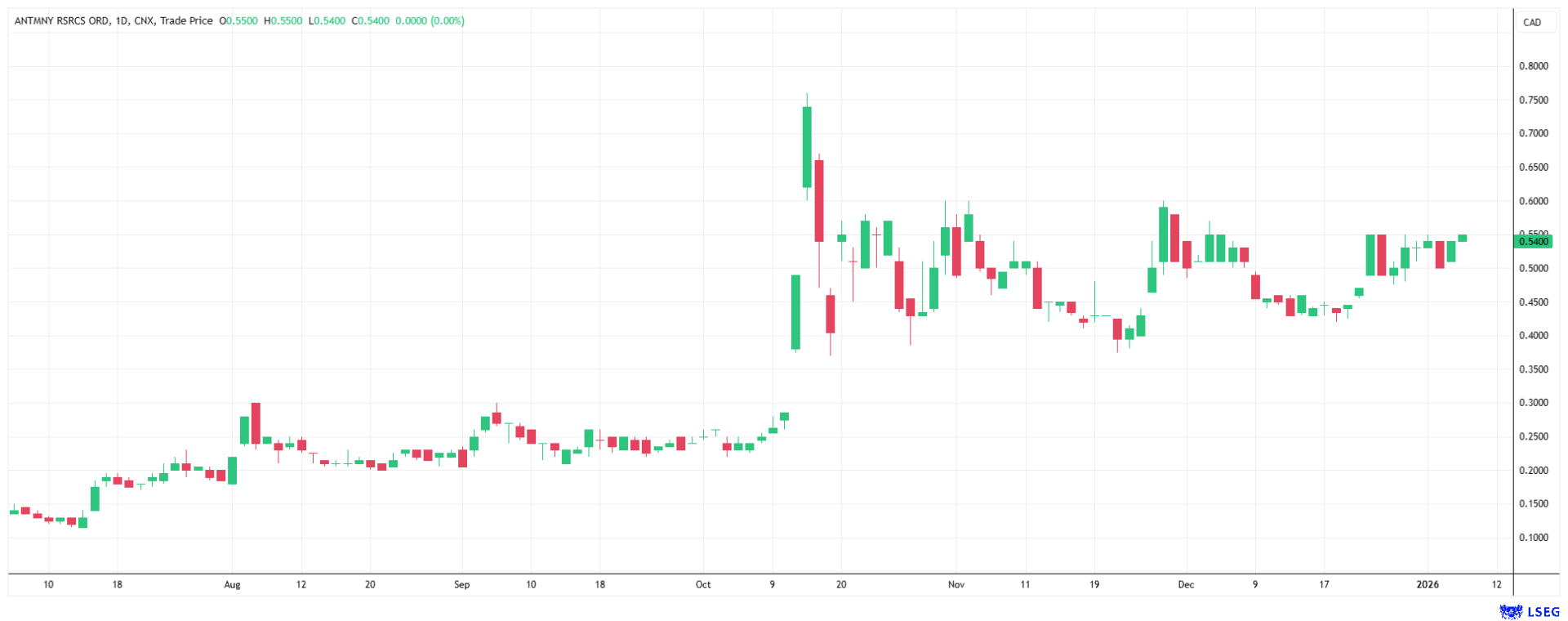
Antimony stock has consolidated
The scenario of direct participation or long-term purchase agreements by government agencies or industrial consortia is becoming increasingly likely as the market tightens. Antimony Resources sits on the raw material that prevents Boeing's assembly lines from standing still and Lockheed's warehouses from running empty. In a world where raw material sovereignty is becoming the new doctrine, the Canadian company could evolve from a pure mining stock to a strategic supporter of North American defense architecture. Antimony Resources' stock rose sharply in 2025, but has since consolidated at an attractive level. At a time when anything seems possible, speculative investors have a foot in the door with antimony.
Conflict of interest
Pursuant to §85 of the German Securities Trading Act (WpHG), we point out that Apaton Finance GmbH as well as partners, authors or employees of Apaton Finance GmbH (hereinafter referred to as "Relevant Persons") may hold shares or other financial instruments of the aforementioned companies in the future or may bet on rising or falling prices and thus a conflict of interest may arise in the future. The Relevant Persons reserve the right to buy or sell shares or other financial instruments of the Company at any time (hereinafter each a "Transaction"). Transactions may, under certain circumstances, influence the respective price of the shares or other financial instruments of the Company.
In addition, Apaton Finance GmbH is active in the context of the preparation and publication of the reporting in paid contractual relationships.
For this reason, there is a concrete conflict of interest.
The above information on existing conflicts of interest applies to all types and forms of publication used by Apaton Finance GmbH for publications on companies.
Risk notice
Apaton Finance GmbH offers editors, agencies and companies the opportunity to publish commentaries, interviews, summaries, news and the like on news.financial. These contents are exclusively for the information of the readers and do not represent any call to action or recommendations, neither explicitly nor implicitly they are to be understood as an assurance of possible price developments. The contents do not replace individual expert investment advice and do not constitute an offer to sell the discussed share(s) or other financial instruments, nor an invitation to buy or sell such.
The content is expressly not a financial analysis, but a journalistic or advertising text. Readers or users who make investment decisions or carry out transactions on the basis of the information provided here do so entirely at their own risk. No contractual relationship is established between Apaton Finance GmbH and its readers or the users of its offers, as our information only refers to the company and not to the investment decision of the reader or user.
The acquisition of financial instruments involves high risks, which can lead to the total loss of the invested capital. The information published by Apaton Finance GmbH and its authors is based on careful research. Nevertheless, no liability is assumed for financial losses or a content-related guarantee for the topicality, correctness, appropriateness and completeness of the content provided here. Please also note our Terms of use.