August 20th, 2026 | 07:05 CEST
Tungsten Shock for Sandvik and Lockheed Martin – Almonty in a Perfect Position
When military equipment or industrial tools reach their performance limits, a highly sought-after heavy metal often comes to the rescue. With a melting point of 3,422 °C, tungsten withstands even extreme heat and has a density nearly identical to that of gold. Yet it is precisely with this key raw material, tungsten, that Western industrialized nations are coming under pressure. Beijing controls over 80% of global production and has significantly tightened export controls in recent years. Since China itself became a net importer in 2025 and the Western defense industry faces strict procurement bans, a race is underway for mining capacity in secure jurisdictions. This is where Almonty Industries comes into play, as it is considered a leading Western tungsten producer. We take a closer look at the market.
time to read: 4 minutes | Author: Nico Popp
ISIN: ALMONTY INDUSTRIES INC. | CA0203987072 | TSX: AII , NASDAQ: ALM , ASX: AII , SANDVIK AB | SE0000667891 , LOCKHEED MARTIN DL 1 | US5398301094
Table of contents:
Author

Nico Popp
At home in Southern Germany, the passionate stock exchange expert has been accompanying the capital markets for about twenty years. With a soft spot for smaller companies, he is constantly on the lookout for exciting investment stories.
Tag cloud
Shares cloud
Sandvik and the Limits of Recycling
As one of the world's leading producers of cutting and drilling tools, Sandvik feels the impact of the geopolitical situation daily. Through its Austrian subsidiary Wolfram Bergbau und Hütten, the Swedish conglomerate operates its own processing line, including the Mittersill underground scheelite mine in the Salzburg region, where crushing takes place in a modern cavern deep within the mountain. In St. Martin im Sulmtal, Styria, Sandvik operates one of the few remaining hydrometallurgical smelters in the Western world to process raw ore and scrap into high-purity powders. To secure sufficient material, the cutting tools division, Sandvik Coromant, is aiming to achieve a buyback rate for used carbide tools by 2028. Nevertheless, the closed-loop system has its limits. High-speed machining of heat-resistant superalloys such as Inconel 718 or titanium alloys used in aircraft fuselages always results in abrasive wear. For those familiar with the industry, the situation is clear: worldwide, around 70% of the tungsten used in industry is permanently lost through abrasive wear and other mechanisms and cannot be recycled. This forces the Scandinavian company to continuously purchase additional tungsten on the tight global market.
Lockheed Martin and the Export Ban
At the end of the value chain, Lockheed Martin faces regulatory hurdles. The US defense giant has an order backlog of over USD 230 billion but must adapt its entire supply chains to a new regulatory regime: a Pentagon directive prohibits, effective January 1, 2027, the delivery of military goods containing tungsten that was mined or refined in China, Russia, North Korea, or Iran. For the company, this represents an enormous undertaking, as tungsten is also used in ammunition. A single warhead contains approximately 180,000 preformed tungsten fragments to achieve an armour-piercing effect without the risk of duds. Because interceptor missiles such as the PAC-3 and THAAD also rely on high-density ballast weights, the production of ammunition requires enormous quantities of tungsten.
Almonty: The Flagship Sangdong Project Is on Track
Amid the tightening global supply situation, tungsten producer Almonty is taking on a pivotal role. The company's flagship project is the historic Sangdong Mine in South Korea's Gangwon Province, which once supplied a significant share of global tungsten demand. Almonty rehabilitated the deposit with the support of a USD 75.1 million loan package from Germany's KfW IPEX-Bank, as well as equity from Austria's Plansee. Geologically, the project stands out significantly from the competition. The company estimates its proven and probable reserves at 7.90 million metric tons of ore with a grade of 0.45% WO₃, which is more than twice the global industry average. In Phase 1, which is now ramping up, the automated flotation plant processes 640,000 metric tons of raw ore annually into approximately 2,300 metric tons of WO₃ concentrate, before expansion to an annual capacity of 1.2 million metric tons is scheduled to take place by 2027. With estimated operating costs of approximately USD 110 per MTU, Almonty secures exceptionally high cash flow margins at current market prices of over USD 3,000 per MTU. The marketing of the tungsten has long been secured. In July 2026, Almonty extended its offtake agreement with Global Tungsten & Powders to 21 years and a total volume of 4.41 million MTU, corresponding to a contracted annual revenue at current APT pricing of approximately USD 490 million. This contract covers approximately 90% of the first phase of expansion and includes a fixed price floor of USD 183 to USD 235 per MTU, along with full participation in rising global market prices.
Almonty Has Even More to Offer: Broad Project Portfolio and Strategic Expansion
In addition to its flagship project in South Korea, Almonty has other projects in Western jurisdictions. In Portugal, the Panasqueira mine has been continuously supplying high-purity tungsten concentrate with grades exceeding 65% WO₃ for over 125 years. Management is currently pushing ahead with the development of the deeper Level 4 to double annual throughput and significantly extend the mine's life. At the same time, the mining group is gaining a foothold directly in the US. The Gentung Browns Lake project in Montana, acquired last year, is set to be gradually brought into production in the coming months. In Spain, the portfolio is rounded out by the reprocessing of tailings at the Los Santos site, with 3.77 million metric tons of reserves at 0.13% WO₃, and the Valtreixal tin-tungsten project—with 2.58 million metric tons of reserves at 0.35% WO₃. In addition, Almonty is developing a separate molybdenum deposit at the Sangdong site, whose production is already marketed through a firm agreement with SeAH M&S and will be shipped to the US.
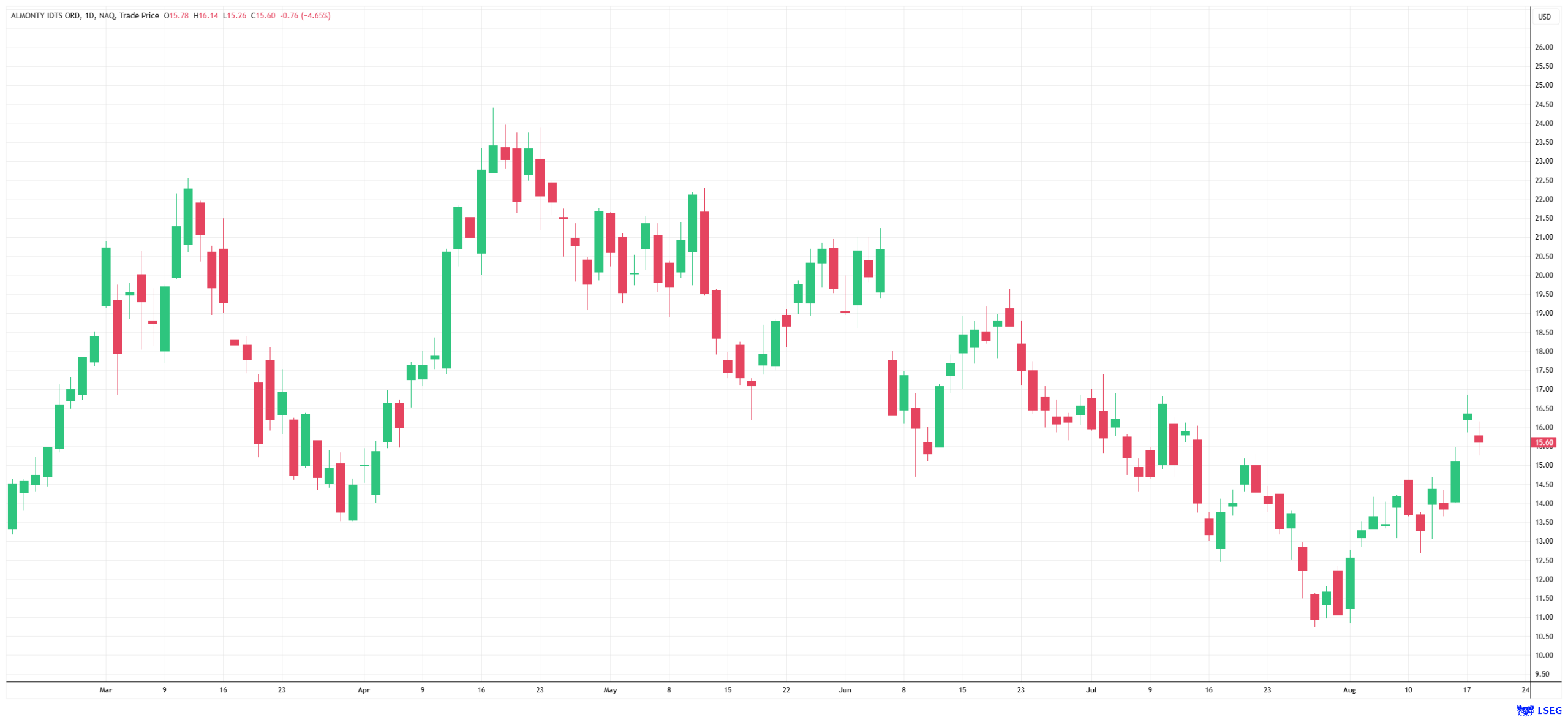
With the US legislative landscape set to change starting in 2027, Almonty is increasingly becoming the focus of industry. Once fully operational, Sangdong alone is expected to account for between 30% and 40% of all tungsten concentrate produced outside of China. Added to this is further potential from existing projects and the company's substantial capital base, which was strengthened by the securing of an USD 800 million credit line this summer. Most recently, the company also announced a USD 300 million share buyback program. The latter should significantly reduce the risk of sell-offs like those that occurred in recent months. Almonty has what many urgently need: tungsten. The stock must therefore be considered an attractive investment. Analysts at Bank of America and Oppenheimer share this view, attributing upside potential to the stock beyond USD 20.
Watch YouTube videoConflict of interest
Pursuant to §85 of the German Securities Trading Act (WpHG), we point out that Apaton Finance GmbH as well as partners, authors or employees of Apaton Finance GmbH (hereinafter referred to as "Relevant Persons") currently hold or hold shares or other financial instruments of the aforementioned companies and speculate on their price developments. In this respect, they intend to sell or acquire shares or other financial instruments of the companies (hereinafter each referred to as a "Transaction"). Transactions may thereby influence the respective price of the shares or other financial instruments of the Company.
In this respect, there is a concrete conflict of interest in the reporting on the companies.
In addition, Apaton Finance GmbH is active in the context of the preparation and publication of the reporting in paid contractual relationships.
For this reason, there is also a concrete conflict of interest.
The above information on existing conflicts of interest applies to all types and forms of publication used by Apaton Finance GmbH for publications on companies.
Risk notice
Apaton Finance GmbH offers editors, agencies and companies the opportunity to publish commentaries, interviews, summaries, news and the like on news.financial. These contents are exclusively for the information of the readers and do not represent any call to action or recommendations, neither explicitly nor implicitly they are to be understood as an assurance of possible price developments. The contents do not replace individual expert investment advice and do not constitute an offer to sell the discussed share(s) or other financial instruments, nor an invitation to buy or sell such.
The content is expressly not a financial analysis, but a journalistic or advertising text. Readers or users who make investment decisions or carry out transactions on the basis of the information provided here do so entirely at their own risk. No contractual relationship is established between Apaton Finance GmbH and its readers or the users of its offers, as our information only refers to the company and not to the investment decision of the reader or user.
The acquisition of financial instruments involves high risks, which can lead to the total loss of the invested capital. The information published by Apaton Finance GmbH and its authors is based on careful research. Nevertheless, no liability is assumed for financial losses or a content-related guarantee for the topicality, correctness, appropriateness and completeness of the content provided here. Please also note our Terms of use.