January 6th, 2026 | 07:00 CET
The new world order after the Venezuela shock: Why Rheinmetall and Bank of America are betting on North America, and Globex Mining is the big winner
The spectacular arrest of the Venezuelan president by US authorities marks another historic turning point that has repercussions far beyond South America. It is the ultimate proof that the era of diplomatic kid gloves is over and that the law of the jungle is increasingly prevailing on the international stage. For global financial markets and strategic investments, this move means a radical reassessment of country risks. If heads of state are no longer safe, then investments in mines and infrastructure in politically unstable regions are certainly not. In this new climate of hard power politics, security of supply is becoming the only currency that counts. That is why the spotlight is now turning to a company that exemplifies North America's commodity security: Globex Mining. With a gigantic portfolio of over 200 projects in the world's safest jurisdictions, Globex offers precisely the geopolitical protective shield that the market is now desperately seeking.
time to read: 4 minutes | Author: Nico Popp
ISIN: RHEINMETALL AG | DE0007030009 , GLOBEX MINING ENTPRS INC. | CA3799005093
Table of contents:
Author

Nico Popp
At home in Southern Germany, the passionate stock exchange expert has been accompanying the capital markets for about twenty years. With a soft spot for smaller companies, he is constantly on the lookout for exciting investment stories.
Tag cloud
Shares cloud
The return of the law of the jungle and the consequences for capital
The US intervention in Venezuela is sending shock waves through the boardrooms of the Western world. The message is clear: anyone who is not within the sphere of influence of NATO or close allies is operating on thin ice. For institutional investors such as Bank of America, which are pouring billions into financing the energy transition and reindustrialization, this means that capital flows must be redirected. Projects in Africa, Latin America, or Central Asia that promise high returns on paper are becoming unpredictable due to skyrocketing risk premiums. Capital shuns uncertainty and flees to the safe haven of North America. Just recently, Bank of America supported tungsten producer Almonty Industries with projects in Portugal, Spain, South Korea, and the US as lead bookrunner.
The trend toward "friend-shoring," which has been ongoing for years, is thus all the more a financial necessity. Banks and funds are willing to pay significant premiums for assets in Canada and the US because legal certainty prevails there and expropriation or state arbitrariness do not pose any real threats. In this environment, companies that already have large land parcels and mining rights in these safe havens become key strategic players. They hold the keys to the raw material supply of the future, which does not depend on the whims of a dictator or geopolitical upheavals.
Rheinmetall and the hunger for strategic metals
On the demand side, Western rearmament is dramatically exacerbating the situation. An arms manufacturer such as Rheinmetall reports that its order books are full for years to come. Tanks, ammunition, and highly complex electronics must be produced, but the supply chains are fragile. It is an open secret in industry that NATO's defense capabilities depend heavily on the availability of critical metals – from titanium for aircraft fuselages to copper for wiring to tungsten for alloys.
If Rheinmetall wants to ensure that the production lines in Unterlüß or Hungary do not come to a standstill, supplies must not come from crisis regions. The pressure on the purchasing departments of the defense industry is enormous to conclude long-term supply contracts with partners in secure legal jurisdictions such as North America in order to guarantee operational sovereignty. This surge in demand is meeting with a limited supply of developed projects, which is driving up the prices for rights to deposits. Globex Mining is at a crucial intersection here: the Company has a diversified portfolio that includes not only gold and other precious metals, but also precisely those base metals and specialty raw materials that are indispensable to the defense and technology industries.
Globex Mining: The "merchant bank" of commodity security
In this perfect storm of geopolitical uncertainty and industrial demand, Globex Mining's business model is showing its full strength. Led by industry veteran Jack Stoch, the company is not a traditional mining operator that bears the operational risk of a single project. Rather, Globex acts as a project generator and licensor—a kind of "merchant bank" for mineral resources. With over 200 projects located almost exclusively in Canada and the US, Globex effectively owns an index on North American exploration success.
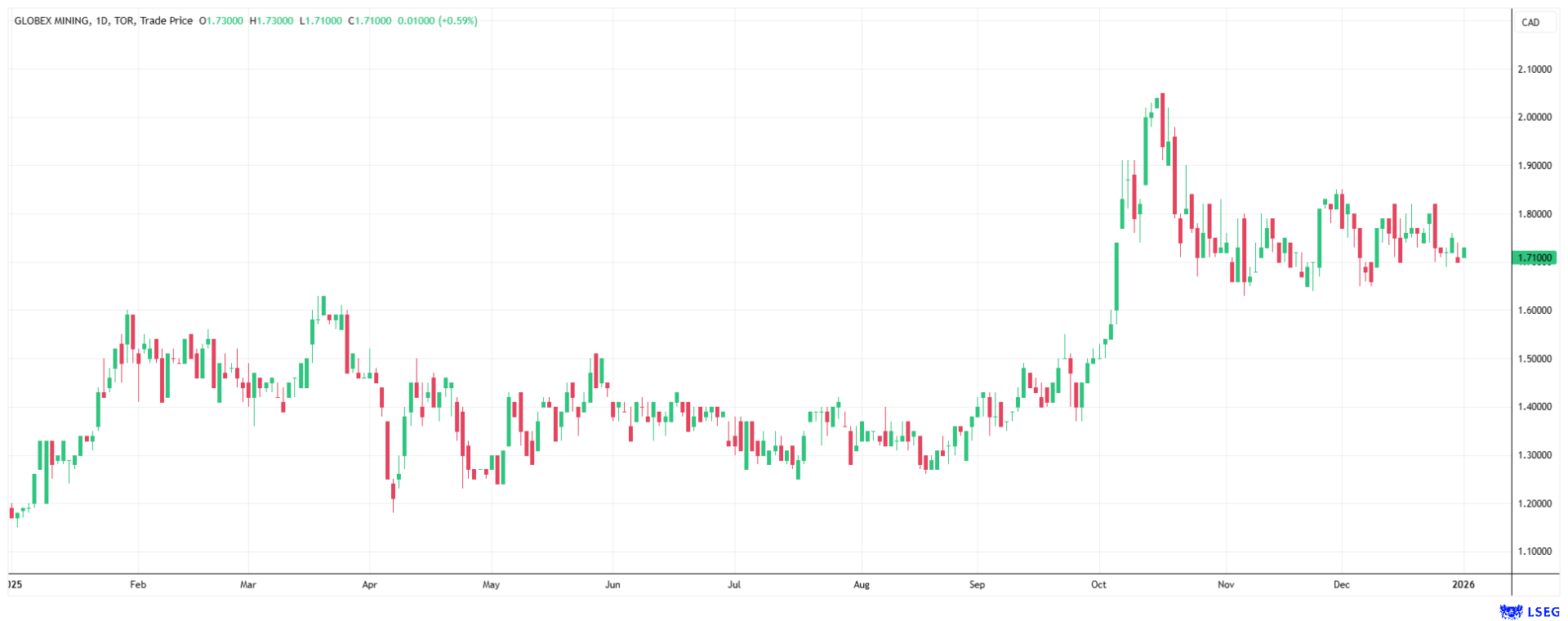
The strategy is as ingenious as it is low-risk: Globex acquires promising properties, evaluates them through historical data analysis and initial work, and then options them to partner companies. These partners assume the financial risk of expensive drilling and development, while Globex retains cash payments, share packages, and, above all, a permanent royalty. If a partner fails, the project, including all data obtained and value increases, reverts to Globex. If the partner is successful, which is likely in times of rising commodity prices, Globex benefits without any further capital risk. The portfolio currently includes everything the market desires: gold projects in Quebec's most productive belts, copper and zinc deposits for industry, and lithium and rare earth properties for the energy transition. Due to the sheer volume of projects, Globex Mining is statistically very diversified.
Conclusion: Asymmetric opportunity in uncertain times
While global politics are being reshuffled after the Venezuela incident and the law of the jungle dictates the rules of the game, Globex Mining offers investors a rare safe haven. The Company combines the security of North American soil with leverage on a huge portfolio of raw materials that are urgently needed by players such as Rheinmetall and favored by financiers such as Bank of America. Globex's valuation currently reflects only the net asset value of its cash and liquid equity holdings, while the value of its more than 200 projects and royalties is insufficiently priced in. In a world where security of supply is the highest good, this imbalance is unlikely to last long. Globex is the logical base investment for anyone who understands that in 2026, commodities will no longer be just commodities, but geopolitical levers.
Watch YouTube videoConflict of interest
Pursuant to §85 of the German Securities Trading Act (WpHG), we point out that Apaton Finance GmbH as well as partners, authors or employees of Apaton Finance GmbH (hereinafter referred to as "Relevant Persons") may hold shares or other financial instruments of the aforementioned companies in the future or may bet on rising or falling prices and thus a conflict of interest may arise in the future. The Relevant Persons reserve the right to buy or sell shares or other financial instruments of the Company at any time (hereinafter each a "Transaction"). Transactions may, under certain circumstances, influence the respective price of the shares or other financial instruments of the Company.
In addition, Apaton Finance GmbH is active in the context of the preparation and publication of the reporting in paid contractual relationships.
For this reason, there is a concrete conflict of interest.
The above information on existing conflicts of interest applies to all types and forms of publication used by Apaton Finance GmbH for publications on companies.
Risk notice
Apaton Finance GmbH offers editors, agencies and companies the opportunity to publish commentaries, interviews, summaries, news and the like on news.financial. These contents are exclusively for the information of the readers and do not represent any call to action or recommendations, neither explicitly nor implicitly they are to be understood as an assurance of possible price developments. The contents do not replace individual expert investment advice and do not constitute an offer to sell the discussed share(s) or other financial instruments, nor an invitation to buy or sell such.
The content is expressly not a financial analysis, but a journalistic or advertising text. Readers or users who make investment decisions or carry out transactions on the basis of the information provided here do so entirely at their own risk. No contractual relationship is established between Apaton Finance GmbH and its readers or the users of its offers, as our information only refers to the company and not to the investment decision of the reader or user.
The acquisition of financial instruments involves high risks, which can lead to the total loss of the invested capital. The information published by Apaton Finance GmbH and its authors is based on careful research. Nevertheless, no liability is assumed for financial losses or a content-related guarantee for the topicality, correctness, appropriateness and completeness of the content provided here. Please also note our Terms of use.