March 11th, 2026 | 07:30 CET
A new drone contender: The potential of NEO Battery Materials, DroneShield, and Amprius Technologies
Energy efficiency and defense capabilities are two sides of the same coin. This is especially true in the rapidly growing drone business, where powerful batteries are crucial. While global demand for batteries continues to rise sharply, according to McKinsey's analysis, the military sector is focusing on a highly specialized niche: maximizing energy density while eliminating dependence on Asian supply chains. The US National Defense Authorization Act (NDAA) for fiscal year 2026 requires that batteries for the Department of Defense be subject to strict criteria in the future in order to end the influence of rival states. In this environment, Amprius Technologies sets the standard with its enormous energy density for long-range drones (UAS). But there is promising competition with its own advantages: NEO Battery Materials' NBMSiDE technology ensures that the batteries in demand can be manufactured independently of China. The technology, which has only been validated in field tests for a few weeks, is entering a market environment in which drone defense is more important than ever. Although the global market leader DroneShield, with its AI-powered defense solutions, is considered the obvious answer to the new threats, drones are increasingly being countered directly by other drones. In this constellation, NEO Battery Materials is coming into the focus of investors.
time to read: 3 minutes | Author: Nico Popp
ISIN: NEO BATTERY MATERIALS LTD | CA62908A1003 | TSXV: NBM , OTC: NBMFF , DRONESHIELD LTD | AU000000DRO2 , AMPRIUS TECHNOLOGIES INC | US03214Q1085 | NYSE: AMPX
Table of contents:
Author

Nico Popp
At home in Southern Germany, the passionate stock exchange expert has been accompanying the capital markets for about twenty years. With a soft spot for smaller companies, he is constantly on the lookout for exciting investment stories.
Tag cloud
Shares cloud
Amprius Technologies delivers the technological standard
The US company Amprius Technologies has established itself as a pioneer in high-energy-density batteries. Its business model is based on the superiority of its silicon anode structure over conventional graphite anodes. While graphite is reaching its physical limits, Amprius' silicon nanowire structures achieve an energy density of up to 520 Wh/kg. This results in significantly lower weight and significantly increased runtime, which is crucial for military drones. In the past fiscal year, the company reached a turning point and increased its revenue by an impressive 202% to USD 73 million. To ramp up production for the mass market while meeting the stringent requirements of the US Department of Defense, Amprius made a strategic shift to a "capital-light manufacturing model." By working closely with established contract manufacturers in the US and South Korea, the company is significantly reducing its financial risk and focusing fully on scaling its new SiCore platform.
DroneShield provides the AI barrier against unmanned attacks
In a world where drones can fly longer and farther thanks to better batteries, the need for effective defense solutions is growing. DroneShield is recognized as the global market leader for AI-based detection and counter-drone systems. DroneShield's products enable the real-time identification of hostile drones based on their radio frequency signature and their interception through targeted jamming signals. This technological superiority has given the company a financial boost in fiscal year 2025. Revenue climbed 276% to AUD 216.5 million, putting DroneShield in the black for the first time. To serve the enormous sales pipeline of up to AUD 2.3 billion in the future, management has expanded its own production capacity to up to AUD 2.4 billion per year at a new facility in Sydney. The company is also increasingly benefiting from civilian contracts for the protection of critical infrastructure and is transforming itself from a pure hardware provider to a high-margin software group. For many investors, DroneShield is an old acquaintance, but its stock market valuation is already ambitious given its recent operational successes.
NEO Battery Materials democratizes the high-performance battery
While Amprius and DroneShield already have a certain degree of name recognition, NEO Battery Materials scores points with a combination of high performance and cost-effectiveness. The Canadian-South Korean company focuses on the production of silicon anode materials using its proprietary NBMSiDE technology. The key competitive feature is a patented water-based "one-pot coating process." Since NEO does not use expensive and complex processes such as chemical vapor deposition and produces at normal atmospheric pressure, the manufacturing costs of the anodes are reduced by 60 to 80%. The end product can be integrated directly into existing battery production lines and enables a performance increase of up to 40%. A live field test conducted in February demonstrated this capability impressively: NEO batteries showed a 98% increase in average drone flight time in a direct comparison with a mass-produced Chinese benchmark battery.
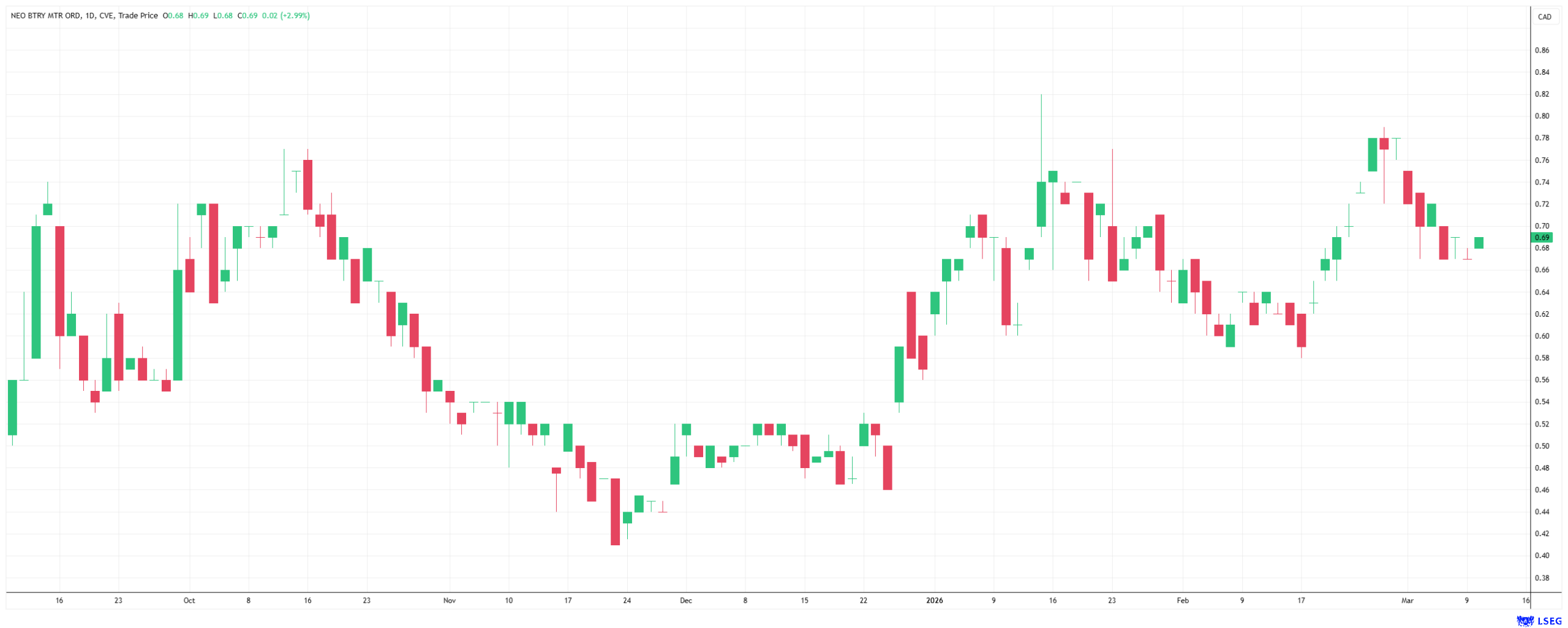
To bring this technology to market, NEO recently secured a 3.2-hectare production site in South Korea, which is expected to reach a capacity of 500 megawatt hours. South Korea's strategic advantage lies not only in its state-of-the-art industrial base, but above all in its geopolitical positioning as a reliable partner for Western governments. Last fall, the company secured its first multi-year purchase agreement worth CAD 4.5 million from an Asian developer of AI flight control systems, demonstrating NEO's transition from research to production.
Drone versus drone: The lever for investors
Recent experiences in Ukraine and the Middle East show a whole new level of military escalation: drones are increasingly being combated with low-cost interceptor drones. Conventional air defense systems are simply too expensive and inefficient against swarms of cheap drones. These new interception systems require batteries that enable extreme sprints for targeted interception while providing sufficient energy density for long patrol flights. This is precisely where NEO Battery Materials can play to its strengths. The combination of enormous performance, complete independence from Chinese supply chains, and an attractive price makes NEO's technology the ideal component for this new class of defense systems.
This dynamic presents a clear opportunity for investors. While Amprius and DroneShield are established but highly valued players, NEO Battery Materials is on the cusp of true industrial scaling. The company will be able to serve customers in the West in the future and score points with the key data of its technology. If the transition to commercial production in South Korea goes smoothly, NEO Battery Materials currently offers speculative investors by far the greatest potential.
Watch YouTube videoConflict of interest
Pursuant to §85 of the German Securities Trading Act (WpHG), we point out that Apaton Finance GmbH as well as partners, authors or employees of Apaton Finance GmbH (hereinafter referred to as "Relevant Persons") currently hold or hold shares or other financial instruments of the aforementioned companies and speculate on their price developments. In this respect, they intend to sell or acquire shares or other financial instruments of the companies (hereinafter each referred to as a "Transaction"). Transactions may thereby influence the respective price of the shares or other financial instruments of the Company.
In this respect, there is a concrete conflict of interest in the reporting on the companies.
In addition, Apaton Finance GmbH is active in the context of the preparation and publication of the reporting in paid contractual relationships.
For this reason, there is also a concrete conflict of interest.
The above information on existing conflicts of interest applies to all types and forms of publication used by Apaton Finance GmbH for publications on companies.
Risk notice
Apaton Finance GmbH offers editors, agencies and companies the opportunity to publish commentaries, interviews, summaries, news and the like on news.financial. These contents are exclusively for the information of the readers and do not represent any call to action or recommendations, neither explicitly nor implicitly they are to be understood as an assurance of possible price developments. The contents do not replace individual expert investment advice and do not constitute an offer to sell the discussed share(s) or other financial instruments, nor an invitation to buy or sell such.
The content is expressly not a financial analysis, but a journalistic or advertising text. Readers or users who make investment decisions or carry out transactions on the basis of the information provided here do so entirely at their own risk. No contractual relationship is established between Apaton Finance GmbH and its readers or the users of its offers, as our information only refers to the company and not to the investment decision of the reader or user.
The acquisition of financial instruments involves high risks, which can lead to the total loss of the invested capital. The information published by Apaton Finance GmbH and its authors is based on careful research. Nevertheless, no liability is assumed for financial losses or a content-related guarantee for the topicality, correctness, appropriateness and completeness of the content provided here. Please also note our Terms of use.