June 1st, 2026 | 06:40 CEST
Volatus Aerospace: Is the Next Drone Giant Coming from Canada?
The global drone market is rapidly evolving into one of the most important future sectors of the defence and security industry. Geopolitical tensions, rising NATO budgets, and the need for autonomous surveillance of critical infrastructure are driving demand massively. Experts expect the market volume for drone defence alone to exceed USD 20 billion by 2030. At the same time, civilian applications such as pipeline, offshore, and power grid inspections are becoming increasingly important. Companies like Volatus Aerospace, which combine hardware, software, and operational services, could benefit disproportionately from this trend. New projects, multi-billion-dollar government programs, and AI-driven systems are currently providing significant momentum.
time to read: 3 minutes | Author: Stefan Feulner
ISIN: VOLATUS AEROSPACE INC | CA92865M1023 | TSXV: FLT , OTCQB: TAKOF
Table of contents:
Author

Stefan Feulner
The native Franconian has more than 20 years of stock exchange experience and a broadly diversified network.
He is passionate about analyzing a wide variety of business models and investigating new trends.
Tag cloud
Shares cloud
The Billion-Dollar Drone Market Takes off to New Heights
Volatus Aerospace has long since ceased to position itself as a traditional drone manufacturer. Instead, the Canadian company is building an integrated aerospace platform that combines unmanned systems, manned aviation, data services, training, AI software, and operational mission solutions. It is precisely this platform approach that could prove to be a decisive competitive advantage in the current market environment. While many competitors offer only individual products, Volatus covers large parts of the value chain, from data collection to autonomous mission control.
The combination of the civil infrastructure business and the growing defence sector appears particularly exciting. Multi-year contracts for monitoring pipelines, power grids, and offshore facilities generate stable cash flows, while new NATO-related projects drive additional growth. At the same time, the SKYDRA™ SaaS platform for drone defence opens up high-margin recurring revenue streams. According to the company, long-term margins of over 80% could be within reach here.
US Billion-Dollar Program Puts Volatus in the Running
Volatus has now achieved a significant milestone by advancing to the next evaluation phase of the "US Drone Dominance Program Phase II." The multi-billion-dollar US program involves approximately USD 1.1 billion in investments and aims to procure more than 300,000 autonomous systems. Volatus qualified in the Long Range Strike category with a One-Way Attack FPV platform.
The next phase includes operational qualifications, production evaluations, and further program analyses. Even though this does not yet result in guaranteed orders, the selection underscores the Canadians' technological competitiveness. CEO Glen Lynch spoke of an important milestone for the company's defence and autonomy strategy.
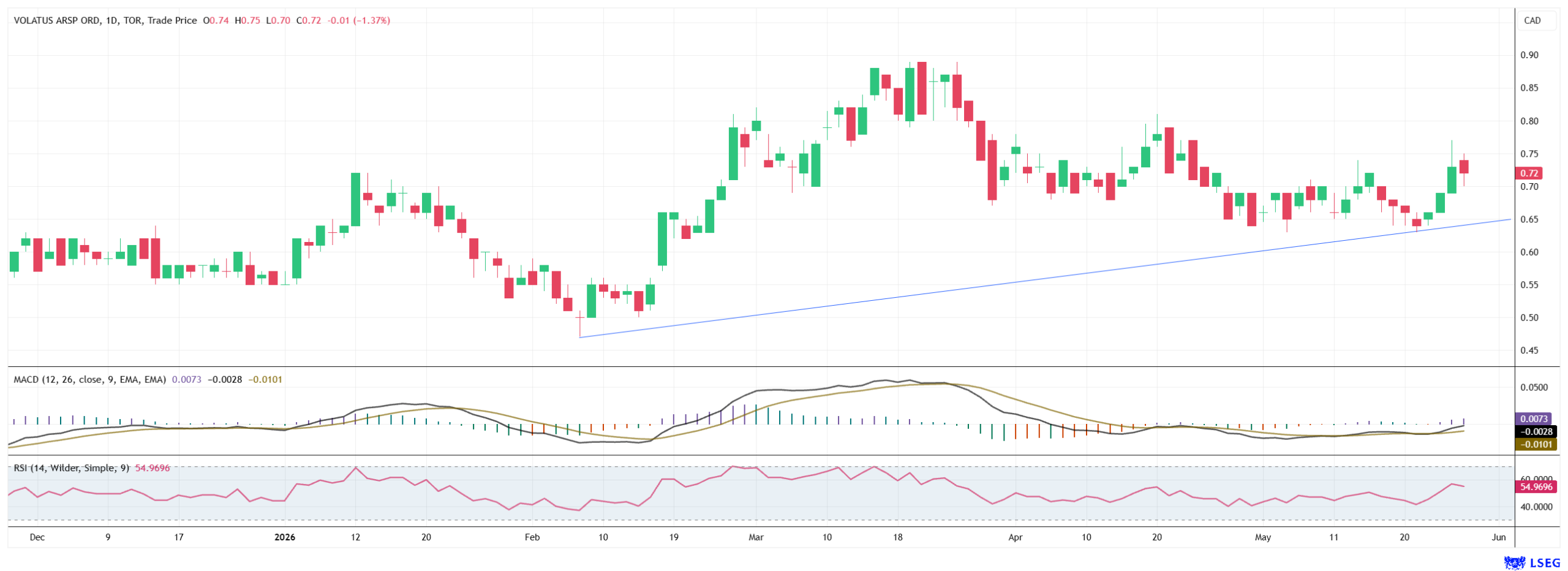
At the same time, Volatus is significantly strengthening its capital base. Through a bought-deal public offering, the company is expected to receive approximately CAD 30 million in gross proceeds. A total of 46.2 million shares will be issued at CAD 0.65 each. Additionally, there is an over-allotment option for a further 15%. The capital is to be invested primarily in production capacity, defence technologies, strategic acquisitions, and balance-sheet strengthening. In doing so, Volatus is laying the groundwork to fulfill larger government and NATO contracts in the future.
AI Push at CANSEC 2026 Draws Attention
The unveiling of the new V-Cortex system at CANSEC 2026, Canada's premier defence and security trade show, is fueling further excitement. This is an AI flight controller complete with an autonomy stack for unmanned systems. The system, developed entirely in Canada, combines flight control, AI-supported autonomy, GNSS-independent navigation, and real-time decision-making processes within a modular architecture.
Weighing less than 15 grams, V-Cortex is among the smallest autonomous operating systems in its class. At the same time, the platform supports applications such as autonomous mission control, target acquisition, drone defence, and the coordination of multiple systems across air, ground, and sea domains. The system was specifically designed to meet the requirements of modern NATO operational scenarios.
The development is additionally supported by the Canadian NRC-IRAP program. Volatus is thus increasingly positioning itself as a provider of sovereign defence technologies "Made in Canada," which could represent a strategic advantage in light of Canada's new "Defence Industrial Strategy."
Volatus Aerospace is increasingly establishing itself as an integrated high-tech provider in the booming market for autonomous aviation and defence systems. The global drone supercycle, rising defence budgets, and the growing importance of AI-driven systems are creating an environment that opens up significant growth potential.
By participating in the multi-billion-dollar US Drone Dominance Program, moving to secure fresh capital of over CAD 30 million, and launching the AI system V-Cortex, Volatus is consistently expanding its technological and operational position. At the same time, recurring revenue from infrastructure monitoring, training, and software solutions provides additional stability.
Should the company succeed in converting its extensive pipeline into concrete large-scale contracts and successfully scaling its new AI and software solutions, Volatus Aerospace could emerge as one of the most exciting growth stories in the international drone and security market.
Conflict of interest
Pursuant to §85 of the German Securities Trading Act (WpHG), we point out that Apaton Finance GmbH as well as partners, authors or employees of Apaton Finance GmbH (hereinafter referred to as "Relevant Persons") may hold shares or other financial instruments of the aforementioned companies in the future or may bet on rising or falling prices and thus a conflict of interest may arise in the future. The Relevant Persons reserve the right to buy or sell shares or other financial instruments of the Company at any time (hereinafter each a "Transaction"). Transactions may, under certain circumstances, influence the respective price of the shares or other financial instruments of the Company.
In addition, Apaton Finance GmbH is active in the context of the preparation and publication of the reporting in paid contractual relationships.
For this reason, there is a concrete conflict of interest.
The above information on existing conflicts of interest applies to all types and forms of publication used by Apaton Finance GmbH for publications on companies.
Risk notice
Apaton Finance GmbH offers editors, agencies and companies the opportunity to publish commentaries, interviews, summaries, news and the like on news.financial. These contents are exclusively for the information of the readers and do not represent any call to action or recommendations, neither explicitly nor implicitly they are to be understood as an assurance of possible price developments. The contents do not replace individual expert investment advice and do not constitute an offer to sell the discussed share(s) or other financial instruments, nor an invitation to buy or sell such.
The content is expressly not a financial analysis, but a journalistic or advertising text. Readers or users who make investment decisions or carry out transactions on the basis of the information provided here do so entirely at their own risk. No contractual relationship is established between Apaton Finance GmbH and its readers or the users of its offers, as our information only refers to the company and not to the investment decision of the reader or user.
The acquisition of financial instruments involves high risks, which can lead to the total loss of the invested capital. The information published by Apaton Finance GmbH and its authors is based on careful research. Nevertheless, no liability is assumed for financial losses or a content-related guarantee for the topicality, correctness, appropriateness and completeness of the content provided here. Please also note our Terms of use.