March 11th, 2026 | 07:25 CET
Iran, Israel, USA – Investors turn to gold! Buying opportunities for Desert Gold, Barrick Mining, TUI, and Lufthansa
The daily news is not easy to stomach. Wars, conflicts, and human tragedies – who still thinks about traveling at times like these? Or is now precisely the time when people want to switch off and escape for a while? For years, investors have had to live with geopolitical uncertainty. So far, however, this has had little impact on equities, as there are always sectors that receive particular attention in such environments. Gold and silver have weathered the inflation surges since the COVID-19 pandemic remarkably well, while the tourism sector has been more of a roller coaster ride with several loops along the way. But what has worked in recent years is now back on the agenda: buy when the cannons thunder! It may sound lacking in empathy, yet it has consistently increased the wealth of those who accept the world as it is. We once again take a look at gold and the travel sector and prepare for another turbulent ride.
time to read: 5 minutes
|
Author:
André Will-Laudien
ISIN:
DESERT GOLD VENTURES INC | CA25039N4084 | TSXV: DAU , OTCQB: DAUGF , BARRICK MINING CORPORATION | CA06849F1080 | NYSE:B , TSX: ABX , TUI AG NA O.N. | DE000TUAG505 , LUFTHANSA AG VNA O.N. | DE0008232125
Table of contents:
Author

André Will-Laudien
Born in Munich, he first studied economics and graduated in business administration at the Ludwig-Maximilians-University in 1995. As he was involved with the stock market at a very early stage, he now has more than 30 years of experience in the capital markets.
Tag cloud
Shares cloud
Barrick Mining – The lights are green
There is currently a great deal of activity in the gold sector. The recent agreement between Barrick Mining and the military government in Mali opens up clear growth prospects for the company in West Africa once again. With the 10-year extension of the license for the Loulo-Gounkoto complex, Barrick now has long-term planning security for one of the continent's most important gold mines, with annual production capacities of up to 750,000 ounces of gold. The return to full operational control is restarting the group's cash flows and marks a new starting point for regional gold production. At the same time, the agreement signals a degree of political predictability in a fragile country after the new mining code had initially caused uncertainty.
Another factor is making investors' hearts beat faster at Barrick Mining. In September 2025, CEO Mark Bristow handed over the reins to interim manager Mark Hill. Against this backdrop, the discussion about a possible split of the group is gaining attention again. Investors are speculating that a structural separation of North American activities from the international portfolio could make the value of individual business areas more transparent. The decisive factor will be whether strategic advantages and operational efficiency gains justify a complex restructuring. Overall, the combination of political détente in Mali and speculation about structural changes within the group is leading to a significantly more positive perception of the stock on the market. Investors should bear in mind that with 4 million ounces of production and gold prices above USD 5,000, additional EBIT of USD 8 to 10 billion can now be achieved. A 133% price increase in just one year is rare for the mining giant. But perhaps this is only the beginning of a complete revaluation. For 2027, the stock is trading at a P/E ratio of only 11.2 – historically cheap!
Desert Gold – Now is the time
Smaller companies are also active in West Africa. The Canadian exploration company Desert Gold Ventures is driving forward the development of its Barani East project in western Mali with a clearly structured, capital-disciplined approach. Desert Gold is strategically positioned not far from major producers such as Barrick and B2Gold along the Senegal-Mali Shear Zone, which offers both geological and infrastructural advantages. The current focus is on preparing the infrastructure, while a modular processing plant is being produced in parallel. It is initially expected to have a processing capacity of around 10 tonnes of ore per hour, with the prospect of expanding to around 50 tonnes per hour. The project development is based on a revised preliminary economic assessment for the SMSZ project, which shows an after-tax present value of around USD 61 million and an internal rate of return (IRR) of around 57% at a gold price of USD 2,850 per ounce. At higher market prices, the project value could rise to around USD 124 million or higher, according to the analysis, with total costs forecast at around USD 1,137 per ounce. Production of 113,100 ounces of gold is expected over the planned mine life of approximately 10 years, while the initial investment costs are comparatively modest at around USD 20 million.
CEO Jared Scharf outlined the next steps in West Africa at the 18th International Investment Forum.
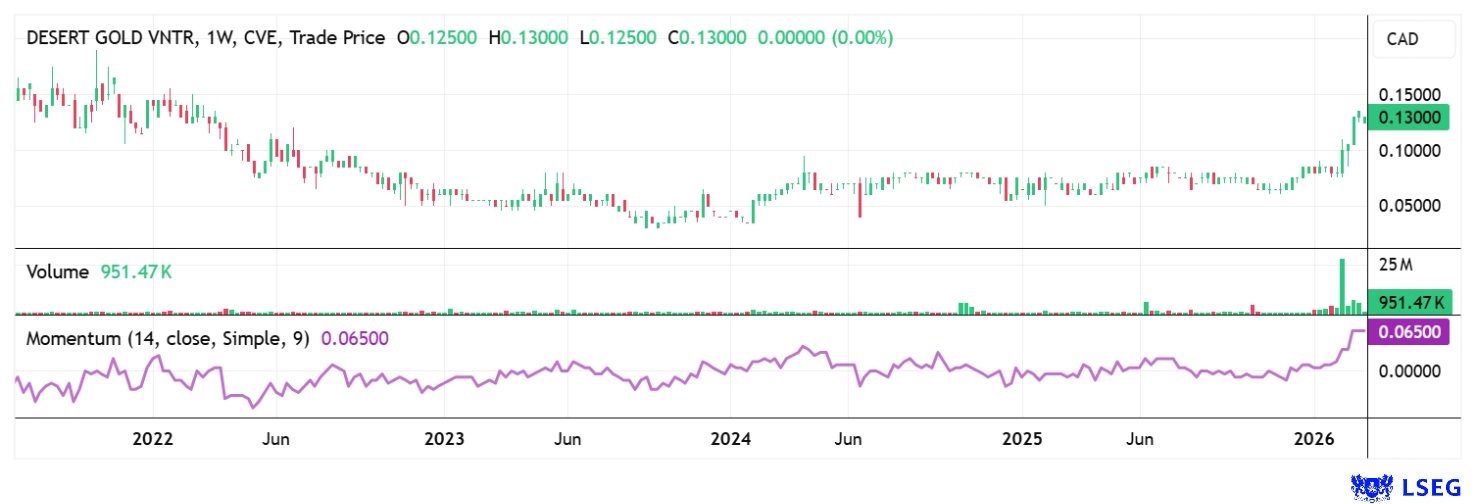
From an analytical perspective, Desert Gold aims to generate operating cash flow as quickly as possible and then gradually expand production. The modular structure reduces financial risks in the early stages and allows for flexible adjustment of capacities to exploration successes and financing opportunities. In addition, the project offers considerable upside potential, as the preliminary economic assessment has so far only taken into account a small part of the total concession area. The company is also strengthening its regional presence with the Tiegba Gold project in Côte d'Ivoire, which could enable additional rapid exploration successes due to an investor-friendly environment. Most recently, the company underscored its development plans with an oversubscribed capital increase of approximately CAD 7.18 million, which will finance the next project phases and further secure the path toward the start of production. The share price remained at CAD 0.08 for a long time and is now finally moving. In our opinion, the current price of CAD 0.13 is a clear intermediate stage on the way to a revaluation, which could quickly reach CAD 1.00 if progress continues. There is still time to jump on board!
TUI and Lufthansa – The Gulf States vacation region takes a break
The already low-valued tourism stocks TUI and Lufthansa are suffering further blows to their share prices with the Iran crisis. The rationale behind this is likely investors' assumption that the adjustments to summer offerings will initially incur considerable costs. This is because crises lead to a short-term decline in bookings, and reservations that have already been made have to be rebooked at the last minute. In addition, images of thousands of stranded vacationers in the Gulf region are putting a strain on the nerves of those willing to book. Viewed from a broader perspective, several thousand trips to Dubai, Abu Dhabi, or Oman are now being canceled, but at the same time, demand in other regions is likely to increase significantly. After all, people will always travel, especially in times when staying at home in front of the TV is more likely to cause depression than bring feelings of happiness. All that remains is a sober look at the fundamentals of the major tourism groups TUI and Lufthansa. On a 2026 P/E basis, the figures are 4.9 and 6.2, respectively. This is complemented by dividend yields of 3.5 to 4.5%. Even if there is now a quarter of higher costs due to repatriations and cancellations, in the medium term, there will also be measurable advantages in air traffic, in particular over the aggressive airlines of the Gulf states, which are less able to react flexibly. Prices of EUR 6.95 for TUI and EUR 7.75 for Lufthansa are already favorable. Those who are still hesitant can simply set low buy limits and will be filled when the night is darkest. In the coming weeks, the current sector discount should normalize quickly. Now is the time to buy!
Volatility seems to be the defining theme of 2026. At the beginning of the week, bad news from the Gulf region sent the oil price up by USD 30 to a peak of USD 118. Stock indices tumbled until US President Donald Trump issued new threats to the Iranian regime. All worries were forgotten again, and the oil price lost a whole USD 40 in just four hours. Investors should remain calm and invest in a balanced manner during this period. Gold is currently proving itself to be a safe haven once again, while the battered tourism sector offers good opportunities.
Conflict of interest
Pursuant to §85 of the German Securities Trading Act (WpHG), we point out that Apaton Finance GmbH as well as partners, authors or employees of Apaton Finance GmbH (hereinafter referred to as "Relevant Persons") currently hold or hold shares or other financial instruments of the aforementioned companies and speculate on their price developments. In this respect, they intend to sell or acquire shares or other financial instruments of the companies (hereinafter each referred to as a "Transaction"). Transactions may thereby influence the respective price of the shares or other financial instruments of the Company.
In this respect, there is a concrete conflict of interest in the reporting on the companies.
In addition, Apaton Finance GmbH is active in the context of the preparation and publication of the reporting in paid contractual relationships.
For this reason, there is also a concrete conflict of interest.
The above information on existing conflicts of interest applies to all types and forms of publication used by Apaton Finance GmbH for publications on companies.
Risk notice
Apaton Finance GmbH offers editors, agencies and companies the opportunity to publish commentaries, interviews, summaries, news and the like on news.financial. These contents are exclusively for the information of the readers and do not represent any call to action or recommendations, neither explicitly nor implicitly they are to be understood as an assurance of possible price developments. The contents do not replace individual expert investment advice and do not constitute an offer to sell the discussed share(s) or other financial instruments, nor an invitation to buy or sell such.
The content is expressly not a financial analysis, but a journalistic or advertising text. Readers or users who make investment decisions or carry out transactions on the basis of the information provided here do so entirely at their own risk. No contractual relationship is established between Apaton Finance GmbH and its readers or the users of its offers, as our information only refers to the company and not to the investment decision of the reader or user.
The acquisition of financial instruments involves high risks, which can lead to the total loss of the invested capital. The information published by Apaton Finance GmbH and its authors is based on careful research. Nevertheless, no liability is assumed for financial losses or a content-related guarantee for the topicality, correctness, appropriateness and completeness of the content provided here. Please also note our Terms of use.