March 24th, 2026 | 07:10 CET
Sangdong Is More Than Just a Mine: How Almonty Industries Is Emerging as a Strategic Pillar for Western Supply Chains
For decades, tungsten was a blind spot in commodity markets - technically indispensable, yet strategically overlooked. That perception is now shifting rapidly. As Western economies reassess their dependence on Chinese supply chains for defense and high-tech applications, Almonty Industries is transitioning from developer to producer at its Sangdong project in South Korea. What follows is not merely the start of production, but a structurally important addition to Western supply security.
time to read: 5 minutes | Author: Armin Schulz
ISIN: ALMONTY INDUSTRIES INC. | CA0203987072 | TSX: AII , NASDAQ: ALM , ASX: AII
Table of contents:
Author

Armin Schulz
Born in Mönchengladbach, he studied business administration in the Netherlands. In the course of his studies he came into contact with the stock exchange for the first time. He has more than 25 years of experience in stock market business.
Tag cloud
Shares cloud
A Strategic Turning Point
It is a moment Lewis Black has been working toward for a decade. In mid-March, the CEO of Almonty Industries gathered political representatives from South Korea and representatives from the US Embassy in Gangwon Province to celebrate the official commissioning of the Sangdong mine. Three decades after its closure, one of the world's largest tungsten deposits returned to operation. For Black, this is more than a corporate milestone: "The completion of Phase 1 at the Sangdong tungsten mine marks the culmination of more than a decade of investment and development work. This is a significant milestone in the efforts of the United States and its allies to diversify critical mineral supply chains away from China, which currently produces about 88% of the world's tungsten supply."
The urgency of these words stems from an unprecedented shift in the global tungsten market. China, which controls the lion's share of global production, has tightened its export policies. In February 2025, strict export licenses and production quotas were imposed by MOFCOM and GAC, throwing international trade out of balance. At the same time, demand from the defense, aerospace, and semiconductor industries is growing structurally. Prices reacted with a ferocity reminiscent of the copper hype of earlier decades. The average APT price surged by 745% year-over-year to a recent high of USD 3,000 per MTU.
From Development Project to Cash Flow Machine
Almonty is stepping into this vacuum. The strategic course set by the US underscores its relevance. Starting in 2027, defense-related tungsten purchases must come from non-Chinese sources. Sangdong, with an ore grade of approximately 0.51% tungsten trioxide, roughly three times the global average, is expected to meet about 40% of Western demand outside of China once fully operational. This represents not only an increase in production but a shift in power in a market that has been dominated by Beijing for decades.
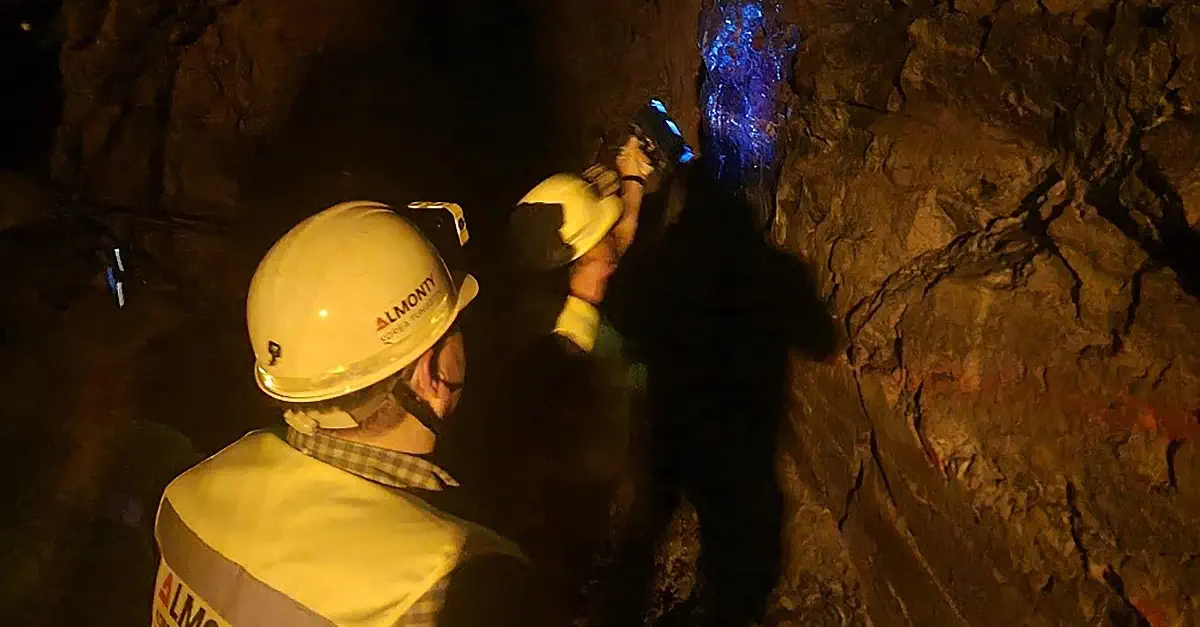
The operational implementation of this ambition follows a deliberate strategy. By the end of 2025, the company reached the first critical milestone with the delivery of the first ore to the run-of-mine stockpile. "The first truckload of ore provides direct proof that the processing plant is operational and that the transport routes, machine coordination, and operator workflows function safely and effectively under production conditions. This successful test demonstrates that the technical foundation of the Sangdong Mine is now firmly established, allowing the commissioning of the crushing, grinding, and flotation circuits to proceed as planned and ensuring a smooth ramp-up to full production capacity," explained Arif Priyambodo, General Manager of Processing. Since then, the phased ramp-up has been underway, with stability and process optimization taking priority over rapid full utilization. In Phase 1, approximately 640,000 tons of ore per year are to be processed, corresponding to about 230,000 MTU of concentrate. The already planned second expansion phase is expected to roughly double this capacity.
Numbers That Can Be Misleading
Investors who are puzzled by the latest quarterly figures should take a closer look at the underlying operational performance. The reported net loss of CAD 102.3 million in the fourth quarter is attributable to a non-cash revaluation of convertible instruments in the amount of CAD 87.3 million, a direct effect of the massive rise in the stock price. CFO Brian Fox clarified: "Excluding these non-cash expenses from the revaluation of derivatives, our operating results were in line with expectations, as the Panasqueira Mine continued to post steady revenue growth thanks to the strengthening APT price environment." Especially since revenue of CAD 3.1 million will not be recognized until the first quarter of 2026 due to the timing of deliveries.
The financial position, often the Achilles' heel of mine developers, is solid. Two capital raises in 2025 brought in over USD 219 million gross to the company's coffers, bringing the cash reserve to CAD 268.4 million at year-end. The ramp-up of Sangdong is thus not taking place under financial pressure, a clear competitive advantage over many comparable projects.
A Platform Across Three Continents
But Almonty is looking beyond South Korea. The portfolio is spread across several Western jurisdictions, which diversifies risks and increases strategic depth. In Portugal, the historic Panasqueira mine is being prepared for a deeper level through a drilling program, which promises higher ore grades. In the US, the Gentung Browns Lake Project in Montana, acquired last year, is expected to be production-ready as early as the second half of 2026, with a 15-year supply contract for the US defense industry. In addition, the company is considering in-house processing of tungsten oxide, as well as a high-grade molybdenum deposit right next to Sangdong, which opens up a second source of raw materials.
Lewis Black summarizes the long-term vision: "The expansion of Phase 2, along with the development of our tungsten oxide plant and the adjacent Sangdong molybdenum deposit, will form the foundation for what we call the 'Korean Trinity' - a fully integrated value chain for strategic minerals that positions South Korea as a global hub for the mining, refining, and processing of tungsten." The goal is a complete, Western-oriented value chain.
Analysts in Unison
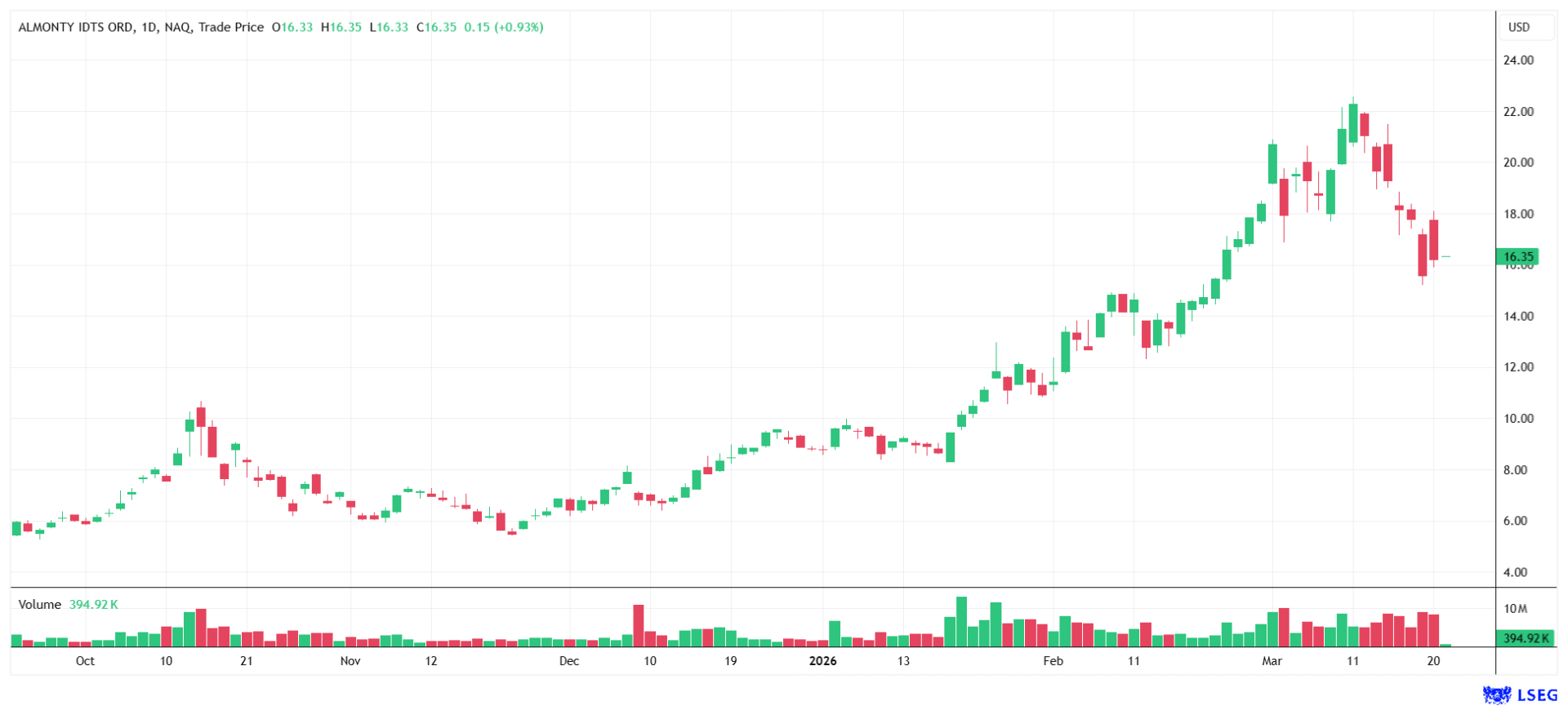
The recent flood of analyst updates underscores the shift in perception. Within a few weeks, price targets rose from USD 17 to as high as USD 25.80. DA Davidson most recently raised its target to USD 25, citing tight supply conditions and the ramp-up of production in Sangdong. Cantor Fitzgerald followed with USD 25.80. The message from the firms is consistent. The focus has shifted away from the question of "if" to "how" the operational implementation will proceed. What matters now is discipline during the ramp-up. The stock is currently trading at USD 16.35 on the NASDAQ.
The story of Almonty Industries has moved beyond its planning phase. With Sangdong, the company has an asset in production that fits precisely into the structural gap in the Western market. Financing is secured, and its strategic positioning, supported by long-term off-take agreements with defense customers, adds visibility. Short-term quarterly distortions due to accounting effects should not obscure operational progress. If execution during ramp-up remains disciplined, Almonty could evolve from a niche supplier into a strategically relevant player in critical raw material supply.
Conflict of interest
Pursuant to §85 of the German Securities Trading Act (WpHG), we point out that Apaton Finance GmbH as well as partners, authors or employees of Apaton Finance GmbH (hereinafter referred to as "Relevant Persons") currently hold or hold shares or other financial instruments of the aforementioned companies and speculate on their price developments. In this respect, they intend to sell or acquire shares or other financial instruments of the companies (hereinafter each referred to as a "Transaction"). Transactions may thereby influence the respective price of the shares or other financial instruments of the Company.
In this respect, there is a concrete conflict of interest in the reporting on the companies.
In addition, Apaton Finance GmbH is active in the context of the preparation and publication of the reporting in paid contractual relationships.
For this reason, there is also a concrete conflict of interest.
The above information on existing conflicts of interest applies to all types and forms of publication used by Apaton Finance GmbH for publications on companies.
Risk notice
Apaton Finance GmbH offers editors, agencies and companies the opportunity to publish commentaries, interviews, summaries, news and the like on news.financial. These contents are exclusively for the information of the readers and do not represent any call to action or recommendations, neither explicitly nor implicitly they are to be understood as an assurance of possible price developments. The contents do not replace individual expert investment advice and do not constitute an offer to sell the discussed share(s) or other financial instruments, nor an invitation to buy or sell such.
The content is expressly not a financial analysis, but a journalistic or advertising text. Readers or users who make investment decisions or carry out transactions on the basis of the information provided here do so entirely at their own risk. No contractual relationship is established between Apaton Finance GmbH and its readers or the users of its offers, as our information only refers to the company and not to the investment decision of the reader or user.
The acquisition of financial instruments involves high risks, which can lead to the total loss of the invested capital. The information published by Apaton Finance GmbH and its authors is based on careful research. Nevertheless, no liability is assumed for financial losses or a content-related guarantee for the topicality, correctness, appropriateness and completeness of the content provided here. Please also note our Terms of use.