May 27th, 2026 | 07:55 CEST
RARE METAL, RARE OPPORTUNITY: ALMONTY INDUSTRIES BETWEEN THE DEFENSE BOOM AND AI HYPE
Almonty Industries is on track for profitability. The Sangdong tungsten mine in South Korea has been in production since March 17, so a sustained return to profitability should now be just a formality. The transition from a promising stock to an indispensable raw materials supplier for the defence and semiconductor industries is being guided by a former Wall Street analyst who is well-connected in both the mining and financial sectors: in a few days, Jorge Beristain will assume the role of Chief Financial Officer (CFO). The Canadian with Mexican roots is the right man to explain to the financial world why Almonty shares, despite a spectacular multi-year rally, are by no means overvalued.
time to read: 4 minutes | Author: Jens Castner
ISIN: ALMONTY INDUSTRIES INC. | CA0203987072 | TSX: AII , NASDAQ: ALM , ASX: AII
Table of contents:
Author

Jens Castner
The Nuremberg native brings over three decades of capital markets experience, backed by a career shaped by deep market insight and a genuine passion for investing. His journey began in 1994 through an investment club among colleagues – a formative experience that sparked a lifelong dedication to identifying compelling investment opportunities.
Following senior editorial roles at Nürnberger Nachrichten, €uro am Sonntag, and €uro, he went on to serve as Editor-in-Chief of the renowned investor magazine Börse Online from 2014, where he played a key role in shaping high-quality financial journalism for a broad investor audience.
Tag cloud
Shares cloud
THE MAN OF CONVICTION
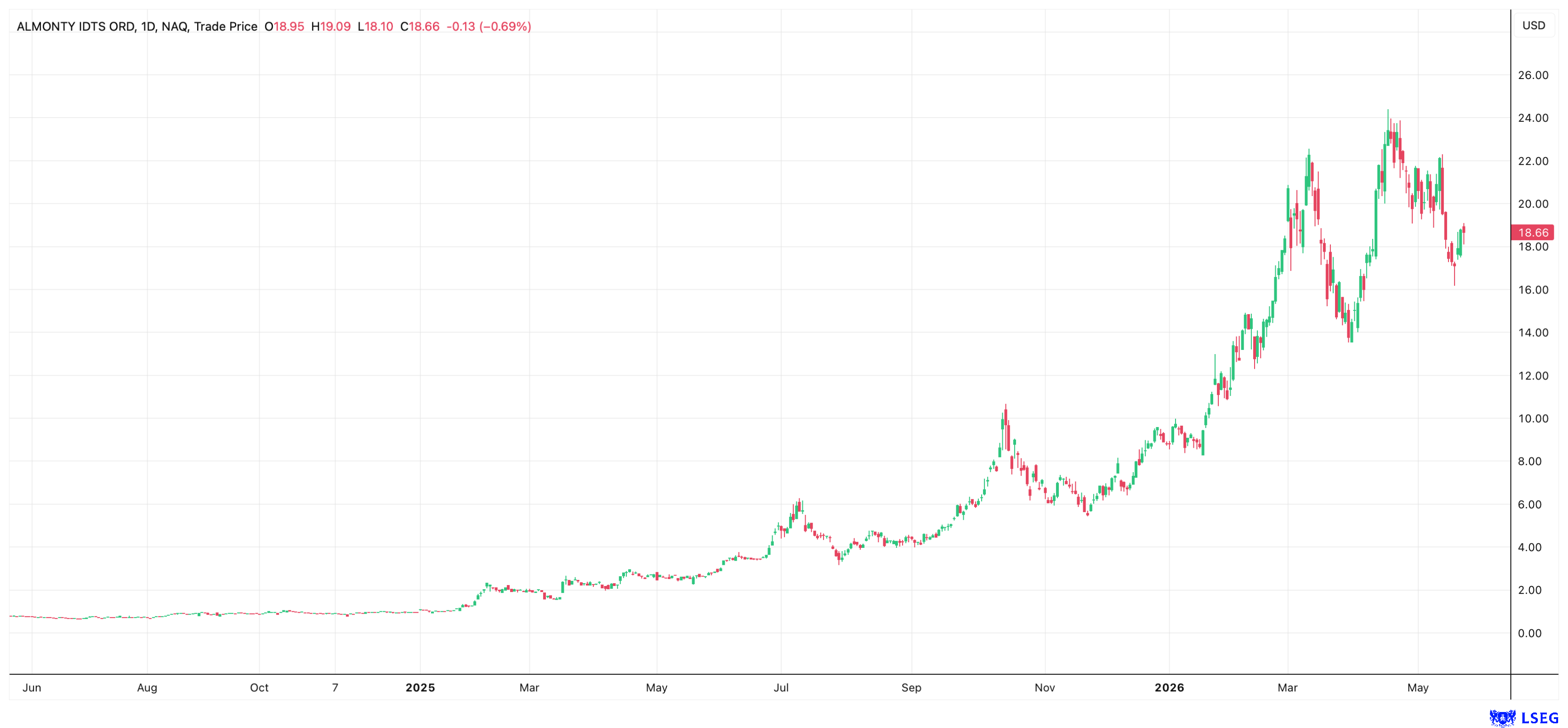
When Jorge Beristain takes over as CFO at Almonty Industries on June 1, it is more than just a routine personnel change. CEO Lewis Black leaves no doubt that he considers the Mexican-born executive the right man to guide the next phase of growth for what may soon be the Western world's most important tungsten producer. Thanks to his previous work as an equity analyst on Wall Street, including at Deutsche Bank Securities, and as an executive advisor to the US metal processor Ryerson Holding, Beristain has an excellent network in both the commodities and financial sectors. At the annual general meeting on June 9, the new Chief Financial Officer (CFO) will introduce himself to shareholders—and then seek dialogue with his former analyst colleagues to explain why Almonty shares are still worth a look despite a rise from USD 0.75 to at times more than USD 20 and a market capitalization of around USD 5 billion. He is likely to be preaching to the choir.
TAILWIND FROM ALL SIDES
Thanks to the unprecedented stock rally, the listing on the Nasdaq just under a year ago, and the recently completed relocation from Toronto to the US state of Montana, prominent firms such as Bank of America and Cantor Fitzgerald had already taken notice of the company, which was originally Canadian. In a study published in April, Morgan Stanley even described Almonty as one of the key stocks for the aerospace industry. Since then, the price of tungsten has risen by nearly 50% again. A metric ton unit (MTU), which represents 10 kg of the company's main trading product, ammonium paratungstate (APT), now costs more than USD 3,000 in Rotterdam—three times as much as at the start of the year. This latest price surge has not yet been factored into the investment firms' current price targets. Nor has the fact that Almonty, now officially a US company, is on its way to becoming the preferred tungsten supplier for the armed forces of the world's largest economy.
FROM THE FILAMENT TO THE SECRET WEAPON
Since traditional light bulbs with their clearly visible tungsten filaments were replaced by energy-saving bulbs, the heavy metal has largely disappeared from the public consciousness. Yet, in modern warfare, it remains virtually irreplaceable. With a melting point of 3,422 degrees Celsius, tungsten has the highest melting point of any metal and is one of the hardest elements. Its hardness, density, and heat resistance make it indispensable for armour-piercing ammunition, rocket nozzles, hypersonic weapons, and heat shields. At the same time, the semiconductor industry is booming. Tungsten hexafluoride is a key gas in chip production, and chip production is running at full speed due to the AI hype. The EU and the US have officially classified tungsten as a critical mineral. The problem: about 80% of global production comes from China, which makes it difficult to supply the defence and tech industries due to export controls. Washington is responding with a clean break. Starting January 1, 2027, the US Department of Defence will ban the procurement of tungsten and other critical minerals that have been mined, processed, or produced in China, Russia, or North Korea. At the same time, multi-billion-dollar programs are underway to build strategic reserves. Western industry is desperately searching for reliable alternatives—and finds them almost exclusively in a single notable scalable producer: Almonty Industries.
WORLD-CLASS ORE WITH A COST ADVANTAGE
The company operates and develops tungsten deposits in politically stable, conflict-free regions, including South Korea, Portugal, Spain, and the US. At the heart of its operations is the Sangdong mine in South Korea's Gangwon Province, which officially began operations on March 17, 2026. Sangdong is one of the largest and highest-grade tungsten deposits on Earth. The ore grade is three times the global average—a decisive competitive advantage that directly impacts production costs. Management estimates production costs of just USD 126.80 per metric ton unit (MTU). With current market prices exceeding USD 3,000 per MTU, this results in an exceptional gross margin more reminiscent of a tech champion than a mining company. Just 150 m from Sangdong lies a molybdenum deposit, also owned by Almonty. Its planned annual production is already 100% pre-sold under a long-term contract with SeAH M&S, South Korea's largest molybdenum processor.
BLACK INK IN SIGHT
The new CFO, Beristain, could go down in company history as the expert who is not only partly responsible for Almonty's rise to become the de facto monopoly supplier of newly mined Western tungsten, but also for its sustainable entry into profitability. Consensus estimates predict that the next quarterly report, expected to be released on August 17, will be entirely in the black. On average, experts expect Almonty to report earnings of USD 0.09 per share for the period between early April and late June, as the Sangdong project is delivering significant revenue and earnings contributions for the first time. In the first quarter, despite an already clearly positive earnings before interest, taxes, and depreciation (EBITDA) and a strong operating cash flow of USD 9.7 million, a small net loss of USD 0.02 per share was still incurred, albeit primarily due to non-cash revaluation effects on convertible bonds and warrants—incidentally, a consequence of the sharp rise in share price. The 221% increase in revenue to USD 25.4 million in the first quarter was almost entirely attributable to operations at the Panasqueira mine in Portugal.
THE VALUATION LEAVES ROOM FOR UPSIDE
Due to the newly added revenue from South Korea, analysts expect full-year revenue to range between USD 250 million and USD 400 million; estimates suggest the USD 700 million mark could be reached as early as 2027, with positive earnings per share (EPS) of USD 1.43. At the current price of USD 18.66, this results in a moderate price-to-earnings (P/E) ratio of 13—and this is calculated, at least in part, based on tungsten prices that are approximately USD 1,000 below current levels.
Conflict of interest
Pursuant to §85 of the German Securities Trading Act (WpHG), we point out that Apaton Finance GmbH as well as partners, authors or employees of Apaton Finance GmbH (hereinafter referred to as "Relevant Persons") may hold shares or other financial instruments of the aforementioned companies in the future or may bet on rising or falling prices and thus a conflict of interest may arise in the future. The Relevant Persons reserve the right to buy or sell shares or other financial instruments of the Company at any time (hereinafter each a "Transaction"). Transactions may, under certain circumstances, influence the respective price of the shares or other financial instruments of the Company.
In addition, Apaton Finance GmbH is active in the context of the preparation and publication of the reporting in paid contractual relationships.
For this reason, there is a concrete conflict of interest.
The above information on existing conflicts of interest applies to all types and forms of publication used by Apaton Finance GmbH for publications on companies.
Risk notice
Apaton Finance GmbH offers editors, agencies and companies the opportunity to publish commentaries, interviews, summaries, news and the like on news.financial. These contents are exclusively for the information of the readers and do not represent any call to action or recommendations, neither explicitly nor implicitly they are to be understood as an assurance of possible price developments. The contents do not replace individual expert investment advice and do not constitute an offer to sell the discussed share(s) or other financial instruments, nor an invitation to buy or sell such.
The content is expressly not a financial analysis, but a journalistic or advertising text. Readers or users who make investment decisions or carry out transactions on the basis of the information provided here do so entirely at their own risk. No contractual relationship is established between Apaton Finance GmbH and its readers or the users of its offers, as our information only refers to the company and not to the investment decision of the reader or user.
The acquisition of financial instruments involves high risks, which can lead to the total loss of the invested capital. The information published by Apaton Finance GmbH and its authors is based on careful research. Nevertheless, no liability is assumed for financial losses or a content-related guarantee for the topicality, correctness, appropriateness and completeness of the content provided here. Please also note our Terms of use.