May 27th, 2026 | 08:10 CEST
China's Antimony Embargo Strikes at the Heart of the US Defence Industry: Lockheed Martin, General Dynamics, and Others Must Rethink Their Strategies! Antimony Resources Corp. Could Be the Solution!
It sounds like the plot of a movie: a little-known metal—or more precisely, a semimetal—that influences the effectiveness of entire armies and military conflicts. But antimony is very real, and supplies are becoming increasingly scarce. China, Russia, and Tajikistan control the majority of global production. In September 2024, Beijing effectively tightened the supply tap, followed in December by an explicit export ban targeting the US. For defence giants like Lockheed Martin and General Dynamics, this has major implications, as their procurement plans must be completely rethought and redesigned. Antimony is found in armour-piercing ammunition, heat-resistant cables for fighter jets, and the sensitive infrared sensors of the F-35. The vulnerability of supply chains is no longer a secret but has become a security risk. Against this backdrop, a small Canadian company is increasingly coming into focus: Antimony Resources. As the name suggests, it is all about antimony. What currently sounds like a speculative exploration story could ultimately become a strategic wildcard in the geopolitical landscape. The question for the future will therefore be: who will supply this critical metal to defence contractors?
time to read: 5 minutes | Author: Matthias Schomber
ISIN: ANTIMONY RESOURCES CORP | CA0369271014 | CSE: ATMY , OTCQB: ATMYF
Table of contents:
Author

Matthias Schomber
Raised in Giessen, Hesse, Matthias Schomber discovered his passion for the financial markets as early as the 1990s—at a time when stock trading was still largely the domain of true, die-hard traders. After completing his banking apprenticeship, he worked for a private bank there and witnessed the rise and fall of the Neuer Markt firsthand on the trading floor of the Frankfurt Stock Exchange, drawing lessons from the experience that continue to shape his thinking as a trader, author, and trading system developer to this day.
Tag cloud
Shares cloud
Weapons, Jets, and Submarines
Lockheed Martin and General Dynamics still dominate the stock markets when it comes to defence. As prime contractors for the F-35 and state-of-the-art submarines, they benefit from the West's massive defence budgets. Yet investment bank analysts are by no means in agreement on whether the stock prices still have room to rise.
Lockheed Martin, the largest defence contractor in the US, is trading with an average price target of about USD 630. The range spans from cautiously optimistic to decidedly skeptical. While the impressive order backlog and the push into space projects are repeatedly highlighted, the majority of analysts are recommending "Hold." Some are even lowering their valuations because they consider the previously assumed margins and revenue growth to be too optimistic. The disappointment in the first quarter of 2026, with earnings of just USD 6.44 per share, therefore also supports this possible assumption that the great euphoria may have faded.
General Dynamics presents itself as a bit more dynamic—one could almost deduce this from the name. The consensus among analysts here is a "Buy" rating with an average price target of around USD 392. Thanks to an order backlog of USD 131 billion and strong demand for business jets, business is going well. However, reality is now setting in here as well, as Citigroup lowered its price target from USD 380 to USD 364 in May 2026. The reasoning is also very revealing, as even after the recent price losses, a quick recovery is not expected as long as geopolitical conflicts remain unresolved.
For both companies, the same applies: dependence on strategic raw materials such as antimony is a risk that few standard analyses fully account for. While a few point to supply chain issues or at least hint at Chinese export bans, it is difficult to make the consequences tangible or correctly deduce them. It remains, in a sense, a "black box"—one that actually exists, however, and that could potentially put entire Western nations under pressure. It could also be used to limit defence capabilities.
Antimony Could Help Determine War and Peace
The significance of this can hardly be overstated: Antimony is not a byproduct of other mining operations, but an independent, strategic material. Its importance for weapons technology is manifold, for example, in the hardening of lead alloys. Armour-piercing projectiles are not made of pure soft lead. Only a small amount of antimony makes the projectiles dimensionally stable. It prevents them from getting stuck in the barrel of a battle tank or an onboard cannon, which would be a disaster in combat. Antimony is used in fire protection in high-tech combat systems. The endless cable harnesses and electronic circuit boards of an F-35 fighter jet are under constant power. A fire following a hit would be fatal. Antimony trioxide slows the spread of flames, giving pilots valuable seconds. The metal is also needed for night vision and target acquisition. Infrared sensors in modern missiles and targeting optics use antimony compounds such as indium antimonide to detect thermal radiation from even the smallest temperature differences. Without them, a cruise missile might no longer be able to distinguish its target from a hot rock.
China has recognized this vulnerability and is deliberately exploiting it. As a result, the price of antimony skyrocketed to a record high of nearly USD 60,000 per ton in the middle of last year. Although prices have since declined somewhat, the structural problem remains, as the US currently has no domestic primary production. And this is precisely where Antimony Resources could come into play.
Antimony Resources: The Beacon of Hope
With the Bald Hill project in the Canadian province of New Brunswick, the company owns what is likely the most promising antimony deposit in North America. According to NI 43-101 standards, the potential resource amounts to approximately 2.7 million tons with an average antimony grade of 3-4%. By comparison, this is the highest known average grade on the entire continent.
The latest drill results are promising. On May 13, 2026, ATMY reported intervals of up to 26.9% antimony in a drill hole, confirming the extension of the main zone at depth. The mineralized zones reach up to 15 m in thickness, and the deepest confirmed mineralization is already 495 m below the surface. A second drill hole shortly before that even returned 13.9% antimony over a width of more than 6 m. These values are well above the already high average grades and reinforce the picture of a geologically exceptional structure.
Even more important than the high individual grades is the project's strategic expansion. The company has now consolidated claims covering 37 km². In the south and west, additional mineralized zones—the Marcus Zone and Bald Hill South—have been discovered, whose potential could nearly double the total deposit. A 10,000-meter drilling program completed in spring 2026 was fully funded, and the next phase, with 18,000 m of drilling planned, is already underway.
The management team brings deep industry expertise to the table. CEO James Atkinson was a senior geologist at the Lake George Mine, North America's last producing antimony mine. He has first-hand knowledge of the permitting process, supply chain logistics and, crucially, longstanding relationships with customers in the defence sector.
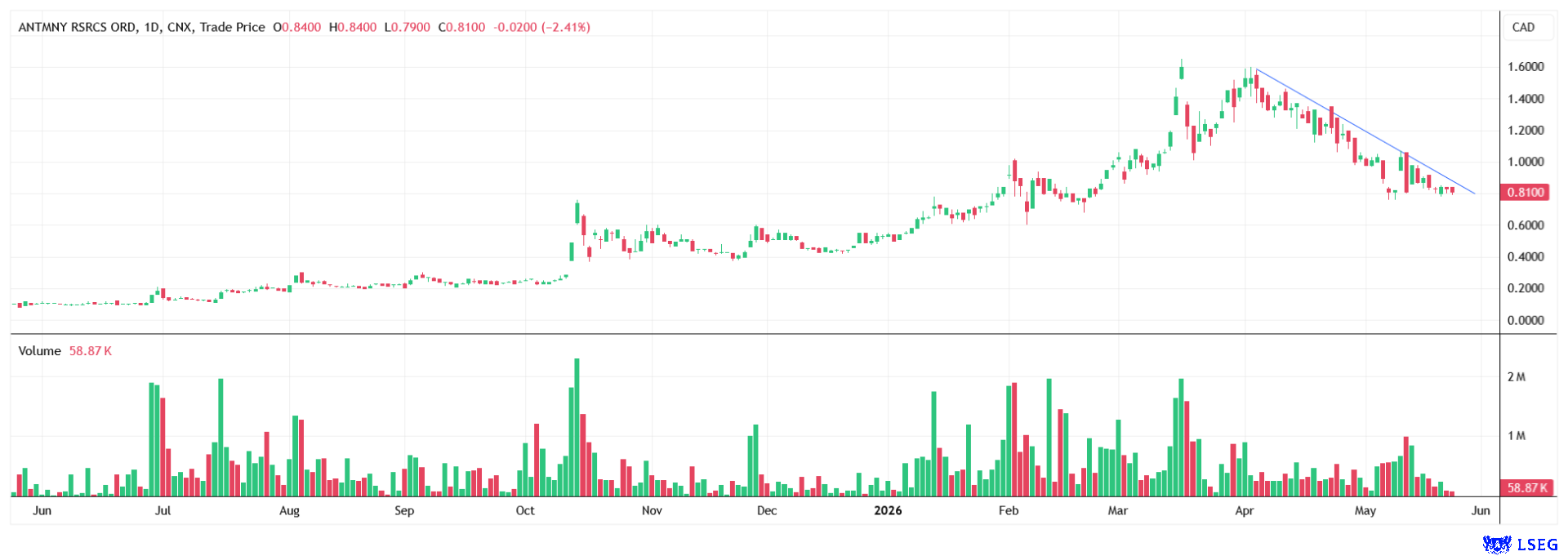
The share is currently trading around CAD 0.81, following a multi-week downtrend that had pushed the price close to the horizontal support level at CAD 0.80. While the new drill results have not yet triggered a breakout from this consolidation, technically speaking, not much is needed for a breakout. Should the stock rise above CAD 0.83, the next price target would be the psychologically important level of CAD 1.00; from there, a rise toward the previous highs of over CAD 1.60 would even be conceivable.
Research firms are optimistic. In a study, the research firm GBC determined a fair value of CAD 3.00 per share, representing a significant increase from the current level. While BMO expressed skepticism regarding short-term supply bottlenecks, it nevertheless sees paramount strategic value for the West in Antimony Resources.
Conclusion: Three Stocks for the Defence Industry
Lockheed Martin and General Dynamics remain the major players in Western defence. Their business models are solid, and their order books are full. Nevertheless, the excitement has cooled for now, and analysts' enthusiasm is currently rather limited. The uncertainties caused by political influences are too great. Investors should adopt a wait-and-see approach with these two companies and not expect any sudden price surges.
The situation could be somewhat different for Antimony Resources. The company is not an established player but a small firm making a big bet on the future of the defence industry—a bet that the West will recognize its strategic vulnerabilities and tap into domestic sources for critical raw materials. Drilling data to date is promising, the management is experienced, and funding for the next twelve months is "secured." While the risk may be higher than with the defence giants, the potential is correspondingly greater. Investors who consider the current geopolitical reality will find it hard to ignore companies like Antimony Resources, whether they like it or not. And this means adding the stock to your watchlist or buying a few shares for your portfolio when it breaks out.
Conflict of interest
Pursuant to §85 of the German Securities Trading Act (WpHG), we point out that Apaton Finance GmbH as well as partners, authors or employees of Apaton Finance GmbH (hereinafter referred to as "Relevant Persons") may hold shares or other financial instruments of the aforementioned companies in the future or may bet on rising or falling prices and thus a conflict of interest may arise in the future. The Relevant Persons reserve the right to buy or sell shares or other financial instruments of the Company at any time (hereinafter each a "Transaction"). Transactions may, under certain circumstances, influence the respective price of the shares or other financial instruments of the Company.
In addition, Apaton Finance GmbH is active in the context of the preparation and publication of the reporting in paid contractual relationships.
For this reason, there is a concrete conflict of interest.
The above information on existing conflicts of interest applies to all types and forms of publication used by Apaton Finance GmbH for publications on companies.
Risk notice
Apaton Finance GmbH offers editors, agencies and companies the opportunity to publish commentaries, interviews, summaries, news and the like on news.financial. These contents are exclusively for the information of the readers and do not represent any call to action or recommendations, neither explicitly nor implicitly they are to be understood as an assurance of possible price developments. The contents do not replace individual expert investment advice and do not constitute an offer to sell the discussed share(s) or other financial instruments, nor an invitation to buy or sell such.
The content is expressly not a financial analysis, but a journalistic or advertising text. Readers or users who make investment decisions or carry out transactions on the basis of the information provided here do so entirely at their own risk. No contractual relationship is established between Apaton Finance GmbH and its readers or the users of its offers, as our information only refers to the company and not to the investment decision of the reader or user.
The acquisition of financial instruments involves high risks, which can lead to the total loss of the invested capital. The information published by Apaton Finance GmbH and its authors is based on careful research. Nevertheless, no liability is assumed for financial losses or a content-related guarantee for the topicality, correctness, appropriateness and completeness of the content provided here. Please also note our Terms of use.