September 30th, 2026 | 07:05 CEST
Missed DroneShield's 500% Rally? The Next Drone Revolution Is Coming – First Hydrogen Set for a Revaluation!
Are we on the verge of the next drone revolution? Last year, investors were able to earn more than 500% at times with stocks like DroneShield. Now, unmanned systems are increasingly taking over the ground as well. The war in Ukraine shows just how quickly UGVs are evolving from logistical aids into offensive weapon systems. The market potential is enormous. On the stock market, the ground drone revolution has so far been treated as little more than a standalone theme. This is likely to change soon and drive up First Hydrogen's shares. After securing exclusive global patent rights in 2026 for the further development and commercialization of a patented AI-powered UGV platform, the company recently unveiled its first model. With a current market capitalization of just around EUR 22 million, it may only be a matter of time before the stock undergoes a major revaluation.
time to read: 4 minutes | Author: Fabian Lorenz
ISIN: First Hydrogen Corp. | CA32057N1042 | TSXV: FHYD
Table of contents:
Author

Fabian Lorenz
For more than twenty years, the Cologne native has been intensively involved with the stock market, both professionally and privately. He is particularly passionate about national and international small and micro caps.
Tag cloud
Shares cloud
After DroneShield's 500%+ Rally, Is First Hydrogen Set to Take Off?
On the stock market, the ground drone revolution has so far barely been recognized as a standalone theme. The drone hype of 2025 showed just how quickly that can change. Shares of the Australian drone defence specialist DroneShield rose at times over the year from AUD 0.77 to more than AUD 6.60. Other drone stocks were also swept up at times by enormous investor enthusiasm. Red Cat, for example, saw its share price multiply within just a few months. It is therefore likely only a matter of time before ground drones also come more into the spotlight on the stock market—especially if Ukraine continues to demonstrate their military utility and Western armies launch corresponding procurement programs. One candidate for this trend is First Hydrogen.
First Mover in a Trillion-Dollar Market
The market potential is enormous. To be a first mover, First Hydrogen is going full throttle. CEO Balraj Mann stated: "The environment on the battlefield and in the security sector is changing rapidly, and autonomous systems are becoming increasingly important in the areas of defence, infrastructure protection, and disaster response. By building specialized expertise in artificial intelligence for our UGV program, we are strengthening the platform's potential to support next-generation defence and security applications, including autonomous navigation, situational awareness, and drone countermeasures. We believe this represents a natural extension of First Hydrogen's strategy at the intersection of clean energy, autonomous systems, mobility, and advanced robotics."
Experts see a trillion-dollar opportunity. For humanoid robotics alone, RBC Capital Markets expects a global market volume of approximately USD 9 trillion by 2050. Not only manufacturers of complete robots are likely to benefit, but also, in particular, suppliers of key components. Bank of America expects annual shipments of humanoid robots to rise from around 20,000 units in 2025 to 10 million in 2035. Significant growth is also on the horizon for unmanned ground vehicles. Fortune Business Insights forecasts that the global market size will rise from just under USD 13 billion to more than USD 32 billion by 2034.
Military studies also increasingly view UGVs as an integral part of future warfare. An Ifri analysis published in February 2026, with support from NATO's Allied Command Transformation, concludes, based on field interviews and data from Ukraine, that ground robots are already being used for resupply, evacuating the wounded, laying and clearing mines, and attacks. Experts see a trend away from a few large platforms toward a larger number of comparatively inexpensive, flexibly adaptable systems. This would align with First Hydrogen's strategy.
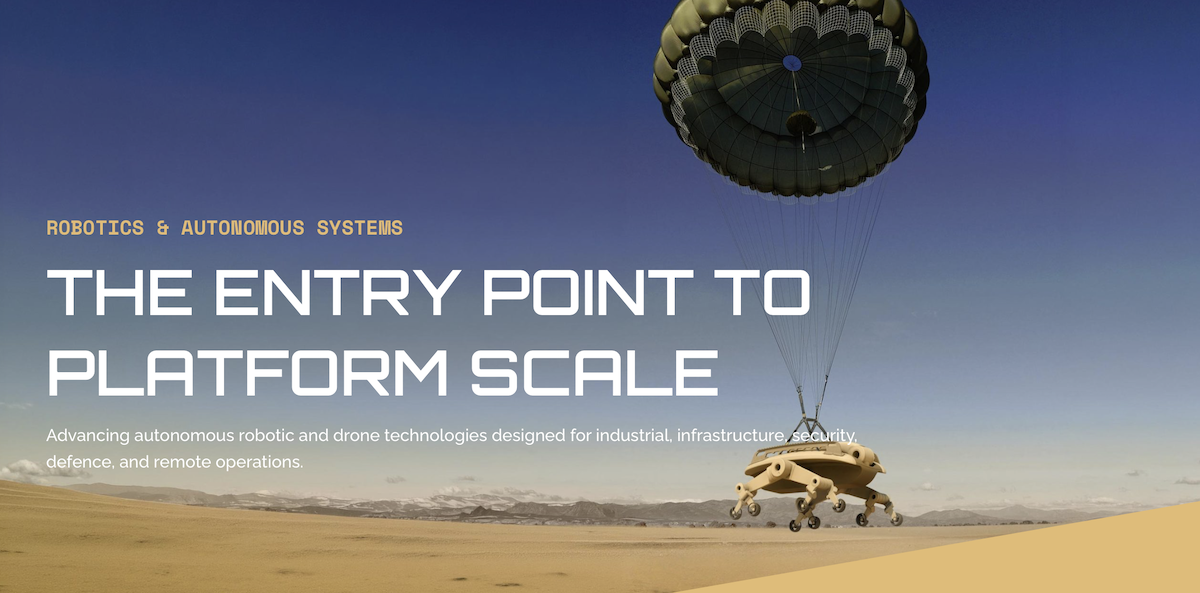
AI-Powered UGV Platform
In the first half of the year, First Hydrogen announced its entry into mobile robotics. By early September, the plans had taken on a more concrete form. The company secured exclusive global rights to further develop and commercially market an AI-powered UGV platform. The concept envisions a flexibly configurable ground vehicle that can be operated both autonomously and via remote control. Potential applications range from military logistics and aerial-drone support to security and industrial operations, as well as construction-site logistics and last-mile delivery.
Shortly thereafter, First Hydrogen significantly expanded its robotics strategy. With a definitive agreement to acquire a 60% stake in Exodus Actuation Solutions, the company gains access to a broad portfolio of technologies and patents related to motors, gearboxes, actuators, and robotics. According to the company, Exodus holds 26 granted patents and has 10 additional patents pending. The systems developed are designed, among other things, for high power density, precision, and efficiency, while simultaneously reducing energy consumption, noise levels, and costs. According to the company, more than 500 motors and gearboxes have been produced and delivered to date. The technology can be used in various fields, including humanoid and industrial robotics, collaborative robot systems, automated production processes, and applications requiring particularly precise motion control.
These new activities are being consolidated within the wholly-owned subsidiary First Humanoid Corp. In the future, it is intended to serve as a platform for humanoid robotics, autonomous systems, and AI-based technologies, and to market both its own developments and the corresponding intellectual property.
First UGV Unveiled
The next milestone followed just a few weeks ago. First Hydrogen has unveiled its first UGV. This allows the company to demonstrate key functions such as mobility, modular payloads, and the basic technical architecture.
The UGV is designed according to an open, modular system approach. Batteries, sensors, cameras, robotic arms, and computing units are designed to be quickly interchangeable, enabling a single platform to serve a variety of tasks. Planned applications include logistics, surveillance, communications, and defence. A key feature is an automatically opening launch and carrier module for drones, allowing the ground vehicle to also serve as a mobile base for aerial drones. In addition, the vehicle features a robust powertrain and a partially robot-controlled suspension system designed to support operation in challenging terrain and improve range and energy efficiency. After validating the core architecture, First Hydrogen now plans to develop additional modules and configurations specifically for security and defence applications. CEO Balraj Mann views the finished platform and the exclusive patent rights as the foundation for tapping into business opportunities in the growing market for autonomous robotics and unmanned ground systems.**
Conclusion: Huge Market, Undervalued Stock
First Hydrogen is rapidly positioning itself in a market that is expected to grow significantly in the coming years. With the UGV platform, exclusive patent rights, and access to Exodus's propulsion and robotics technology, the company is building a robotics platform. At the same time, the war in Ukraine demonstrates that unmanned ground vehicles are becoming increasingly important in military operations. This substantial market potential currently contrasts with a comparatively low market capitalization of approximately EUR 22 million. If First Hydrogen succeeds in generating commercial orders and revenue from this technology, the stock could see a revaluation.
Conflict of interest
Pursuant to §85 of the German Securities Trading Act (WpHG), we point out that Apaton Finance GmbH as well as partners, authors or employees of Apaton Finance GmbH (hereinafter referred to as "Relevant Persons") may hold shares or other financial instruments of the aforementioned companies in the future or may bet on rising or falling prices and thus a conflict of interest may arise in the future. The Relevant Persons reserve the right to buy or sell shares or other financial instruments of the Company at any time (hereinafter each a "Transaction"). Transactions may, under certain circumstances, influence the respective price of the shares or other financial instruments of the Company.
In addition, Apaton Finance GmbH is active in the context of the preparation and publication of the reporting in paid contractual relationships.
For this reason, there is a concrete conflict of interest.
The above information on existing conflicts of interest applies to all types and forms of publication used by Apaton Finance GmbH for publications on companies.
Risk notice
Apaton Finance GmbH offers editors, agencies and companies the opportunity to publish commentaries, interviews, summaries, news and the like on news.financial. These contents are exclusively for the information of the readers and do not represent any call to action or recommendations, neither explicitly nor implicitly they are to be understood as an assurance of possible price developments. The contents do not replace individual expert investment advice and do not constitute an offer to sell the discussed share(s) or other financial instruments, nor an invitation to buy or sell such.
The content is expressly not a financial analysis, but a journalistic or advertising text. Readers or users who make investment decisions or carry out transactions on the basis of the information provided here do so entirely at their own risk. No contractual relationship is established between Apaton Finance GmbH and its readers or the users of its offers, as our information only refers to the company and not to the investment decision of the reader or user.
The acquisition of financial instruments involves high risks, which can lead to the total loss of the invested capital. The information published by Apaton Finance GmbH and its authors is based on careful research. Nevertheless, no liability is assumed for financial losses or a content-related guarantee for the topicality, correctness, appropriateness and completeness of the content provided here. Please also note our Terms of use.