
Volkswagen AG

Commented by Stefan Bode on September 10th, 2026 | 08:30 CEST
A Plunge, Corporate Restructuring, and a Bet on Technology – Novartis, HPQ Silicon, Volkswagen
In the stock market, it is often not the big promises but the critical transition phases that determine investment opportunities—true to the saying: "The profit lies in the purchase." That is exactly where the following three stocks stand. A corporation with costly pipeline risk, a tech stock on the path from testing to potential commercialization, and an industrial giant in the midst of a tough restructuring. Investors looking to understand where hope, risk, and revaluation are currently most strongly intertwined will find interesting case studies here.
Read
Commented by Armin Schulz on September 2nd, 2026 | 07:05 CEST
Volkswagen, Strategic Resources and TKMS: How to Capitalize on the Mega-Trend of Defence and Raw Materials
When a vehicle manufacturer becomes a defence contractor, a raw materials developer provides the key to green steel production, and a naval group reports record orders, a realignment of German industry is taking shape. Volkswagen is on the brink of its most profound transformation and is turning to the defence sector as a lifeline. At the same time, the race for strategic resources is intensifying. Without decarbonized steel, there can be no modern defence, and this steel requires specific grades of iron ore. This is precisely where Strategic Resources comes in. While thyssenkrupp Marine Systems is benefiting from full order books, a new value chain is emerging. Today, we take a closer look at the shares of Volkswagen, Strategic Resources and TKMS.
Read
Commented by André Will-Laudien on September 1st, 2026 | 07:25 CEST
AI: The 180-Degree Turn for Performance Cars! VW, Porsche, BYD and Standard Uranium in Focus
It has finally happened – AI is permeating every aspect of life. This is creating many new conditions, including for stock market investors. One example is the automotive sector: for the traditional auto industry to survive, a fundamental U-turn is essential. Whilst long-established brands such as VW and Porsche have dominated for decades thanks to their mastery of classic mechanical engineering and driving dynamics, AI is now rapidly shifting the core of value creation to the software level. The modern vehicle is rapidly evolving from a mechanical means of transport into a rolling supercomputer. This is evident in the disruptive strategy of Chinese tech giants such as BYD. Not only does the company control around 75% of its vertical supply chain, including its own AI chips, but its integrated AI architecture is also completely breaking down the traditional barriers between the powertrain, the cockpit and the driver-assistance systems. This transformation is putting German premium manufacturers under enormous pressure in terms of time and margins, as the iterative addition of individual control units appears too sluggish and inflexible compared to BYD's centralized AI 'brain'. For investors, this creates a highly dynamic environment. It is worth taking a closer look.
Read
Commented by Matthias Schomber on August 3rd, 2026 | 07:45 CEST
Alarm at Volkswagen, Steyr Motors Takeover Called Off! When Will dynaCERT Spark a Long-Awaited Breakout?
While some of Germany's largest automakers are grappling with a deepening crisis and planning historic restructuring measures, other well-known companies are also facing major challenges. Volkswagen is struggling with a sharp decline in vehicle sales and sweeping cost-cutting plans that have unsettled investors, a trend reflected in the company's weakening share price. At the same time, Austrian engine specialist Steyr Motors is navigating a highly challenging market environment and is being forced to redefine its strategic direction. Most recently, the company put an end to takeover speculation after acquisition talks failed to result in a transaction. Amid these turbulent times, investors are turning their attention to smaller players, such as the Canadian cleantech company dynaCERT. The company has developed an innovative technology for internal combustion engines designed to reduce fuel consumption and emissions, potentially delivering meaningful cost savings for fleet operators.
Read
Commented by Nico Popp on July 29th, 2026 | 07:45 CEST
Battery Metals Bottleneck: Volkswagen and BHP Under Pressure as Power Metallic Mines Faces Weeks of Truth
Electric vehicles are becoming an increasingly common sight on German roads, driven in part by the arrival of aggressively priced models from China. However, the rapid growth of electric mobility is placing mounting pressure on automotive supply chains. Automakers are grappling with volatile markets while becoming increasingly concerned about securing reliable access to critical raw materials. Commodities are no longer viewed as readily available inputs but as strategic assets essential to industrial competitiveness. This complex situation calls for new alliances: mining companies, major automakers, and dynamic project developers are pulling out all the stops to secure raw materials for the future.
Read
Commented by Stefan Bode on July 29th, 2026 | 07:00 CEST
US Uranium Independence in Focus, T-Mobile US Under Pressure, Volkswagen Cuts Forecast – American Atomics, Deutsche Telekom, Porsche
The Iran war and the potential for escalation into neighbouring countries remain firmly on investors' radar despite the temporary pause in US air strikes. This report examines current developments at companies from various sectors that are currently attracting market attention. Whether it is strategic realignments to secure critical raw materials, turbulent share price reactions among telecommunications giants following earnings season, or the margin challenges facing European automakers in the Asian market—the latest market data offers plenty of potential for volatility. Find out which fundamental metrics and trends are now becoming decisive for investors.
Read
Commented by Carsten Mainitz on July 28th, 2026 | 07:25 CEST
The Automotive Industry Is Under Pressure: Why dynaCERT Could Be the Missing Piece of the Puzzle for Volkswagen and Daimler Truck
The discussion about the future of mobility is currently dominated by electric vehicles and hydrogen, both of which meet the vision of zero-emission transportation. But the road ahead is long; further technological advances and, in particular, the expansion of infrastructure pose challenges. Another crucial factor is often overlooked. In heavy-duty transport in particular, diesel forms the backbone of global logistics and will continue to do so for decades to come. This is precisely where dynaCERT comes in with an innovative bridging technology. The Canadian company's retrofit solution generates hydrogen and oxygen on board as needed. These are fed into the intake system of diesel engines, thereby reducing fuel consumption and emissions. Is a billion-dollar market on the horizon?
Read
Commented by Nico Popp on July 27th, 2026 | 07:35 CEST
China's Export Restrictions: German Industry Must Invest in Raw Materials. How VW and Rheinmetall Respond & Why Aspermont Could Benefit
For decades, raw materials were commodities in the truest sense of the word—interchangeable goods purchased at the lowest possible price. But in recent years, security of supply has evolved from a procurement issue into a decisive factor for the survival of Western industry. Depending on the sector, shortages can threaten entire business models. To reduce the risks posed by geopolitical tensions, volatile commodity prices and increasingly stringent sustainability requirements, industrial companies are taking a much closer look at their raw material supply chains. Some are investing directly in mining projects, while others are forming strategic partnerships. In either case, access to reliable information on mining projects and the conditions across the value chain is essential for assessing supply risks. Aspermont, a specialist provider of mining and commodities intelligence, could be well positioned to benefit from this shift.
Read
Commented by Matthias Schomber on July 26th, 2026 | 07:00 CEST
Volkswagen Under Pressure! Is Porsche AG Ready to Accelerate? RE Royalties Near a Technical Breakout?
The world remains mired in a web of conflicts and wars, leaving financial markets repeatedly holding their breath. Geopolitically, we appear to be heading towards a scenario that would have seemed unthinkable only a short time ago. Will the conflict with Iran escalate further? Are we facing devastating large-scale US air strikes in the Middle East, following the deployment of B-1 bombers to the region? Could the situation even escalate to the use of a tactical nuclear weapon, or is this historic sabre-rattling ultimately a calculated bluff by global powers—designed to trigger panic before the next major "TACO trade" unfolds? While investors grapple with uncertainty, Europe's traditional industries are coming under increasing pressure. The automotive sector and its suppliers are particularly vulnerable. Even iconic German industrial giants such as Volkswagen are showing signs of strain, prompting an increasingly uncomfortable question: Will Volkswagen still exist in five years? In this historic context, the wheat is truly being separated from the chaff. While traditional industries and corporations are fighting for their very survival, smaller niche players are seeing significant opportunities emerge. We take a closer look at where investors may still be able to generate attractive returns.
Read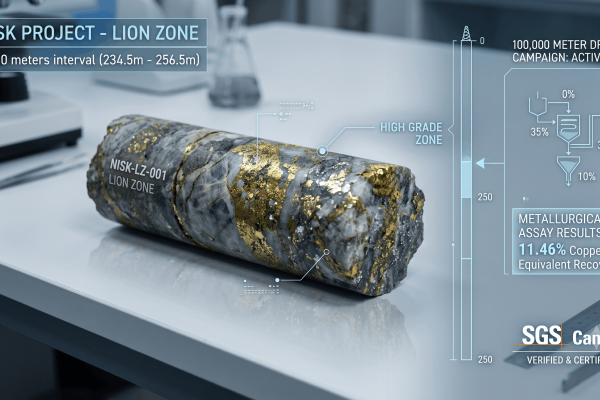
Commented by Nico Popp on July 8th, 2026 | 07:05 CEST
Canada and Europe Are Jointly Securing Raw Materials: Why BMW and Volkswagen Should Keep an Eye on Power Metallic Mines
The automotive industry's transition to electric mobility is disrupting traditional supply chains. While efficient assembly used to be the key factor, in the era of electric vehicles, secure, environmentally responsible access to critical minerals matters most. Above all, strict legal requirements, such as the European Supply Chain Due Diligence Act, are forcing automakers to fully document the origin of their raw materials all the way back to the mine. In this complex landscape, Canada has emerged as one of the most important partners for European industry. The standards and mineral content are just right here—we introduce the market and potential beneficiaries.
Read