December 17th, 2025 | 07:15 CET
Gold rush: After producers Barrick Mining and Equinox Gold, it is now the turn of explorers – why Desert Gold is a takeover candidate
Forecasts for the gold market in 2026 are clear and point to a continuing supercycle. However, while producers such as Barrick Mining and Equinox Gold have already benefited massively from higher gold prices in recent months and expanded their margins, the valuation of exploration companies is still lagging behind. This historical divergence is likely to close in the coming year. Experience shows that capital flows cyclically: first, investors buy the security of cash flows, then they seek the leverage of resource development. In this environment, Desert Gold Ventures is coming into focus. The Company controls one of the largest non-producing land packages in West Africa, and is active precisely where industry giants are urgently searching for new supply.
time to read: 3 minutes | Author: Nico Popp
ISIN: BARRICK MINING CORPORATION | CA06849F1080 , EQUINOX GOLD CORP. NEW | CA29446Y5020 , DESERT GOLD VENTURES | CA25039N4084
Table of contents:
Author

Nico Popp
At home in Southern Germany, the passionate stock exchange expert has been accompanying the capital markets for about twenty years. With a soft spot for smaller companies, he is constantly on the lookout for exciting investment stories.
Tag cloud
Shares cloud
Sector rotation: Why "smart money" is changing now
A classic pattern can currently be observed on the stock market. The shares of established producers have priced in the first wave of the gold price rise. **A company like Equinox Gold was able to restructure its balance sheet and benefit from high sales prices. But for 2026, investors are looking for the next multiplier, and mathematically, this is hardly possible for a billion-dollar corporation. This is where junior miners like Desert Gold come into play, as they do not operate expensive factories but define valuable ounces in the ground, whose theoretical value grows disproportionately with every dollar increase in the gold price. While a producer struggles with operational risks such as diesel prices or labor costs, the explorer offers the pure option on the resource. Industry experts anticipate 2026 to be the year of acquisitions, as large mines are depleting their reserves faster than they can find new ones, making companies with ready-made resources sought-after targets.
The SMSZ Project: A strategic giant in a prime location
At the heart of Desert Gold is the SMSZ (Senegal Mali Shear Zone) project, which covers a vast area of 440 sq km. Location is everything in mining, and Desert Gold is geologically located in the "approach path" of the major mining companies. The SMSZ project is not far from Barrick Mining's world-class Loulo-Gounkoto mine and within striking distance of Allied Gold and B2Gold's operations. This region is one of the most productive gold belts in the world. It is a geological truism that ore veins do not stop at license boundaries, and Desert Gold's data confirms that its neighbors' mineralized structures continue onto its own property. With an already defined resource of over 1.1 million ounces of gold in the Indicated and Inferred categories from 2022, which has since been expanded, Desert Gold has crossed the critical threshold at which a project becomes not just interesting but strategically relevant to its large neighbors.
The projects in detail: From Barani East to Mogoyafara
Desert Gold's great advantage is the diversification within its own land package, as it does not depend on a single discovery. A central pillar is the Barani East zone. Here, the Company has demonstrated that gold could be mined profitably. A preliminary economic assessment (PEA) has already outlined the potential for the cost-effective heap leach process, as the ore oxidizes on the surface and is therefore easy to process. This is attractive to potential buyers, as it promises rapid cash flow with low investment costs.**
However, the real scaling potential lies in the Gourbassi West zone. Here, the gold deposits extend over a strike length of around 1.8 km. Drilling has consistently revealed high-grade sections, indicating that a much larger system lies dormant here at depth. This is complemented by the huge potential of Mogoyafara South. This zone hosts the highest-volume deposits in Desert Gold's portfolio. Historical data and current models indicate broad zones of gold mineralization that would be perfectly suited for massive open-pit mining. Taken together, these sub-projects do not form a loose collection, but rather a cluster that can either be developed as a stand-alone mine or serve as a perfect "satellite deposit" to feed the mills of the surrounding large mines for years to come.
The M&A logic: Why Desert Gold is a takeover candidate
For a company like Barrick Mining or Allied Gold, the calculation is simple: Is it cheaper to invest millions in your own risky exploration, or to buy your neighbor's defined ounces for a fraction of the cost? Since the large mines in the region, such as Barrick's Loulo-Gounkoto, whose production is currently being ramped up again after a dispute between Barrick and the Malian government, constantly need new ore to keep their huge processing plants running at full capacity, purchasing nearby material is often the most economical solution. Desert Gold is currently valued on the stock market at only a fraction of what it costs to discover an ounce of gold today. This extreme valuation gap between the cost of discovery and the stock market price is the main driver for a potential takeover.
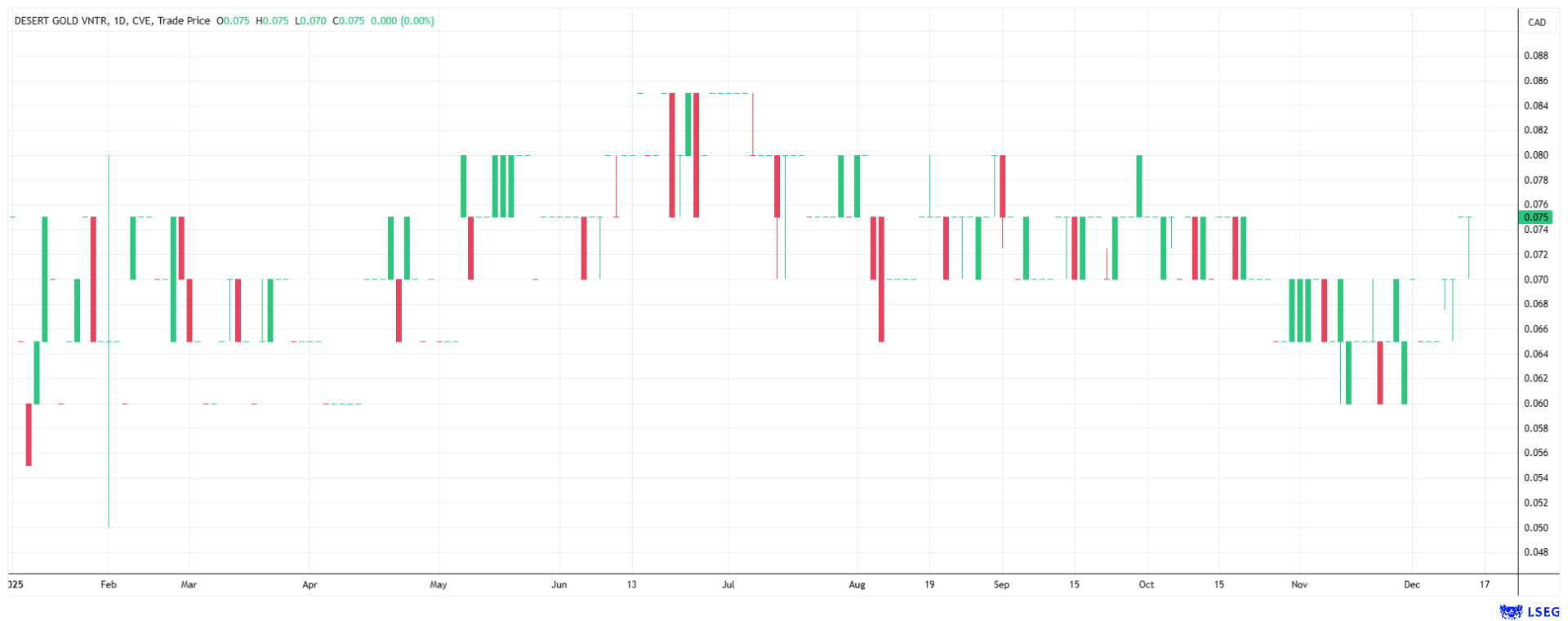
While investors wait for dividends from Barrick, they speculate on Desert Gold for the premium that will be due when a major player wants to secure the strategic 440 sq km before a competitor does. In a gold market that is targeting new highs in 2026, Desert Gold is the logical speculative addition to any portfolio that wants to capitalize on the "leverage effect" of explorers. Analysts also see opportunities in the stock – market experts at GBC Research recently issued a "Buy" recommendation for Desert Gold with a price target of EUR 0.50.
Watch YouTube videoConflict of interest
Pursuant to §85 of the German Securities Trading Act (WpHG), we point out that Apaton Finance GmbH as well as partners, authors or employees of Apaton Finance GmbH (hereinafter referred to as "Relevant Persons") currently hold or hold shares or other financial instruments of the aforementioned companies and speculate on their price developments. In this respect, they intend to sell or acquire shares or other financial instruments of the companies (hereinafter each referred to as a "Transaction"). Transactions may thereby influence the respective price of the shares or other financial instruments of the Company.
In this respect, there is a concrete conflict of interest in the reporting on the companies.
In addition, Apaton Finance GmbH is active in the context of the preparation and publication of the reporting in paid contractual relationships.
For this reason, there is also a concrete conflict of interest.
The above information on existing conflicts of interest applies to all types and forms of publication used by Apaton Finance GmbH for publications on companies.
Risk notice
Apaton Finance GmbH offers editors, agencies and companies the opportunity to publish commentaries, interviews, summaries, news and the like on news.financial. These contents are exclusively for the information of the readers and do not represent any call to action or recommendations, neither explicitly nor implicitly they are to be understood as an assurance of possible price developments. The contents do not replace individual expert investment advice and do not constitute an offer to sell the discussed share(s) or other financial instruments, nor an invitation to buy or sell such.
The content is expressly not a financial analysis, but a journalistic or advertising text. Readers or users who make investment decisions or carry out transactions on the basis of the information provided here do so entirely at their own risk. No contractual relationship is established between Apaton Finance GmbH and its readers or the users of its offers, as our information only refers to the company and not to the investment decision of the reader or user.
The acquisition of financial instruments involves high risks, which can lead to the total loss of the invested capital. The information published by Apaton Finance GmbH and its authors is based on careful research. Nevertheless, no liability is assumed for financial losses or a content-related guarantee for the topicality, correctness, appropriateness and completeness of the content provided here. Please also note our Terms of use.