November 20th, 2025 | 07:05 CET
Safe havens with dividends of almost 10%: RE Royalties, Enbridge, Realty Income
The euphoria surrounding artificial intelligence has driven tech stocks to dizzying heights—but not without increasing risk. Stefan Hoops, CEO of asset manager DWS, recently warned that the explosive rise in the price of many AI stocks is increasingly resembling a bubble and that there is "no playbook" for such a development. The situation is reminiscent of the dot-com bubble of the late 1990s, when private investors also drove valuations to extremes in the final phase of the rally. While Hoops and other market experts caution that tech stocks could face a painful correction, savvy investors have already begun looking for alternatives outside the AI hype. Dividend stocks with stable, inflation-resistant business models are coming back into focus – and the associated business models that secure robust returns regardless of short-term market developments.
time to read: 3 minutes | Author: Nico Popp
ISIN: RE ROYALTIES LTD | CA75527Q1081 , ENBRIDGE INC. | CA29250N1050 , REALTY INC. CORP. DL 1 | US7561091049
Table of contents:
Author

Nico Popp
At home in Southern Germany, the passionate stock exchange expert has been accompanying the capital markets for about twenty years. With a soft spot for smaller companies, he is constantly on the lookout for exciting investment stories.
Tag cloud
Shares cloud
Dividends do not automatically mean security
Dividend stocks are one thing; truly stable income generators are another. Just because a company pays a high dividend based on its current share price does not mean that an investment is truly crisis-proof. All too often, companies have had to drastically reduce their distributions during crises. This happens, for example, when the liquidity situation becomes threatening or there are simply no more income streams because the business is collapsing. The Canadian royalty company RE Royalties, on the other hand, is in a much more stable position.
RE Royalties generates low-risk returns with renewable energy
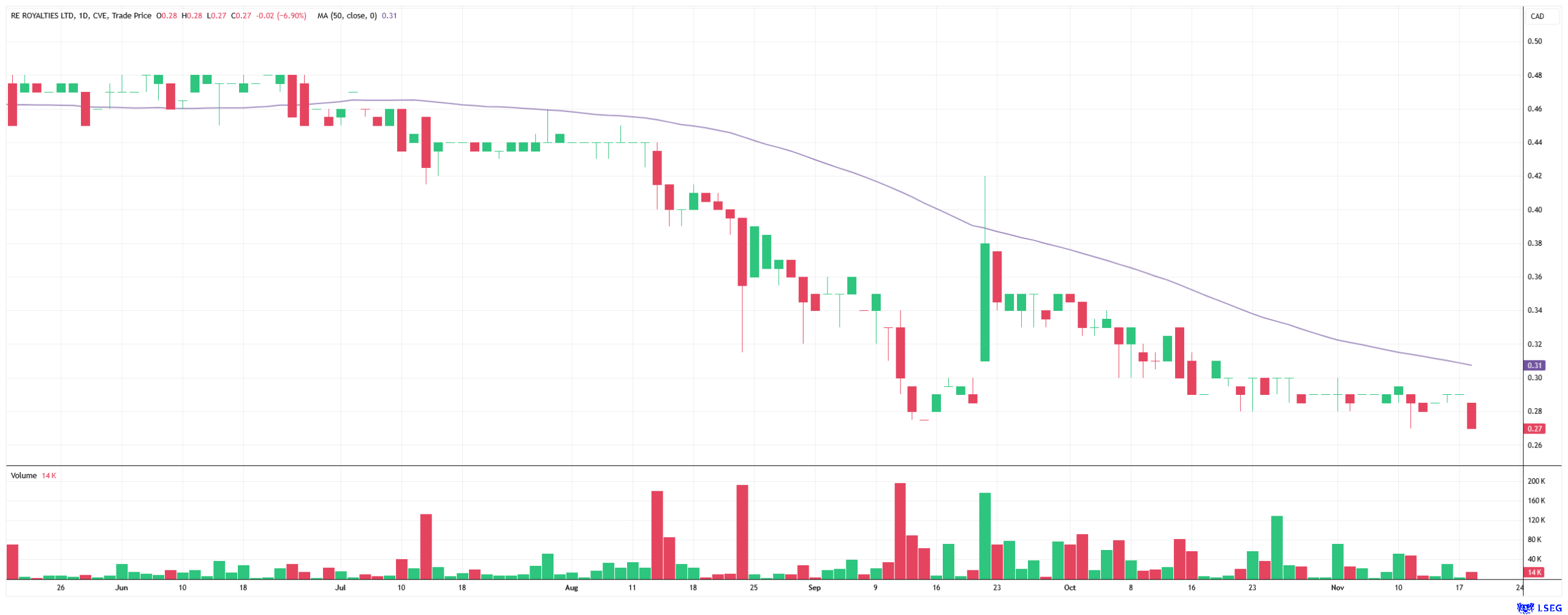
The renewable energy experts are pioneers when it comes to applying the royalty approach known from the oil and gas industry to energy parks. RE Royalties provides capital to operators of solar, wind, hydroelectric, or battery storage projects and, in return, receives ongoing revenue shares in the form of royalties from electricity generation. This business model is designed to promote the expansion of clean energy while securing predictable returns for shareholders. In fact, the current dividend yield is around 9% per annum. Since 2020, the Company has paid out a cent in dividends every quarter.
RE Royalties has a total of around 100 royalty streams from renewables in its portfolio and also diversifies these regionally. This pays off: just this year, the Company invested USD 9 million in the form of a loan in a wind farm with a capacity of 9.6 MW in the US. The terms are impressive, with 12% interest and a 5% share of revenue. Such combinations of royalties and interest enable high gross margins, as the ongoing operating costs are low. As a result, capital remains available for further investments. RE Royalties also finances itself through green bonds. The Company recently raised CAD 6.2 million in the form of a green bond. The coupon is 9% and the term runs until 2029. The bonds are secured by the royalty portfolio and will be used to expand into further projects. RE Royalties could therefore be of interest to professional investors who like to invest in combinations of shares and associated bonds.
Enbridge: Pipeline operator benefiting even in turbulent times
While RE Royalties is breaking new ground with its combination of royalties and renewable energy, Enbridge remains a classic dividend stock. The Canadian company is one of North America's largest energy infrastructure groups. Its core business comprises pipeline transportation of oil and gas, supplemented by gas supply networks and renewable energy projects. Enbridge operates a gigantic network of oil pipelines from Alberta, Canada, to the US, including the Mainline system, which moves roughly 3 million barrels of oil per day. The Company also manages natural gas pipelines, storage facilities, and gas distribution networks across Canada, as well as offshore wind farms in Europe. This diversified portfolio generates stable cash flow and underpins Enbridge's reputation as a reliable dividend payer.**
From pipelines to renewables to real estate – Predictable cash flows increasingly in demand
As pipelines increasingly fail due to local opposition, the market leader benefits - its existing pipelines are simply worth more because of protests and high barriers to entry. Enbridge has again slightly increased its quarterly dividend for 2025. The dividend yield is currently around 5.6%. Realty Income offers an almost identical dividend yield of 5.7%. The real estate company, specializing in commercial properties, pays out monthly and has achieved a certain degree of notoriety with this practice.** The 132 individual dividend increases since its IPO in 1994 also attract many fans. Although real estate investments are always sensitive to interest rates, Realty Income is considered a major player in the sector and has proven in the past to handle refinancing well.
While the stock market is discussing AI trends and the next NVIDIA, dividend stocks such as RE Royalties, Enbridge, and Realty Income remind us of the virtues of solid business models. They may not dominate the headlines, but they offer predictable cash flows and downside protection. DWS CEO Hoops' warning about a possible AI bubble underscores the importance of diversification beyond hyped sectors. High-yield stocks may be one answer here.
RE Royalties outperforms dividend aristocrats in terms of yield
RE Royalties demonstrates that sustainable investing and attractive returns are not mutually exclusive. The royalty model in renewable energy delivers near double-digit returns, with a dividend yield of around 9%, while remaining sustainable. The green bonds issued by the company may also appeal to specialized investors. Meanwhile, Enbridge and Realty Income continue to generate strong cash flows. Negative points here, however, are the lower dividend yield, the prospect of dwindling fossil fuel business in the case of the pipeline operator, and the cyclical nature of real estate investments in the commercial sector. RE Royalties shares remain largely under the radar. For investors seeking high-yield safe havens, it deserves closer attention.
Watch YouTube videoConflict of interest
Pursuant to §85 of the German Securities Trading Act (WpHG), we point out that Apaton Finance GmbH as well as partners, authors or employees of Apaton Finance GmbH (hereinafter referred to as "Relevant Persons") may hold shares or other financial instruments of the aforementioned companies in the future or may bet on rising or falling prices and thus a conflict of interest may arise in the future. The Relevant Persons reserve the right to buy or sell shares or other financial instruments of the Company at any time (hereinafter each a "Transaction"). Transactions may, under certain circumstances, influence the respective price of the shares or other financial instruments of the Company.
In addition, Apaton Finance GmbH is active in the context of the preparation and publication of the reporting in paid contractual relationships.
For this reason, there is a concrete conflict of interest.
The above information on existing conflicts of interest applies to all types and forms of publication used by Apaton Finance GmbH for publications on companies.
Risk notice
Apaton Finance GmbH offers editors, agencies and companies the opportunity to publish commentaries, interviews, summaries, news and the like on news.financial. These contents are exclusively for the information of the readers and do not represent any call to action or recommendations, neither explicitly nor implicitly they are to be understood as an assurance of possible price developments. The contents do not replace individual expert investment advice and do not constitute an offer to sell the discussed share(s) or other financial instruments, nor an invitation to buy or sell such.
The content is expressly not a financial analysis, but a journalistic or advertising text. Readers or users who make investment decisions or carry out transactions on the basis of the information provided here do so entirely at their own risk. No contractual relationship is established between Apaton Finance GmbH and its readers or the users of its offers, as our information only refers to the company and not to the investment decision of the reader or user.
The acquisition of financial instruments involves high risks, which can lead to the total loss of the invested capital. The information published by Apaton Finance GmbH and its authors is based on careful research. Nevertheless, no liability is assumed for financial losses or a content-related guarantee for the topicality, correctness, appropriateness and completeness of the content provided here. Please also note our Terms of use.