October 21st, 2025 | 07:05 CEST
NEO Battery Materials is igniting the battery revolution in the West!
Drones, robotics, and e-mobility increasingly demand batteries with greater range, faster charging times, and lower costs. At the same time, the security of Chinese supply chains is deteriorating. This is precisely where NEO Battery Materials comes into play. With its silicon anodes (NBMSiDE®), the Company promises up to 70% higher energy density at over 60% lower production costs, while simultaneously establishing a Western supply chain suitable for defense applications. Recent orders and purchase agreements indicate that commercialization is now gaining strong momentum.
time to read: 3 minutes | Author: Stefan Feulner
ISIN: NEO BATTERY MATERIALS LTD | CA62908A1003
Table of contents:
Author

Stefan Feulner
The native Franconian has more than 20 years of stock exchange experience and a broadly diversified network.
He is passionate about analyzing a wide variety of business models and investigating new trends.
Tag cloud
Shares cloud
From silicon anodes to high-performance batteries
NEO Battery Materials is positioning itself as an innovator in the next generation of battery technology. The goal: to replace conventional graphite anodes in lithium-ion cells with silicon. The process is not only more efficient but also significantly more cost-effective. A special polymer coating stabilizes the sensitive silicon particles, resulting in significantly higher cycle stability and longer service life. This makes the technology particularly attractive for applications where energy density and reliability are critical - including drones, unmanned systems, robotics, and electric vehicles.
Tangible contracts underscore that NEO is delivering on its promises. The Company recently secured a multi-year order worth CAD 4.5 million from an Asian drone manufacturer active in the military sector. Under this agreement, NEO will develop two types of batteries for various drone models, from heavy industrial systems to models for defense purposes.
In addition, a multi-year purchase agreement for 50 metric tons of silicon anode material was recently signed with a North American battery manufacturer specializing in defense applications. At the same time, a joint development agreement aims to enhance the performance of both lithium-ion and lithium-polymer cells. CEO Spencer Huh describes this partnership as "an important milestone on the road to a robust North American battery supply chain."
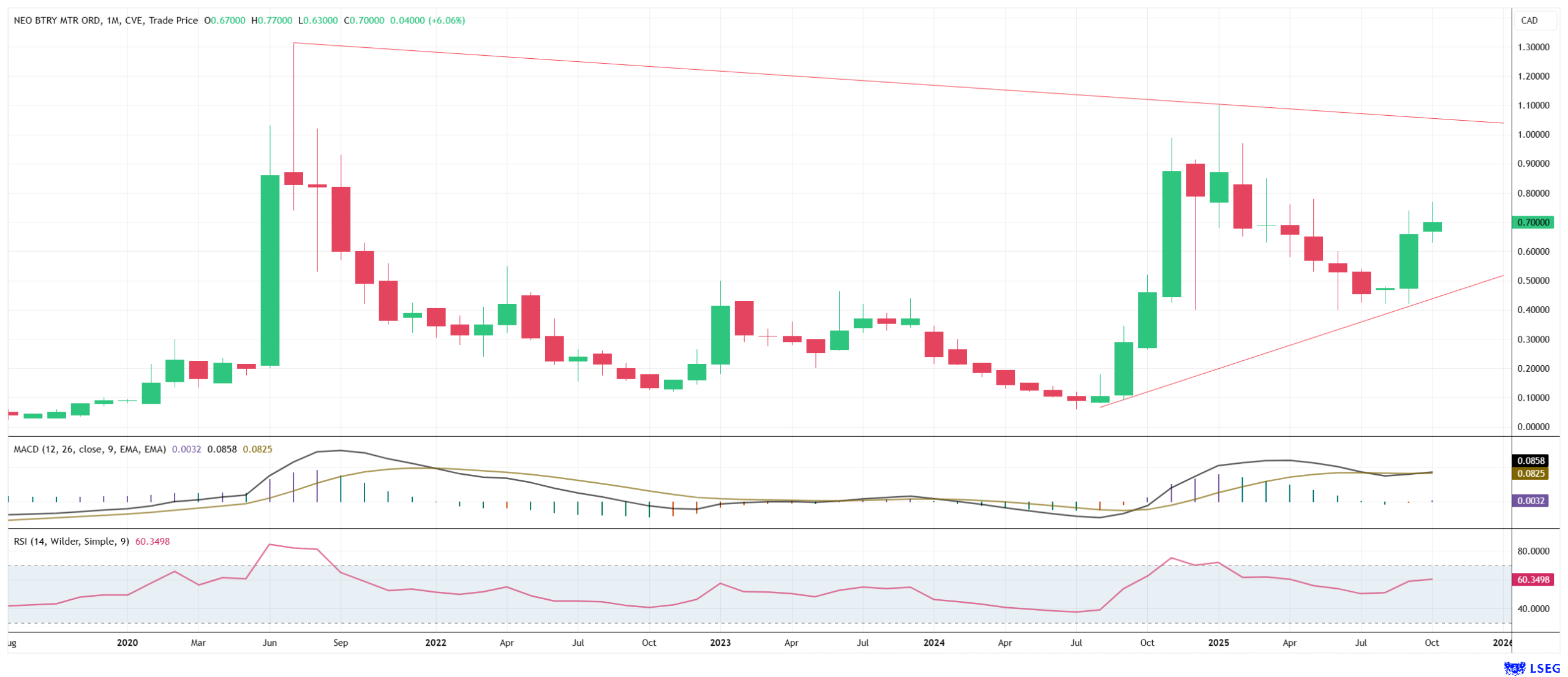
Geopolitics as a growth driver
Starting in November 2025, China will drastically tighten export rules for high-performance batteries above 300 Wh/kg and their key components. This move is set to once again turn the global supply of modern battery materials upside down, as China already accounts for 70 to 80% of global battery capacity. For manufacturers in the US and Europe who rely on high-performance cells, this means growing uncertainty. At the same time, new tariffs loom in the escalating trade conflict between the US and China. Against this backdrop, companies such as NEO Battery Materials are gaining strategic importance.
With a value chain outside China and a clear focus on North America, South Korea, and Europe, NEO could emerge as a key player in Western battery supply. The latest political tailwinds from Washington, where initiatives such as major investments in MP Materials and Lithium Americas support domestic supply chains, play directly into NEO's hands. Higher tariffs on Chinese components would further reinforce the cost advantage of NEO's silicon anode technology and establish the Company as a geopolitically secure alternative, especially for US automotive and drone manufacturers seeking to reduce their dependence on Chinese suppliers.
Vertical integration and global expansion
While many competitors are still fighting for subsidies and suitable sites, NEO Battery Materials has already significantly expanded its capacities. Production of silicon anode material rose to 4 tons per year and is set to increase to 20 tons by the end of 2025. At the same time, a 240-ton factory is being built in Windsor, Ontario, for the planned scaling. In South Korea, the Company also has an industrial site with six buildings directly adjacent to the planned electrode factory, which can be put into operation without any new construction.
This means that NEO will be able to cover all three standard battery formats in the future: pouch, cylindrical, and prismatic cells, and will be able to deliver customized high-performance batteries for applications in drones, AI electronics, energy storage, and electric vehicles. This vertical integration, from core materials to finished cells, forms the basis for NEO's own "Battery Innovation Platform". Strategic collaborations with partners such as Rockwell Automation and Linde Korea further strengthen NEO's technological and operational growth trajectory.
Conclusion
NEO Battery Materials combines technological innovation with political timing. A silicon anode that offers up to 70% more energy density and can be produced at a cost that is over 60% lower is entering a market that is urgently seeking safe, powerful, and non-Chinese alternatives. With production sites in Canada and South Korea, clear growth targets, and millions in orders, NEO is on the cusp of transitioning from developer to producer - and could evolve into one of the most important battery technology players in the Western world.
Conflict of interest
Pursuant to §85 of the German Securities Trading Act (WpHG), we point out that Apaton Finance GmbH as well as partners, authors or employees of Apaton Finance GmbH (hereinafter referred to as "Relevant Persons") may hold shares or other financial instruments of the aforementioned companies in the future or may bet on rising or falling prices and thus a conflict of interest may arise in the future. The Relevant Persons reserve the right to buy or sell shares or other financial instruments of the Company at any time (hereinafter each a "Transaction"). Transactions may, under certain circumstances, influence the respective price of the shares or other financial instruments of the Company.
In addition, Apaton Finance GmbH is active in the context of the preparation and publication of the reporting in paid contractual relationships.
For this reason, there is a concrete conflict of interest.
The above information on existing conflicts of interest applies to all types and forms of publication used by Apaton Finance GmbH for publications on companies.
Risk notice
Apaton Finance GmbH offers editors, agencies and companies the opportunity to publish commentaries, interviews, summaries, news and the like on news.financial. These contents are exclusively for the information of the readers and do not represent any call to action or recommendations, neither explicitly nor implicitly they are to be understood as an assurance of possible price developments. The contents do not replace individual expert investment advice and do not constitute an offer to sell the discussed share(s) or other financial instruments, nor an invitation to buy or sell such.
The content is expressly not a financial analysis, but a journalistic or advertising text. Readers or users who make investment decisions or carry out transactions on the basis of the information provided here do so entirely at their own risk. No contractual relationship is established between Apaton Finance GmbH and its readers or the users of its offers, as our information only refers to the company and not to the investment decision of the reader or user.
The acquisition of financial instruments involves high risks, which can lead to the total loss of the invested capital. The information published by Apaton Finance GmbH and its authors is based on careful research. Nevertheless, no liability is assumed for financial losses or a content-related guarantee for the topicality, correctness, appropriateness and completeness of the content provided here. Please also note our Terms of use.