March 19th, 2026 | 07:45 CET
Modern Warfare: Can Volatus Aerospace Compete with Industry Leaders Rheinmetall and DroneShield?
The defense industry has been booming for years - that is hardly news anymore. In 2025, global defense spending reached USD 2.63 trillion. In their latest studies, analysts at Forecast International predict that this annual spending will rise slightly by the end of 2026 and reach USD 2.9 trillion by the end of the decade. At the NATO summit in The Hague in 2025, the Allies committed to increasing their defense spending to 5% of gross domestic product by 2035, with 1.5% specifically earmarked for innovation. In a report, McKinsey highlights the shift from platform-centric hardware toward software-defined warfare and cost-effective, replaceable mass-produced systems. While industry giants like Rheinmetall still rely heavily on traditional defense equipment, DroneShield is addressing the growing niche of drone defense. Volatus Aerospace is leveraging its long-standing civilian expertise with drones and is coming into focus as a supplier to NATO forces.
time to read: 4 minutes | Author: Nico Popp
ISIN: VOLATUS AEROSPACE INC | CA92865M1023 | TSXV: FLT , OTCQB: TAKOF , RHEINMETALL AG | DE0007030009 , DRONESHIELD LTD | AU000000DRO2
Table of contents:
Author

Nico Popp
At home in Southern Germany, the passionate stock exchange expert has been accompanying the capital markets for about twenty years. With a soft spot for smaller companies, he is constantly on the lookout for exciting investment stories.
Tag cloud
Shares cloud
Rheinmetall Represents the Traditional Backbone of European Defense
By exiting the civilian automotive business in 2025, Rheinmetall has fully aligned its business model with the defense sector. The Group's consolidated revenue rose by 29% to EUR 9.94 billion in 2025, while operating profit climbed by 33% to EUR 1.84 billion. This growth is driven by the Weapons and Ammunition segment, which achieved an operating margin of 29.3%. The order backlog reached a record level of EUR 63.8 billion at year-end. The Group continues to focus on heavy platforms such as the Leopard 2 and the Boxer Carinus program, which has a volume of EUR 38 billion. To close the gap in air defense, the new Air Defense division is focusing on systems such as Skynex and Skyranger, as underscored by recent orders from Italy and the Netherlands in this area. However, analysts at Third Bridge point to execution risks, as scaling up tank production could be hampered by bottlenecks in ballistic steel, and the Group is responding too slowly to unmanned systems. Rheinmetall currently offers investors a dividend yield of around 1.5%.
DroneShield Scales Up AI-Powered Drone Defense
DroneShield focuses on electronic warfare and AI-powered drone defense. Its portfolio ranges from portable devices like the DroneGun Mk4 to fixed systems like DroneSentry. In 2025, DroneShield increased revenue by 276% to AUD 216.5 million and generated adjusted EBITDA of AUD 36.5 million. The sales pipeline totals AUD 2.3 billion, comprising 295 projects worldwide. Europe accounts for the largest share at AUD 1.2 billion, while the US promises strong growth with 112 projects in the public safety sector. A core element of CEO Oleg Vornik's strategy is the expansion of Software-as-a-Service, whose revenue grew by 475% in the fourth quarter of 2025 and is expected to account for over 30% of total revenue in five years. This scalability ensures the company a gross margin of 65%.
Why drones are the future: Maneuver highlights the weakness of conventional forces
Just how relevant unmanned systems have become was demonstrated by the major NATO maneuver Hedgehog, which took place in Estonia in 2025. During this exercise involving 16,000 soldiers, a small team of Ukrainian drone operators managed to render two NATO battalions combat-ineffective within half a day. The Ukrainian forces used the Delta system to analyze data via AI and coordinate attacks. The conventional NATO forces moved across this transparent battlefield without sufficient camouflage. The result was the simulated destruction of 17 armored vehicles and 30 additional command structures, which Reserve Major Sten Reimann described as a real shock to the military leadership. The evaluation showed that conventional tactics such as advancing in columns without drone protection are no longer viable on modern battlefields. Tanks like the Challenger 2 or Leopard 2 are highly vulnerable without integrated protection, forcing new approaches to military procurement: the military must rely on drones more than ever.
Volatus Aerospace Combines Civilian and Military Technology
In this context, drone specialist Volatus Aerospace is positioning itself as a strategic supplier. The Canadian company has built up expertise in the civilian sector and is now adapting it for the defense industry. The business model rests on three pillars: services provided through the Operations Control Center in Toronto, the sale of drones such as the Condor XL or the Canary RPAS, and the certified training of 114,000 drone operators worldwide. The company benefits from Canada's defense strategy, which has a total budget of CAD 81.8 billion, and has already secured NATO contracts for training systems. Production takes place at the Mirabel Manufacturing Hub in Quebec, where up to ten systems can be manufactured monthly, which could result in annual sales with revenues exceeding CAD 150 million. In the third quarter of 2025, revenue rose by 60% to CAD 10.6 million. Following successful financing rounds, the cash position stands at CAD 40 million. The company also scores points in the ESG sector through reforestation initiatives and its clean supply chain.
Volatus: Margins and Undervaluation Attract Investors to the Sector
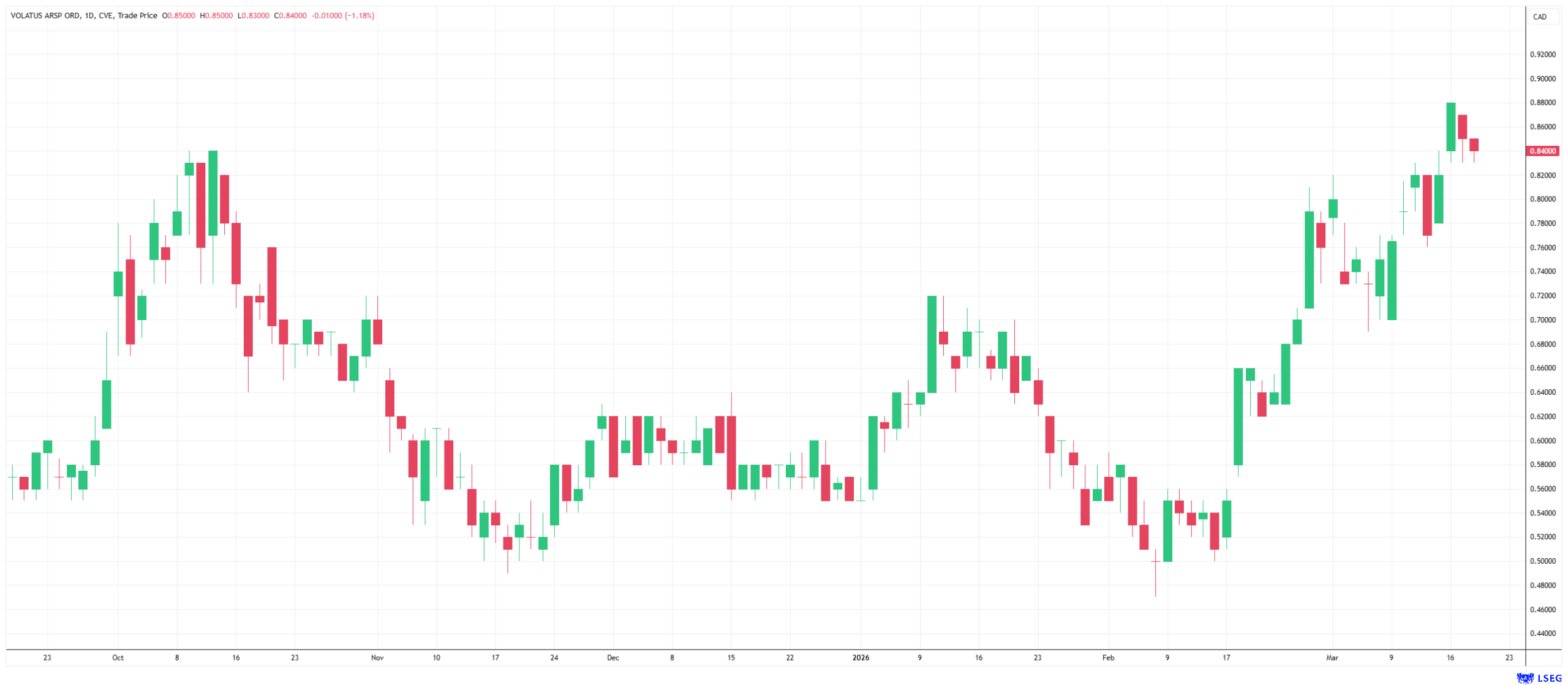
Volatus Aerospace presents itself as a stock with concrete catalysts for the near future. Analysts see significant undervaluation, as Volatus is trading at an enterprise-to-revenue multiple of 7.9x for 2026, while competitors like Ondas reach multiples of 34.3x. A key driver of profitability is the launch of the proprietary software platform SKYDRA, which is designed to simulate defense operations and targets strong gross margins of 80 to 85%. The competition shows where SKYDRA's journey could lead. DroneShield is also succeeding in the software sector. Volatus' management and board of directors hold over 20% of the shares and have not sold any since the IPO. Analysts at Stifel and Ventum Capital Markets see the company at a clear turning point. Analyst Rob Goff of Ventum Capital Markets raised the price target to CAD 0.95, as the market has not fully priced in the capacity at the Mirabel Hub and the billions in Canadian defense spending. Volatus Aerospace stock offers investors the opportunity to benefit from drone investments by militaries worldwide. The average price target of around CAD 1.25 offers strong return potential at current prices.
Volatus is an exciting company because it possesses expertise built up over years and has already demonstrated success in the military sector. Since drones are indispensable in modern warfare, the Canadian company's offerings are taking center stage. In addition to further contracts, the company could also serve as a valuable addition to the portfolios of numerous defense giants. The stock has recently shown strength and aligns with the current market sentiment.
Watch YouTube videoConflict of interest
Pursuant to §85 of the German Securities Trading Act (WpHG), we point out that Apaton Finance GmbH as well as partners, authors or employees of Apaton Finance GmbH (hereinafter referred to as "Relevant Persons") currently hold or hold shares or other financial instruments of the aforementioned companies and speculate on their price developments. In this respect, they intend to sell or acquire shares or other financial instruments of the companies (hereinafter each referred to as a "Transaction"). Transactions may thereby influence the respective price of the shares or other financial instruments of the Company.
In this respect, there is a concrete conflict of interest in the reporting on the companies.
In addition, Apaton Finance GmbH is active in the context of the preparation and publication of the reporting in paid contractual relationships.
For this reason, there is also a concrete conflict of interest.
The above information on existing conflicts of interest applies to all types and forms of publication used by Apaton Finance GmbH for publications on companies.
Risk notice
Apaton Finance GmbH offers editors, agencies and companies the opportunity to publish commentaries, interviews, summaries, news and the like on news.financial. These contents are exclusively for the information of the readers and do not represent any call to action or recommendations, neither explicitly nor implicitly they are to be understood as an assurance of possible price developments. The contents do not replace individual expert investment advice and do not constitute an offer to sell the discussed share(s) or other financial instruments, nor an invitation to buy or sell such.
The content is expressly not a financial analysis, but a journalistic or advertising text. Readers or users who make investment decisions or carry out transactions on the basis of the information provided here do so entirely at their own risk. No contractual relationship is established between Apaton Finance GmbH and its readers or the users of its offers, as our information only refers to the company and not to the investment decision of the reader or user.
The acquisition of financial instruments involves high risks, which can lead to the total loss of the invested capital. The information published by Apaton Finance GmbH and its authors is based on careful research. Nevertheless, no liability is assumed for financial losses or a content-related guarantee for the topicality, correctness, appropriateness and completeness of the content provided here. Please also note our Terms of use.