May 19th, 2026 | 07:35 CEST
556 Drones in One Night: Why the World Needs Volatus Aerospace
In a single night, Ukraine launched more than 550 drones into Russian territory. This marks the heaviest attack on the Moscow region since the beginning of the war. In the Middle East, a drone strikes a nuclear power plant in the UAE, Saudi Arabia intercepts unmanned aerial vehicles over its airspace, and Latvia nearly plunges into a government crisis due to inadequate drone defence. The message is therefore unmistakable: drones have fundamentally changed the global order—and likely permanently so. In this shifted geopolitical landscape, a Canadian company is quietly positioning itself as an increasingly relevant player in this fast-growing market. Volatus Aerospace combines military drone technology with civilian applications. The share price may be approaching a decisive technical turning point, and those who are not paying attention now may risk missing an important opportunity.
time to read: 4 minutes | Author: Matthias Schomber
ISIN: VOLATUS AEROSPACE INC | CA92865M1023 | TSXV: FLT , OTCQB: TAKOF
Table of contents:
Author

Matthias Schomber
Raised in Giessen, Hesse, Matthias Schomber discovered his passion for the financial markets as early as the 1990s—at a time when stock trading was still largely the domain of true, die-hard traders. After completing his banking apprenticeship, he worked for a private bank there and witnessed the rise and fall of the Neuer Markt firsthand on the trading floor of the Frankfurt Stock Exchange, drawing lessons from the experience that continue to shape his thinking as a trader, author, and trading system developer to this day.
Tag cloud
Shares cloud
The World Needs Drones—and Drone Defence Too
The news from the past few days reads like a textbook on modern warfare. On Saturday night, Ukraine launched the largest wave of drones to date against the Moscow region; Russian authorities reported intercepting 556 flying objects. Residential buildings were damaged, an oil depot caught fire, and hundreds of flights at Sheremetyevo Airport were cancelled. At the same time, Ukraine attacked Crimea. Ukrainian President Zelenskyy spoke of a "fully justified" retaliation for Russian attacks in which 24 people were killed in a residential high-rise in Kyiv alone.
In the Middle East, the situation is escalating in parallel. A drone struck a power plant near the Barakah nuclear power plant in the UAE, causing oil prices to rise noticeably. Saudi Arabia shot down three drones entering from Iraq. The Iran conflict is keeping the entire region and energy markets on edge.
But Europe is safe, right? Latvia nearly experienced a full-blown government crisis because misdirected drones repeatedly entered the airspace of the NATO member, and the government had no response. The defence minister and the prime minister resigned. The debate over affordable, efficient drone defence—instead of expensive missiles and fighter jets—has long since begun in Europe.
These are just a few examples from the past few days. They make it clear that modern warfare is impossible without drones—both for attack and for defence.
This is exactly where Volatus Aerospace comes in. In March 2026, the Canadian company launched SKYDRA™, its own software platform for defending against enemy drones. NATO training contracts have already been signed, and a contract with an allied ministry worth CAD 2.1 million is currently in effect. Canada's first national defence industry strategy, which includes CAD 81.8 billion in reinvestment in the armed forces, explicitly names unmanned systems as a priority. And Volatus is ready.
Volatus's Civilian Division
Volatus Aerospace does not just make its money from defence. The company is deeply rooted in everyday civilian life. Power utilities deploy Volatus drones to inspect power lines and wind turbines without requiring technicians to climb towers. In the oil and gas industry, the drones fly over pipelines and report leaks before they become a problem. Mining companies use the technology to survey raw material quantities. This is done quickly, safely, and without risk to the workforce. Bridges, airports, and construction sites are also part of the customer base. What connects all of this is that, even in the civilian sector, drones make dangerous or expensive jobs cheaper and safer. This civilian business operates independently of wars and crises, ensuring Volatus has revenue even in calmer times.
Technical Analysis
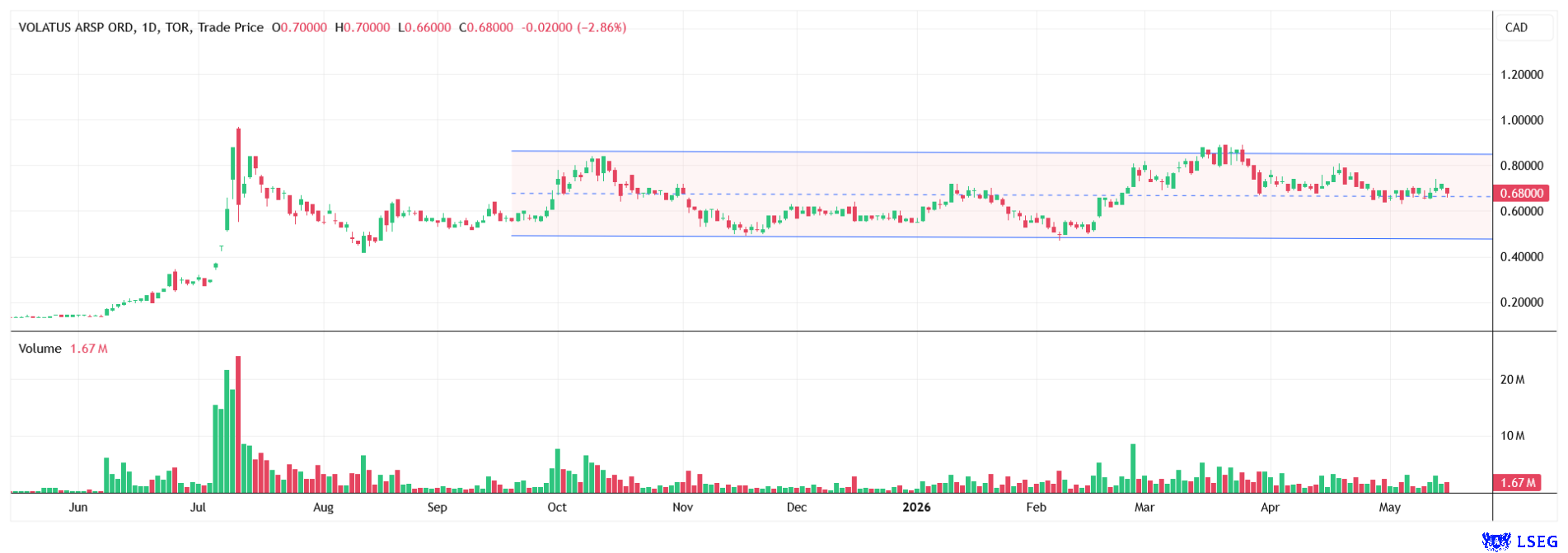
The stock market already largely reflects this potential with a market capitalization of CAD 460 million, though perhaps not entirely. This could make the stock attractive in the future as well, even though some positive price movement has already been priced in. Volatus Aerospace's share price is currently in the middle of a long-term trend channel. This should limit downside risk at the lower edge of the channel while leaving room for upside movement. In a future drone-hype scenario, anything is possible if momentum picks up again. In that case, the first target would be the zone around CAD 0.80. If there is a sustained breakout above CAD 0.80 to 0.84, the path toward CAD 1.00 opens up from a technical perspective. CAD 1.20 would be a realistic technical price target if the channel extends upward. However, the fundamental data must also align with this valuation.
Volatus recently released its first-quarter 2026 results. These painted a mixed but overall constructive picture. Revenue remained stable at CAD 5.6 million, in line with the previous year, though seasonal fluctuations during the Canadian winter must be factored in. What stands out, however, is the gross margin. This climbed to 35%—the highest in the company's history. The adjusted EBITDA loss of approximately CAD 3.2 million is not necessarily a cause for alarm, but rather a reflection of targeted investments in AI research related to the V-Cortex platform and in NATO sales. The liquidity position, on the other hand, is solid at over CAD 31 million, with equity totalling around CAD 62 million.

Conclusion: What to do?
Volatus Aerospace is not a classic blue chip, but rather comparable to a growth bet on one of the most relevant megatrends of our time. The geopolitical demand for drone technology and drone defence, driven by all the wars and conflicts, is genuine, and it is growing daily. The company has the business model, the contracts, and the technology to benefit from this. The market capitalization has already gotten slightly ahead of the fundamentals. Now, upcoming orders and news must meet these expectations.
From a technical perspective, the stock's current position in the middle of the channel offers an interesting starting point with rather limited downside potential from the lower channel boundary. Fundamentally, recent reports indicate that the direction is right, even if the path to overall profitability may still take some time. However, investors who believe in the future of drones should definitely add the share to their watchlist.
For risk-conscious investors with some patience, the current price range could offer a gradual entry opportunity, with a clear focus on the CAD 0.80 level as the first breakout signal. Those waiting for the breakout may end up paying slightly more, but would likely enter the position with stronger momentum. In both cases, the key principle applies: adjust position size to your risk profile, as stocks of this scale can also be highly volatile.
Conflict of interest
Pursuant to §85 of the German Securities Trading Act (WpHG), we point out that Apaton Finance GmbH as well as partners, authors or employees of Apaton Finance GmbH (hereinafter referred to as "Relevant Persons") may hold shares or other financial instruments of the aforementioned companies in the future or may bet on rising or falling prices and thus a conflict of interest may arise in the future. The Relevant Persons reserve the right to buy or sell shares or other financial instruments of the Company at any time (hereinafter each a "Transaction"). Transactions may, under certain circumstances, influence the respective price of the shares or other financial instruments of the Company.
In addition, Apaton Finance GmbH is active in the context of the preparation and publication of the reporting in paid contractual relationships.
For this reason, there is a concrete conflict of interest.
The above information on existing conflicts of interest applies to all types and forms of publication used by Apaton Finance GmbH for publications on companies.
Risk notice
Apaton Finance GmbH offers editors, agencies and companies the opportunity to publish commentaries, interviews, summaries, news and the like on news.financial. These contents are exclusively for the information of the readers and do not represent any call to action or recommendations, neither explicitly nor implicitly they are to be understood as an assurance of possible price developments. The contents do not replace individual expert investment advice and do not constitute an offer to sell the discussed share(s) or other financial instruments, nor an invitation to buy or sell such.
The content is expressly not a financial analysis, but a journalistic or advertising text. Readers or users who make investment decisions or carry out transactions on the basis of the information provided here do so entirely at their own risk. No contractual relationship is established between Apaton Finance GmbH and its readers or the users of its offers, as our information only refers to the company and not to the investment decision of the reader or user.
The acquisition of financial instruments involves high risks, which can lead to the total loss of the invested capital. The information published by Apaton Finance GmbH and its authors is based on careful research. Nevertheless, no liability is assumed for financial losses or a content-related guarantee for the topicality, correctness, appropriateness and completeness of the content provided here. Please also note our Terms of use.