March 5th, 2026 | 07:20 CET
Iran's drones are unstoppable! Volatus Aerospace poised for massive growth!
Images of burning buildings in Dubai, Qatar, and Riyadh are circulating worldwide. With relatively inexpensive drones, Iran is demonstrating just how vulnerable even heavily armed states and major cities are: nothing seems safe – neither military bases nor consulates, neither infrastructure nor residential buildings. While the war in Ukraine has long shown the dominance of unmanned systems, many regions still lack adequate drone defense. This is precisely where Volatus Aerospace comes into play. The Canadian drone specialist is entering the drone defense market while its core business continues to boom - and the stock is on the move again.
time to read: 4 minutes | Author: Fabian Lorenz
ISIN: VOLATUS AEROSPACE INC | CA92865M1023 | TSXV: FLT , OTCQB: TAKOF
Table of contents:
Author

Fabian Lorenz
For more than twenty years, the Cologne native has been intensively involved with the stock market, both professionally and privately. He is particularly passionate about national and international small and micro caps.
Tag cloud
Shares cloud
Sensational news on Monday – Drone defense
On Monday, Volatus unveiled its SKYDRA system: a Software-as-a-Service (SaaS) platform designed to support operational planning and simulation for counter-unmanned aerial systems (C-UAS).
Target customers range from armed forces and public safety agencies to operators of sensitive infrastructure such as airports, ports, and energy facilities. This will allow Volatus to compete in the next billion-dollar market. The global market for drone defense is expected to reach a volume of over USD 20 billion by 2030. Recent global developments leave no doubt about this.
SKYDRA was developed by Volatus to provide customers with a secure virtual environment for conducting structured planning, simulations, and tabletop exercises prior to operational deployment. It is offered as a subscription-based licensing model, enabling Volatus to generate recurring revenue.
Canadian government announces billion-dollar budget for "Build in Canada"
The Canadian drone specialist is also poised for a boom in its core business. The Canadian government is sending a clear signal with a massive defense investment package and a new "Defense Industrial Strategy." "Build in Canada," keep IP in the country, prioritize unmanned and autonomous systems, accelerate procurement, and protect the north. Volatus Aerospace fits perfectly into this framework – and not just since yesterday. In a recent interview with Lyndsay Malchuk from the International Investment Forum, CEO Glen Lynch emphasizes that Volatus did not wait for political tailwinds. Instead, the company secured manufacturing capacity early on, invested in autonomy, and built up strategic drone assets. With the announcement, there is now not only a billion-dollar budget, but also a strategy and an industrial framework that gives companies like Volatus planning security for long-term investments.
https://youtu.be/Ss7fxhBQ16c?si=fdVdwsugFeUTgd8i
Over CAD 600 million: A bulging order pipeline
Volatus has built up an IP portfolio of high-performance drones and is relocating manufacturing to Canada. Lynch sees the announced quota of 70% of procurement for Canadian suppliers as a strong sign. After decades in which a large portion of defense spending went abroad, a domestic ecosystem is now emerging. This is relevant for investors because clearer priorities and a new Defense Investment Agency can improve the prospects for faster award processes and more predictable revenue streams. At the same time, Lynch remains realistic. Headlines alone do not create corporate value – contracts do. And last year, the company already received numerous exciting orders, including from Europe. As a result, the company has a well-filled order pipeline worth over CAD 600 million.
Dual-use partner for military and civilian tasks
Operationally, Volatus positions itself as a dual-use partner for military and civilian tasks. The company is already operating on a large commercial scale, for example, monitoring around 1.7 million km of pipeline per year. Ultimately, it doesn't matter whether a pipeline, power line, border, enemy positions, or coastline is being monitored – it is all about data collection, sensor technology, evaluation, and robust platforms. Even for the Arctic, Volatus offers a performance-graded fleet that is specifically hardened for the Canadian north, according to Lynch. Systems with around 10 hours of operation, heavy-fuel platforms with up to 35 hours, and endurance lasting several days. When it comes to global scaling, Volatus aims to master the balancing act between growth and sovereignty through consistent IP management. The basis for this is the approximately 14 active patents. The bottom line is that the interview paints a picture of a company that is not "going along for the ride" in the new Canadian defense cycle, but is structurally positioned – and whose greatest opportunity now lies in putting the new strategic situation into practice.
When will analysts' price targets rise?
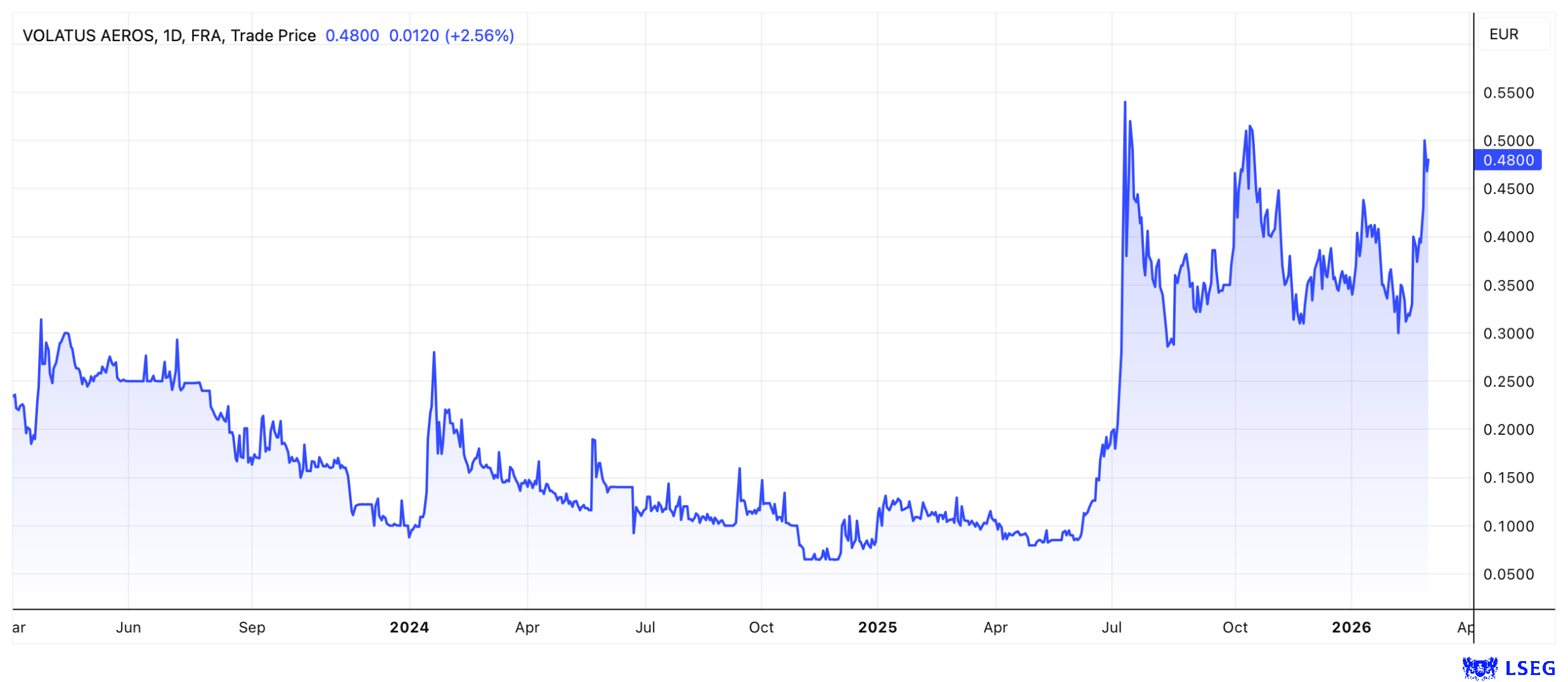
Volatus shares rebounded in mid-February and are currently trading at around CAD 0.75 again. In July 2025, they were trading at almost CAD 1. Today, the company is much further ahead in terms of operations and strategy. Analysts at Maxim Group see the fair value at CAD 1.25. However, the study is from the end of 2025. Against the backdrop of excellent prospects in the domestic market, but also in the entire NATO area, new analyst studies are likely to be published soon. These should give the stock, which is also actively traded in Germany and recently moved up from the TSX Venture Exchange to the Toronto Stock Exchange ("TSX") on its home exchange, an additional boost. The experts at researchanalyst.com recently titled their update on Volatus "Drone supercycle meets undervaluation." The stock market still underestimates Volatus. Artificial intelligence, manufacturing, and the training of drone pilots are the next growth drivers. Click here for the article.
Conclusion: Huge opportunities in the drone supercycle
There is a lot to suggest that Volatus' share price will continue to rise. Over the past year, the company has been preparing intensively for the opportunities presented by the drone supercycle. The growth opportunities are huge in both the military and civilian sectors. The order pipeline of over CAD 600 million shows where sales growth could be headed. The entry into drone defense comes at exactly the right time.
Conflict of interest
Pursuant to §85 of the German Securities Trading Act (WpHG), we point out that Apaton Finance GmbH as well as partners, authors or employees of Apaton Finance GmbH (hereinafter referred to as "Relevant Persons") may hold shares or other financial instruments of the aforementioned companies in the future or may bet on rising or falling prices and thus a conflict of interest may arise in the future. The Relevant Persons reserve the right to buy or sell shares or other financial instruments of the Company at any time (hereinafter each a "Transaction"). Transactions may, under certain circumstances, influence the respective price of the shares or other financial instruments of the Company.
In addition, Apaton Finance GmbH is active in the context of the preparation and publication of the reporting in paid contractual relationships.
For this reason, there is a concrete conflict of interest.
The above information on existing conflicts of interest applies to all types and forms of publication used by Apaton Finance GmbH for publications on companies.
Risk notice
Apaton Finance GmbH offers editors, agencies and companies the opportunity to publish commentaries, interviews, summaries, news and the like on news.financial. These contents are exclusively for the information of the readers and do not represent any call to action or recommendations, neither explicitly nor implicitly they are to be understood as an assurance of possible price developments. The contents do not replace individual expert investment advice and do not constitute an offer to sell the discussed share(s) or other financial instruments, nor an invitation to buy or sell such.
The content is expressly not a financial analysis, but a journalistic or advertising text. Readers or users who make investment decisions or carry out transactions on the basis of the information provided here do so entirely at their own risk. No contractual relationship is established between Apaton Finance GmbH and its readers or the users of its offers, as our information only refers to the company and not to the investment decision of the reader or user.
The acquisition of financial instruments involves high risks, which can lead to the total loss of the invested capital. The information published by Apaton Finance GmbH and its authors is based on careful research. Nevertheless, no liability is assumed for financial losses or a content-related guarantee for the topicality, correctness, appropriateness and completeness of the content provided here. Please also note our Terms of use.