May 13th, 2026 | 07:30 CEST
Takeover at Bayer! Shock at Rheinmetall! Opportunity for MustGrow Stock!
Created and published on behalf of MustGrow Biologics Corp.
The blockade of the Strait of Hormuz is turning into a stress test for global food security. Supply chains across the fertilizer industry are coming under pressure — and this could create a significant opportunity for MustGrow Biologics. The company's organic biological fertilizer (biofertilizer) is being approved in an increasing number of US states. And in the field of biological crop protection, they are collaborating with Bayer. Meanwhile, Rheinmetall is grappling with disappointed market expectations. Revenues at the defence contractor are simply not growing fast enough, although the company continues to modernize its product portfolio.
time to read: 4 minutes | Author: Fabian Lorenz
ISIN: MUSTGROW BIOLOGICS CORP. | CA62822A1030 | TSXV: MGRO , OTCQB: MGROF , BAYER AG NA O.N. | DE000BAY0017 , RHEINMETALL AG | DE0007030009
Table of contents:
Author

Fabian Lorenz
For more than twenty years, the Cologne native has been intensively involved with the stock market, both professionally and privately. He is particularly passionate about national and international small and micro caps.
Tag cloud
Shares cloud
MustGrow: Bayer Partner Poised for a Breakthrough in 2026
The blockade of the Strait of Hormuz is far more than just an energy crisis. It is also becoming a stress test for global food security. The Persian Gulf region is also one of the world's key exporters of sulphur and urea—both essential raw materials for fertilizer production. Supply disruptions could therefore have consequences ranging from lower crop yields to severe food supply shortages. Against this backdrop, TerraSante, the biofertilizer product developed by MustGrow Biologics, is becoming increasingly relevant.
TerraSante is based on mustard plants and addresses one of the biggest trends in modern agriculture: more sustainable and efficient soil management. The biological powder is designed to improve soil quality and the soil microbiome, increase nutrient and water efficiency, and ultimately enable higher crop yields over the long term. Particularly noteworthy is that the product contains no artificial additives or preservatives and complies with the strict OMRI and California OIM standards for organic agriculture.
After generating initial revenue last year—which could have been even higher had the product not temporarily sold out—the company is now aiming for a major commercial breakthrough in 2026. To that end, MustGrow is currently focusing heavily on the US market. As one of the world's most attractive fertilizer markets, it represents an estimated annual market volume of around USD 3.5 billion. Initially, MustGrow is targeting a market share of approximately 3%, equivalent to potential annual revenue of around USD 100 million. By comparison, the company is currently valued at roughly CAD 35 million.
Most recently, TerraSante received distribution approval in the state of Georgia. This is a significant step for MustGrow, as Georgia is one of the leading agricultural regions in the US—particularly for peanuts, pecans, and blueberries. In addition to Georgia, TerraSante is now also registered in California, Arizona, Idaho, Oregon, Washington, and Florida.
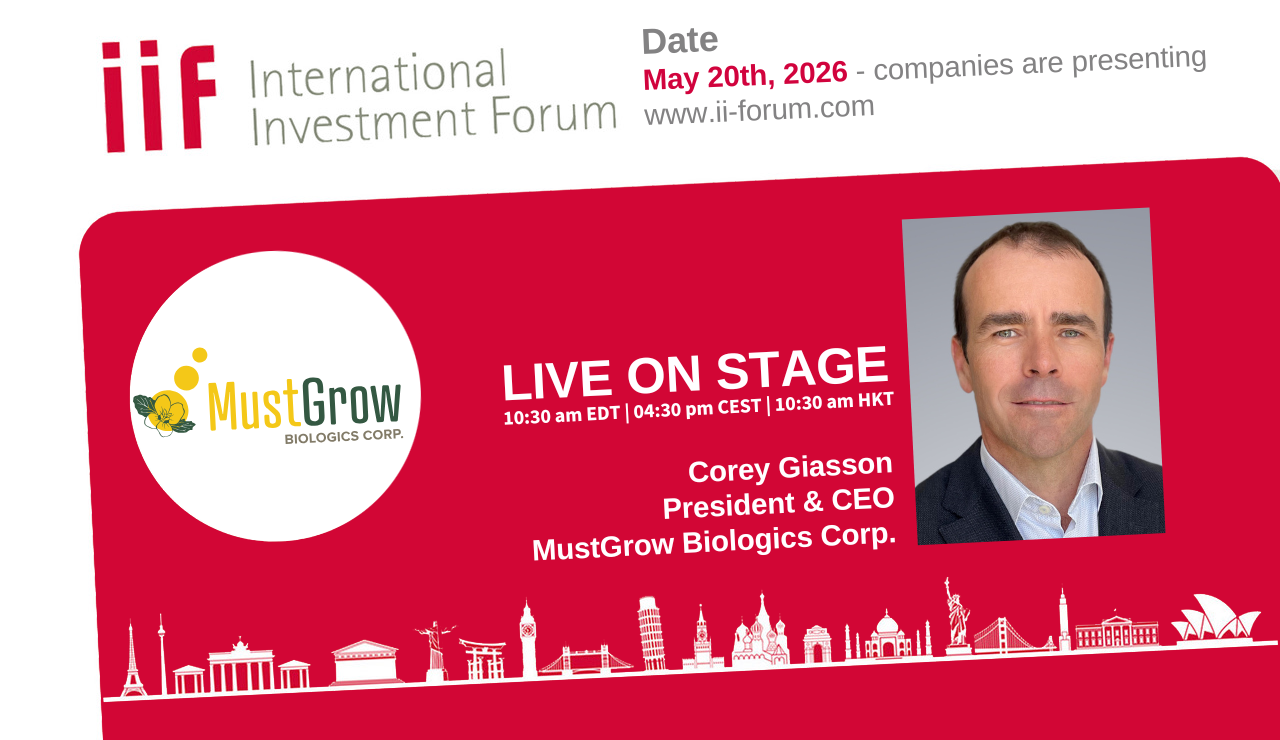
May 20, 2026, could prove particularly interesting for investors. On that date, MustGrow President & CEO Corey Giasson will present at the virtual International Investment Forum (IIF), where the company is expected to provide further updates on its commercial development.
At the international level, MustGrow is working together with local companies to expand TerraSante's footprint. And in the field of biological crop protection, the company is collaborating with Bayer. The product, TerraMG™, is currently in the regulatory approval phase.
Bayer: Acquisition in the Pharmaceutical Sector
Bayer has secured licensing rights to MustGrow's ecological biopesticide TerraMG for Europe, Africa, and the Middle East. The Leverkusen-based company is even covering the regulatory approval costs for these regions, which are reportedly expected to amount to a double-digit million-dollar figure. Bayer's financial strength — and its willingness to fully acquire strategic partners in some cases — was once again recently underscored.
The Leverkusen-based company plans to acquire Perfuse Therapeutics for up to USD 2.45 billion. Bayer will initially pay USD 300 million upfront, with additional milestone payments tied to development, regulatory approvals, and commercial progress. Perfuse is a US biotech company focused on eye diseases and is developing PER-001, a novel drug targeting glaucoma and diabetic retinopathy. The drug is already in Phase II clinical trials and aims not only to treat symptoms but potentially to influence the progression of the disease itself.
Bayer shares are currently working on finding a bottom around EUR 37. In mid-February, the stock had reached a multi-year high of EUR 50 but was unable to sustain that level. Last Friday, analysts reaffirmed their "Buy" recommendation and set a fair value of EUR 52. They point to expert commentary favourable to Bayer ahead of the US Supreme Court's upcoming decision on glyphosate.
Rheinmetall: Battling Disappointment
Rheinmetall's stock has been a tragedy this year. The stock of Germany's largest defence contractor has lost around 30% of its value in 2026. The most recent setback occurred last Friday, when the stock lost about 9% and closed at just over EUR 1,200. JPMorgan was the catalyst. Analysts had slashed their price target from EUR 2,130 to EUR 1,500. The recommendation was downgraded from "Overweight" to "Neutral." From the analysts' perspective, the DAX-listed company is failing to execute its high-order backlog operationally. As a result, it has repeatedly missed expectations in recent quarters. Consequently, the analysts reduced their estimates for the coming years.
In addition, there are growing voices criticizing the Düsseldorf-based company's product portfolio. It is said to be too heavily focused on "old-style" warfare. The latest announcement marks a step toward the modern world. Rheinmetall plans to produce cruise missiles in the future. This is particularly interesting, as the German government has so far been unsuccessful in its efforts to purchase "Tomahawk" cruise missiles from the US. Rheinmetall plans to begin production of the "Ruta 2" at its Unterlüß site before the end of this year. The cruise missile was developed in collaboration with the Dutch defence firm Destinus and has a range of approximately 700 km.
The environment for rising demand at MustGrow appears highly favourable. If revenue picks up in the coming months, the stock could enter a revaluation phase. At Bayer, investors are closely awaiting the decision from the US Supreme Court, which is likely to drive the stock decisively in one direction or the other. At Rheinmetall, sentiment is currently strongly negative. However, the stock increasingly appears technically oversold.
Conflict of interest
Pursuant to §85 of the German Securities Trading Act (WpHG), we point out that Apaton Finance GmbH as well as partners, authors or employees of Apaton Finance GmbH (hereinafter referred to as "Relevant Persons") may hold shares or other financial instruments of the aforementioned companies in the future or may bet on rising or falling prices and thus a conflict of interest may arise in the future. The Relevant Persons reserve the right to buy or sell shares or other financial instruments of the Company at any time (hereinafter each a "Transaction"). Transactions may, under certain circumstances, influence the respective price of the shares or other financial instruments of the Company.
In addition, Apaton Finance GmbH is active in the context of the preparation and publication of the reporting in paid contractual relationships.
For this reason, there is a concrete conflict of interest.
The above information on existing conflicts of interest applies to all types and forms of publication used by Apaton Finance GmbH for publications on companies.
Risk notice
Apaton Finance GmbH offers editors, agencies and companies the opportunity to publish commentaries, interviews, summaries, news and the like on news.financial. These contents are exclusively for the information of the readers and do not represent any call to action or recommendations, neither explicitly nor implicitly they are to be understood as an assurance of possible price developments. The contents do not replace individual expert investment advice and do not constitute an offer to sell the discussed share(s) or other financial instruments, nor an invitation to buy or sell such.
The content is expressly not a financial analysis, but a journalistic or advertising text. Readers or users who make investment decisions or carry out transactions on the basis of the information provided here do so entirely at their own risk. No contractual relationship is established between Apaton Finance GmbH and its readers or the users of its offers, as our information only refers to the company and not to the investment decision of the reader or user.
The acquisition of financial instruments involves high risks, which can lead to the total loss of the invested capital. The information published by Apaton Finance GmbH and its authors is based on careful research. Nevertheless, no liability is assumed for financial losses or a content-related guarantee for the topicality, correctness, appropriateness and completeness of the content provided here. Please also note our Terms of use.