April 8th, 2026 | 07:30 CEST
From pipeline inspections to defense contracts to drone defense: Why Volatus Aerospace Is Undervalued
Some stocks have two sides. Volatus Aerospace operates a dual-engine business model: a commercial services division generating stable, recurring revenue from energy and infrastructure inspections, and a rapidly expanding defense segment benefiting from NATO contracts and Canada's evolving defense strategy. While many drone companies either sell only hardware or offer only services, Volatus has combined both under one roof. And with a decisive advantage: NATO is right there in the cockpit.
time to read: 4 minutes | Author: Armin Schulz
ISIN: VOLATUS AEROSPACE INC | CA92865M1023 | TSXV: FLT , OTCQB: TAKOF
Table of contents:
Author

Armin Schulz
Born in Mönchengladbach, he studied business administration in the Netherlands. In the course of his studies he came into contact with the stock exchange for the first time. He has more than 25 years of experience in stock market business.
Tag cloud
Shares cloud
Volatus Aerospace's Strategy
Volatus Aerospace is often perceived as a drone manufacturer, but this understates the scope of its integrated platform. The company emerged from the 2024 merger with Drone Delivery Canada and has since integrated 19 firms, including the British manufacturer Caliburn with its long-range platforms V100, V200, and V300, as well as, most recently, the remaining shares in Synergy Aviation. The result is a fully integrated platform combining manned and unmanned aviation, in-house manufacturing in Mirabel (Québec), proprietary autonomy software, and a centralized Operations Control Center in Vaughan. From there, missions can be controlled worldwide, provided local authorities give their approval.
Engine 1: Commercial Footing with Global Training
Services provide the stable foundation. In 2025, the services segment generated CAD 17.9 million in revenue, driven primarily by pipeline and power grid inspections, with over 75,000 cumulative flight hours. A multi-year contract with a major North American power grid operator runs through 2028. In addition, there is an offshore wind pilot project using heavy-lift drones weighing up to 100 kg, which could generate approximately USD 20 million annually if the rollout is successful.
At the same time, Volatus is expanding its training business. At the end of March 2026, a strategic partnership was established with the University of Technology, Jamaica. The program focuses on disaster response and begins with an online course, followed by practical exercises on the Kingston campus. Participants are prepared for operations such as emergency response, damage assessment, and mission planning. The company has already trained over 100,000 people worldwide.
Engine 2: NATO as a Turbo
The defense division grew by 106% in 2025 to CAD 16.3 million. Europe and the UK saw a 150% increase. A NATO contract worth up to CAD 9 million for an ISR training system was signed in December. In February 2026, another contract followed from a NATO partner for drone training in extreme environments.
The company's strategic alignment with NATO was further reinforced in March with the appointment of Major General Gary Deakin (CBE) to the Advisory Board, a former senior leader in both the British Army and NATO. Deakin served in the British Army and at NATO for over three decades, including as Chief of Staff in NATO command structures. He joins an existing panel of high-ranking Canadian military officers, including the former Commander of the Canadian Army and a former Deputy Commander of NORAD.
New Partnership for Interceptor Drones
Also in late March, Volatus signed a Memorandum of Understanding with Sentinel R&D Inc., a Canadian specialist in advanced composite drone structures. The goal is to develop a Canadian interceptor UAV platform designed for counter-drone applications. Sentinel is contributing airframe engineering and composite manufacturing, while Volatus is providing system integration, autonomy software, testing, and commercialization. The collaboration aims to strengthen domestic production capacity for unmanned systems and fits perfectly into the national defense strategy.
The Domestic Market is Catching Up
Canada introduced its Defense Industrial Strategy at the end of 2025. A total of CAD 81.8 billion is to be invested in the defense sector. The new procurement agency has been tasked with awarding 70% of this spending to domestic companies. Unmanned and autonomous systems have been officially classified as "core sovereign capabilities". The Department of Defense's Borealis program aims to purchase up to 10,000 drones per month from three suppliers in the long term. Volatus has reached Phase 1.
In April 2026, the US presented a record defense budget of USD 1.5 trillion; analysts estimate that approximately USD 63 billion of this will go toward unmanned systems, a massive increase from USD 10 billion the previous year. As a NATO partner and with its "Made in Canada" manufacturing, Volatus is well-positioned to benefit indirectly.
Technology and Funding
The company possesses a robust patent portfolio covering core system architectures and operating methods. It also has a proprietary autonomy platform that operates without GPS. In March, the company also launched SKYDRA™, its first SaaS platform for drone defense. It is cloud-based and aims to generate recurring software revenue with margins of 80–85%.
Also in March, Volatus received funding of up to CAD 320,000 from the National Research Council of Canada Industrial Research Assistance Program (NRC-IRAP). The funds will go toward the development of the Condor XL, a heavy-lift drone system for logistics, infrastructure support, and emergency response. Funding will support avionics architecture, autonomy integration, and flight validation. The project will run until early 2027.
Financial Housework Done
The balance sheet was transformed in 2025. Cash on hand rose from CAD 1.6 million to CAD 41.1 million. Working capital improved from a deficit of CAD 8.4 million to a surplus of CAD 36.5 million. Total assets grew by 60% to CAD 92.7 million. At the same time, the EBITDA loss decreased by 25%.
The Valuation Question
Analysts see significant potential. Ventum Capital Markets sets a price target of CAD 0.95. Haywood estimates CAD 1.00. Desjardins is higher with a range of CAD 1.10 to 1.25. The Maxim Group sets the most ambitious target at CAD 1.25, while Stifel remains the most cautious at CAD 0.85. The valuation gap relative to US peers in the defense drone segment remains strikingly large.
The stock is currently trading at CAD 0.73.
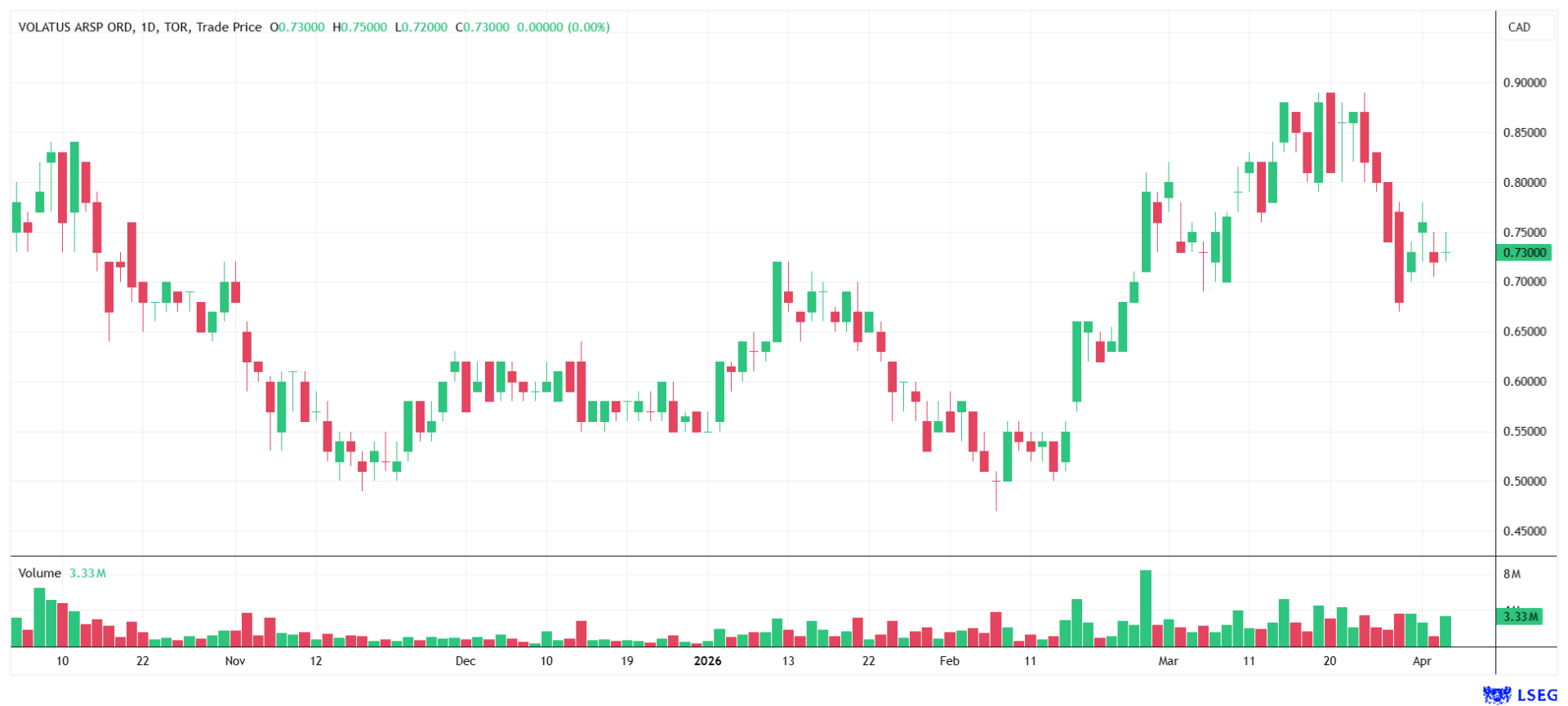
Volatus Aerospace has established multiple revenue streams, including commercial services with predictable revenue, as well as NATO contracts and Canada's new defense strategy as growth drivers. The latest news from March—the Sentinel partnership, training in Jamaica, the appointment of a NATO general, and non-dilutive funding—demonstrates systematic expansion. The balance sheet is clean, and the technology is proprietary. Investors focusing on the intersection of civil aviation, autonomous systems, and the NATO alliance will find a structural investment opportunity here.
Conflict of interest
Pursuant to §85 of the German Securities Trading Act (WpHG), we point out that Apaton Finance GmbH as well as partners, authors or employees of Apaton Finance GmbH (hereinafter referred to as "Relevant Persons") currently hold or hold shares or other financial instruments of the aforementioned companies and speculate on their price developments. In this respect, they intend to sell or acquire shares or other financial instruments of the companies (hereinafter each referred to as a "Transaction"). Transactions may thereby influence the respective price of the shares or other financial instruments of the Company.
In this respect, there is a concrete conflict of interest in the reporting on the companies.
In addition, Apaton Finance GmbH is active in the context of the preparation and publication of the reporting in paid contractual relationships.
For this reason, there is also a concrete conflict of interest.
The above information on existing conflicts of interest applies to all types and forms of publication used by Apaton Finance GmbH for publications on companies.
Risk notice
Apaton Finance GmbH offers editors, agencies and companies the opportunity to publish commentaries, interviews, summaries, news and the like on news.financial. These contents are exclusively for the information of the readers and do not represent any call to action or recommendations, neither explicitly nor implicitly they are to be understood as an assurance of possible price developments. The contents do not replace individual expert investment advice and do not constitute an offer to sell the discussed share(s) or other financial instruments, nor an invitation to buy or sell such.
The content is expressly not a financial analysis, but a journalistic or advertising text. Readers or users who make investment decisions or carry out transactions on the basis of the information provided here do so entirely at their own risk. No contractual relationship is established between Apaton Finance GmbH and its readers or the users of its offers, as our information only refers to the company and not to the investment decision of the reader or user.
The acquisition of financial instruments involves high risks, which can lead to the total loss of the invested capital. The information published by Apaton Finance GmbH and its authors is based on careful research. Nevertheless, no liability is assumed for financial losses or a content-related guarantee for the topicality, correctness, appropriateness and completeness of the content provided here. Please also note our Terms of use.