January 29th, 2026 | 07:40 CET
Flight to substance: How Chevron, Hapag-Lloyd, and RE Royalties are weatherproofing portfolios
Many investors are currently experiencing a vague sense of unease when they look at their portfolios. On paper, the returns of recent years look fantastic, driven by an unprecedented boom in artificial intelligence (AI). But when taking a closer look, one can see the cluster risk: The MSCI World, once synonymous with broad diversification, is now effectively a technology fund. Giants such as NVIDIA, Apple, and Microsoft dominate the indices to such an extent that a correction in the tech sector would drag down the entire portfolio. In this phase of market saturation, with valuations running high and global politics seeming more unpredictable than ever, investors are returning to an old virtue: cash flow. Dividend stocks are back in vogue – not as a boring addition, but as an indispensable anchor. We analyse three companies that promise stability in this environment: the indestructible energy giant Chevron, the logistics group Hapag-Lloyd, and the Canadian energy specialist RE Royalties, which has established a particularly smart model.
time to read: 3 minutes | Author: Nico Popp
ISIN: CHEVRON CORP. DL-_75 | US1667641005 , HAPAG-LLOYD AG NA O.N. | DE000HLAG475 , RE ROYALTIES LTD | CA75527Q1081
Table of contents:
Author

Nico Popp
At home in Southern Germany, the passionate stock exchange expert has been accompanying the capital markets for about twenty years. With a soft spot for smaller companies, he is constantly on the lookout for exciting investment stories.
Tag cloud
Shares cloud
Chevron as a fortress in the energy storm
When it comes to financial robustness, Chevron is something of a rock in the surf. In recent years, the US energy giant has imposed an operational discipline that is second to none. As current analyses show, the group's breakeven point – the oil price at which dividends and investments are covered – is just over USD 50 per barrel. This means that even if the energy markets collapse, Chevron will still be making money while its competitors are already in the red.
For investors looking for stable returns, this is the most important metric of all. Chevron does not use its stable cash flows for expensive adventures, but consistently returns them to its shareholders. In a world where the International Energy Agency (IEA) forecasts growing supply but geopolitical conflicts are supporting prices, Chevron is the ultimate insurance policy. It is betting on the physical reality that the global economy would still grind to a halt without oil and gas.
Hapag-Lloyd as a beneficiary of the complex global situation
Hapag-Lloyd enjoys a similar status, albeit in a more cyclical environment. The long-established Hamburg-based shipping company has used the boom years of the pandemic to restructure its balance sheet and build up a war chest. The ongoing tensions in the Red Sea and the reorganization of global trade routes are playing into the hands of the major liner shipping companies, as scarcity is keeping freight rates high.
With the cooperation that Hapag-Lloyd has entered into with Maersk under the code name "Gemini," the Company is cementing its claim to operational excellence.
Although profits in shipping fluctuate more than in the energy sector, Hapag-Lloyd has proven that it can pay generous dividends even in rough seas. For investors, the stock is a bet that global trade in goods will continue to grow despite all the doom and gloom, and that capacity will remain tight.
RE Royalties: Profiting from the energy transition
While Chevron and Hapag-Lloyd represent the old economy, RE Royalties brings a breath of fresh air to the portfolio – with a business model that combines the security of infrastructure with the returns of private equity. The Canadian company finances renewable energy projects in the areas of wind, solar, and storage. To do this, the Company does not rely on loans, but on so-called royalties. The principle is ingeniously simple: RE Royalties provides project developers with capital and, in return, receives a fixed percentage of gross revenue – before operating costs are deducted.
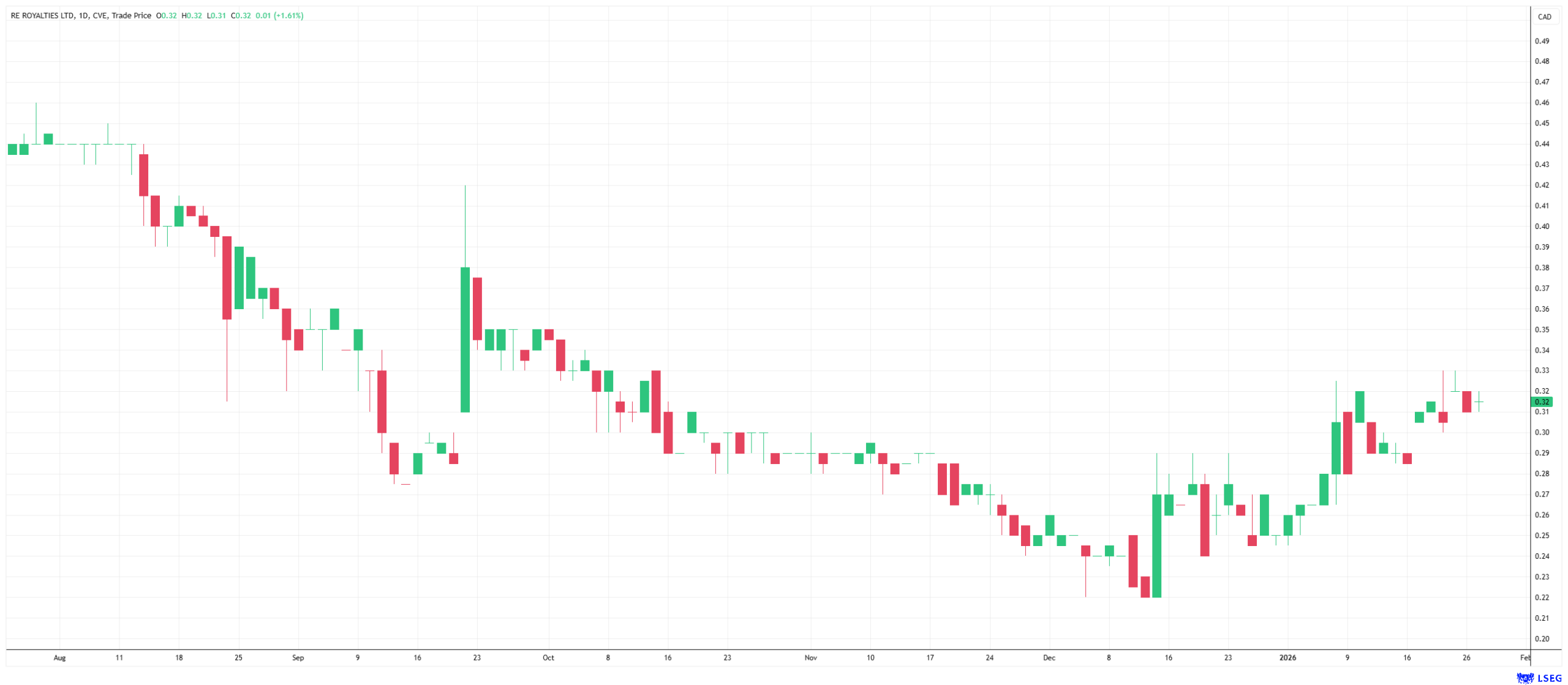
This model eliminates the typical operator risk for RE Royalties. If a gearbox breaks down at a wind farm or maintenance costs rise, that is the operator's problem, not RE Royalties'. The revenue flows as long as the electricity flows. **The Company thus closes a critical gap in the market, as banks are often too inflexible for medium-sized projects. Operators of wind and solar farms are therefore often dependent on the support of players such as RE Royalties. The key figures speak for themselves. The portfolio is now broadly diversified across various technologies and jurisdictions in North America and Europe, which minimizes cluster risks. For dividend hunters, RE Royalties is an exciting hybrid: you get the stable distributions that are otherwise only offered by utilities, but at the same time have the growth potential of a specialized financier. The stock currently offers a dividend yield of around 12%.
Conclusion: Stability through diversification
Those who want to protect their portfolio against a tech crash need assets that generate real returns. Chevron provides the basic supply, Hapag-Lloyd the logistical leverage, and RE Royalties the smart and significantly greener returns. As a small-cap, the stock is more volatile than an oil multinational and therefore more suited to speculative investors, but the model of secure income streams is a strong argument, especially in uncertain times. The market is increasingly seeing it this way, too – the stock has been rising again for some time.
Watch YouTube videoConflict of interest
Pursuant to §85 of the German Securities Trading Act (WpHG), we point out that Apaton Finance GmbH as well as partners, authors or employees of Apaton Finance GmbH (hereinafter referred to as "Relevant Persons") may hold shares or other financial instruments of the aforementioned companies in the future or may bet on rising or falling prices and thus a conflict of interest may arise in the future. The Relevant Persons reserve the right to buy or sell shares or other financial instruments of the Company at any time (hereinafter each a "Transaction"). Transactions may, under certain circumstances, influence the respective price of the shares or other financial instruments of the Company.
In addition, Apaton Finance GmbH is active in the context of the preparation and publication of the reporting in paid contractual relationships.
For this reason, there is a concrete conflict of interest.
The above information on existing conflicts of interest applies to all types and forms of publication used by Apaton Finance GmbH for publications on companies.
Risk notice
Apaton Finance GmbH offers editors, agencies and companies the opportunity to publish commentaries, interviews, summaries, news and the like on news.financial. These contents are exclusively for the information of the readers and do not represent any call to action or recommendations, neither explicitly nor implicitly they are to be understood as an assurance of possible price developments. The contents do not replace individual expert investment advice and do not constitute an offer to sell the discussed share(s) or other financial instruments, nor an invitation to buy or sell such.
The content is expressly not a financial analysis, but a journalistic or advertising text. Readers or users who make investment decisions or carry out transactions on the basis of the information provided here do so entirely at their own risk. No contractual relationship is established between Apaton Finance GmbH and its readers or the users of its offers, as our information only refers to the company and not to the investment decision of the reader or user.
The acquisition of financial instruments involves high risks, which can lead to the total loss of the invested capital. The information published by Apaton Finance GmbH and its authors is based on careful research. Nevertheless, no liability is assumed for financial losses or a content-related guarantee for the topicality, correctness, appropriateness and completeness of the content provided here. Please also note our Terms of use.