May 6th, 2026 | 07:25 CEST
Countdown to a Tungsten Shortage: Why Almonty Industries Is Reaping Disproportionate Benefits Right Now
By mid-2026, the chip industry could be in a tight spot. Not because of a lack of factories, but because of a gas that hardly anyone knows about: tungsten hexafluoride (WF6). Japanese suppliers have warned Korean semiconductor companies. Their own stockpiles will only last until summer. Not because the world is ending. But because China is steadily turning off the tungsten tap. One company has long been positioned to fill the gap: Almonty Industries. Those looking to invest in tungsten can hardly avoid this key supplier.
time to read: 4 minutes | Author: Armin Schulz
ISIN: ALMONTY INDUSTRIES INC. | CA0203987072 | TSX: AII , NASDAQ: ALM , ASX: AII
Table of contents:
Author

Armin Schulz
Born in Mönchengladbach, he studied business administration in the Netherlands. In the course of his studies he came into contact with the stock exchange for the first time. He has more than 25 years of experience in stock market business.
Tag cloud
Shares cloud
Japanese WF6 Warning
When Japanese WF6 manufacturers like Kanto Denka Kogyo and Central Glass approached Samsung Electronics and DB HiTek a few weeks ago, it initially sounded like a technical detail. But the Japanese companies' message carried serious weight. Existing WF6 stocks are expected to last only until the middle of the year. They advised their Korean customers to switch to domestic suppliers such as SK Specialty or Foosung.
This is not a done deal, but a concrete supply warning. Because WF6 is not just any gas; it is the means of transporting tungsten into chip manufacturing. The metal is used to vapour-deposit an ultra-thin layer onto silicon wafers, creating the electrical pathways in high-performance memory chips. 3D NAND chips, with their vertically stacked cells, are particularly reliant on tungsten. No WF6 means no large AI models; no tungsten means no gas.
The weak link in the chain is obvious. China controls around 80% of the world's tungsten powder. Anyone manufacturing WF6 in Japan or Korea is dependent on Chinese raw materials. Beijing's export licenses, in place since February 2025, and the tightened dual-use regulations, in place since January 2026, have throttled supply. An industry expert summed it up at the end of March: Helium can still be sourced in the US or Russia—but when it comes to tungsten, there is ultimately no way around China.
Almonty: The Western Producer with Perfect Timing
This is exactly where Almonty Industries comes in. Over the past 10 years, the company has quietly continued to develop its projects. On March 16, Almonty announced the completion of the Phase 1 commissioning of the Sangdong mine in South Korea. In total, the facility can currently process 640,000 tons of ore annually, and delivers approximately 230,000 MTU of tungsten concentrate per year. A second expansion phase is planned for 2027 and is expected to double capacity. Just one day later, the official inauguration ceremony took place, attended by over 200 South Korean political dignitaries and representatives from the US Embassy, underscoring the importance of Sangdong.
Just two days after the ceremony, Almonty released its quarterly results. Revenue in Q4 2025 rose by 39% to CAD 8.7 million. While adjusted cash flow remained negative, this was primarily due to one-time administrative costs related to the IPO and acquisitions. Financing is the key factor. At the end of 2025, Almonty held CAD 268.4 million in cash and cash equivalents, raised through two oversubscribed capital increases in July and December 2025.
Tungsten Beyond Rockets and Drills
The WF6 shortage is merely the latest symptom of a deeper-rooted shift. Tungsten is no longer used solely for carbide tools or armour-piercing ammunition. Its applications have expanded rapidly, and Almonty is benefiting from every single one of these developments.
As mentioned earlier, tungsten is the material of choice for the semiconductor industry for vertical interconnects in 3D NAND chips.
Tungsten is being rediscovered in the aerospace sector. Rocket nozzles, heat shields, and radiation components benefit from its extremely high melting point of over 3,400 degrees Celsius. Morgan Stanley recently added Almonty to a list of 60 aerospace suppliers, as the only pure-play tungsten company.
Defence remains the biggest driver of demand. A report by Foreign Policy in early April highlighted that the US military relies on tungsten and that supplies could be running low. The US has not produced commercial tungsten since 2015, and the Pentagon's ban on Chinese tungsten in defence equipment takes effect in 2027. This opens a strategic window for Almonty.
Even the energy transition is increasingly turning to tungsten. Leading battery manufacturers are testing tungsten oxide coatings to improve the longevity of lithium-ion cells.
The Move to Montana and Analysts' Reaction
In mid-April, Almonty played a remarkable strategic card. The company relocated its headquarters from Toronto to Dillon, Montana. That is, directly to the Gentung Tungsten Project, which is scheduled to begin production as early as 2026. Management explained that the move was not merely symbolic but reflected where the company's future lies. With its Nasdaq listing, fresh capital, and the appointment of former US Army generals as directors, Almonty has unmistakably positioned itself as a US-aligned producer.
Analysts followed suit. Cantor Fitzgerald raised its price target to USD 25.80, Bank of America to USD 20, and DA Davidson to USD 25. The consensus reasoning was that Almonty is no longer an exploration company but an operational producer with a clear growth pipeline.
What the Numbers Really Say
The high balance sheet losses in 2025, totalling approximately CAD 162 million, are alarming at first glance. However, they were largely caused by non-cash revaluations of convertible bonds, a consequence of the rapid rise in the stock price from CAD 1.36 to CAD 12.07 over the course of the year. Operating cash flow remains unaffected by this.
More important are the projections. If the targets of 230,000 MTU of tungsten in Sangdong are met and the price remains at USD 3,140 per MTU, revenues will exceed USD 700 million for 2026. If Phase 2 of the Sangdong expansion and the commissioning of the Montana project go according to plan, the value for 2027 could even exceed USD 1 billion.
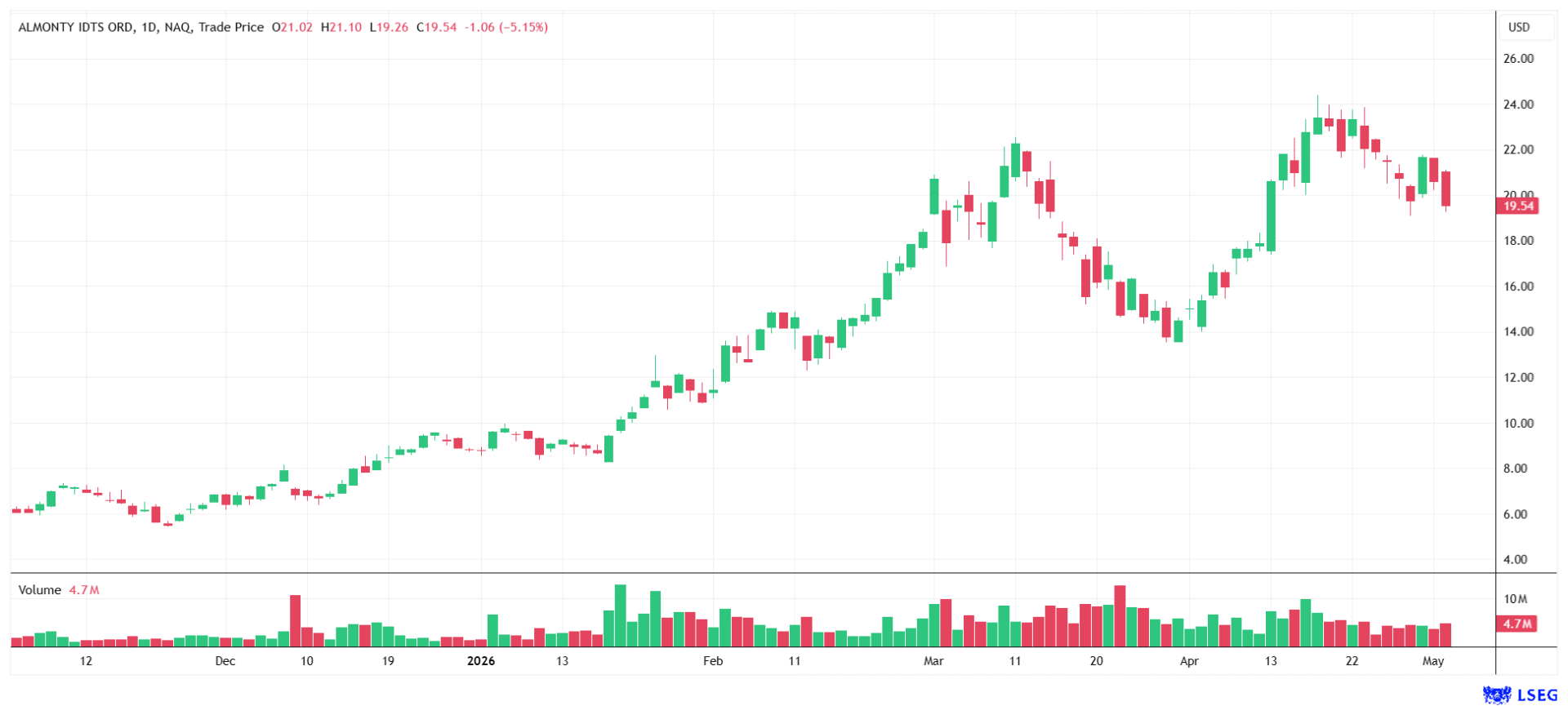
The stock is currently trading at USD 19.54, giving it a market capitalization of approximately USD 5.5 billion.
The WF6 warning from Japan is not the end of the world, but rather a sign of a system under strain. Tungsten is needed everywhere, from AI chips to space travel to armour. Almonty Industries is the first producer outside of China to reach a scale that Western suppliers can rely on. The mine is operational, the coffers are full, and the headquarters are now in the US. Investors betting on the restructuring of critical supply chains will find here one of the few true tungsten players. The coming quarters will reveal the operational implementation.
Conflict of interest
Pursuant to §85 of the German Securities Trading Act (WpHG), we point out that Apaton Finance GmbH as well as partners, authors or employees of Apaton Finance GmbH (hereinafter referred to as "Relevant Persons") currently hold or hold shares or other financial instruments of the aforementioned companies and speculate on their price developments. In this respect, they intend to sell or acquire shares or other financial instruments of the companies (hereinafter each referred to as a "Transaction"). Transactions may thereby influence the respective price of the shares or other financial instruments of the Company.
In this respect, there is a concrete conflict of interest in the reporting on the companies.
In addition, Apaton Finance GmbH is active in the context of the preparation and publication of the reporting in paid contractual relationships.
For this reason, there is also a concrete conflict of interest.
The above information on existing conflicts of interest applies to all types and forms of publication used by Apaton Finance GmbH for publications on companies.
Risk notice
Apaton Finance GmbH offers editors, agencies and companies the opportunity to publish commentaries, interviews, summaries, news and the like on news.financial. These contents are exclusively for the information of the readers and do not represent any call to action or recommendations, neither explicitly nor implicitly they are to be understood as an assurance of possible price developments. The contents do not replace individual expert investment advice and do not constitute an offer to sell the discussed share(s) or other financial instruments, nor an invitation to buy or sell such.
The content is expressly not a financial analysis, but a journalistic or advertising text. Readers or users who make investment decisions or carry out transactions on the basis of the information provided here do so entirely at their own risk. No contractual relationship is established between Apaton Finance GmbH and its readers or the users of its offers, as our information only refers to the company and not to the investment decision of the reader or user.
The acquisition of financial instruments involves high risks, which can lead to the total loss of the invested capital. The information published by Apaton Finance GmbH and its authors is based on careful research. Nevertheless, no liability is assumed for financial losses or a content-related guarantee for the topicality, correctness, appropriateness and completeness of the content provided here. Please also note our Terms of use.