May 14th, 2026 | 07:50 CEST
Checkmate for Cancer: What Eli Lilly and Bayer Can Learn from Vidac Pharma
Modern medicine is on the cusp of groundbreaking innovations in which the regulation of cellular energy metabolism, known as metabolic correction, is becoming a decisive strategy. While traditional cancer research has relied primarily on the destruction of cells using toxic agents for decades, researchers now recognize that the key to success may lie in the precise control of enzymatic processes. In light of this, value creation is shifting away from the conventional "sledgehammer approach" toward correcting cellular dysregulation. We highlight three exciting companies and focus in particular on metabolism pioneer Vidac Pharma.
time to read: 3 minutes | Author: Nico Popp
ISIN: VIDAC PHARMA HOLDING PLC | GB00BM9XQ619 , BAYER AG NA O.N. | DE000BAY0017 , ELI LILLY | US5324571083
Table of contents:
Author

Nico Popp
At home in Southern Germany, the passionate stock exchange expert has been accompanying the capital markets for about twenty years. With a soft spot for smaller companies, he is constantly on the lookout for exciting investment stories.
Tag cloud
Shares cloud
Eli Lilly: Metabolism as a Growth Driver
No company currently demonstrates more impressively than Eli Lilly just how efficient it can be to master metabolic processes. Through its innovations in the field of incretin mimetics, the US giant has revolutionized the treatment of obesity and diabetes and recorded a 56% jump in revenue to USD 19.8 billion in the first quarter. Eli Lilly shows how a deep understanding of enzyme interactions can turn entire markets upside down. Now this strategy is also finding its way into oncology. Eli Lilly is using its substantial cash reserves to build a bridge between metabolic medicine and cancer research through targeted acquisitions. The market, too, recognizes that correcting metabolic dysregulation is a powerful growth driver.
Bayer: Pressure to Transform Due to the Patent Cliff
The situation at Bayer illustrates that it is becoming increasingly crucial for established companies to be technologically flexible. The Leverkusen-based company faces the challenge of renewing its oncology pipeline following the expiration of key patents. The focus is on "first-in-class technologies" with revolutionary potential. For companies like Bayer, access to novel mechanisms of action that go beyond conventional chemotherapy is the only safeguard against the looming "patent cliff"—that is, the impending expiration of key patents and the resulting loss of stable revenue. The shift toward more precise, less toxic therapies is crucial for Bayer to continue playing a key role in the highly competitive oncology market.
Vidac Pharma and the Metabolic Revolution
The innovative biotech company Vidac Pharma is positioning itself in this promising niche. While Eli Lilly leverages metabolism for weight loss and Bayer is searching for new blockbusters, Vidac is regarded as an expert in the field of oncometabolics. The company aims to reverse the Warburg effect by detaching the enzyme hexokinase-2 (HK2) from the mitochondria of cancer cells. This detachment restores normal oxidative metabolism and reactivates the cancer cell's natural ability to initiate programmed cell death. Vidac thus targets a fundamental mechanism that works beyond oncology in other fields, such as dermatology. This demonstrates the versatility of Vidac's approach and reduces shareholder risk.
Since hexokinase-2 also plays a central role in inflammatory skin diseases such as psoriasis, Vidac is targeting not only oncology but also a market estimated to exceed USD 39 billion by 2030. Vidac has recently initiated new in vivo models to demonstrate the superiority of its mechanism of action over conventional therapies. The company's conviction in the technology is also reflected in a USD 1.5 million investment by management to support the next clinical phase without external financing, thereby avoiding near-term shareholder dilution. This was achieved by management selling their personal shareholdings, with the proceeds used to fund the company's development activities. While this approach is unconventional, it may help avoid raising capital at depressed share price levels. Such signals can, in some cases, strengthen market confidence in both management and the company.
Conclusion: Vidac Pharma occupies a promising niche
While some market participants are still eyeing the next blockbuster that tackles cancer with aggressive methods, Vidac Pharma is advancing its smart and, above all, versatile technology centred on cellular metabolism. GBC analysts view Vidac as clearly undervalued, with a price target of EUR 4.30, which, given its current market capitalization of around EUR 30 million, points to significant upside potential.
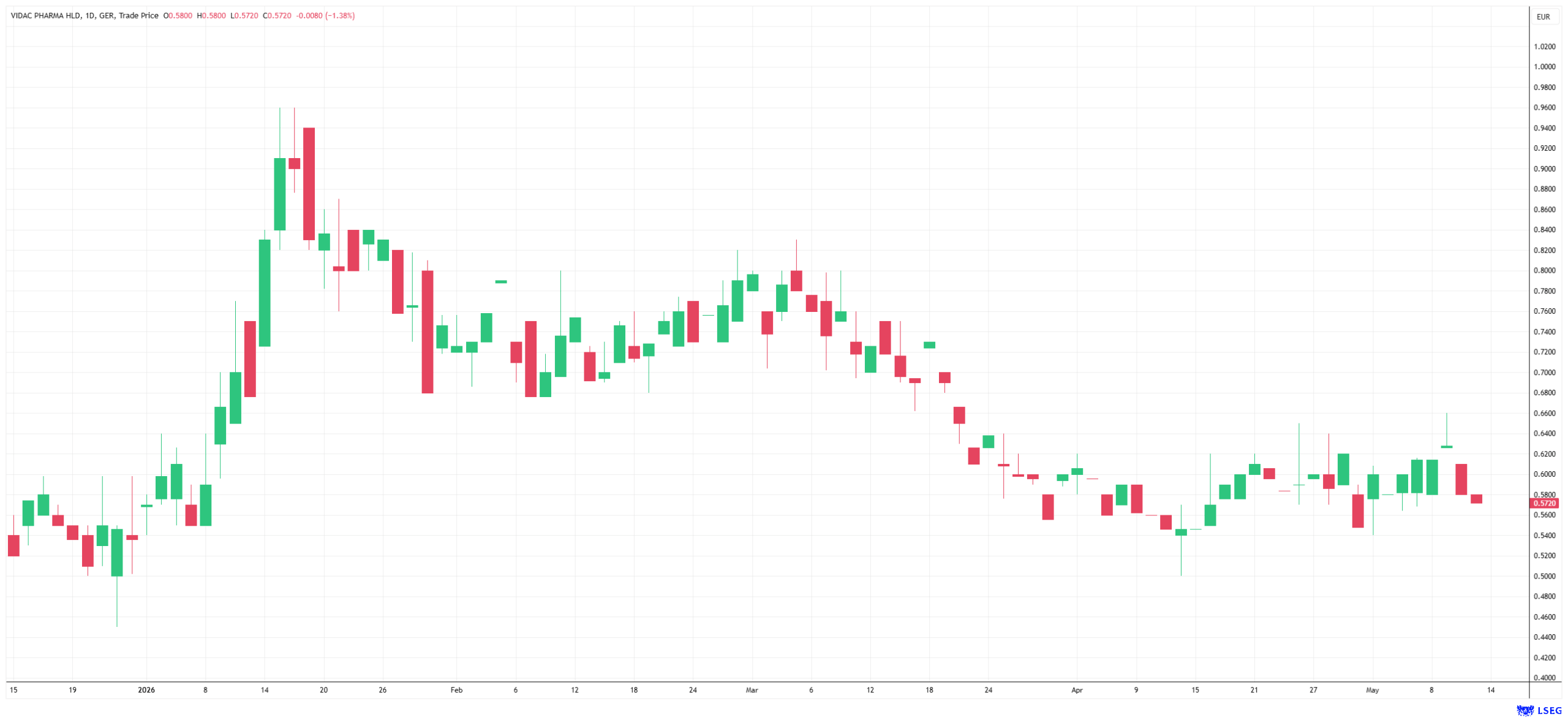
At a time when new approaches in biotechnology are in high demand, and companies like Bayer must replace expiring patents, Vidac is positioning itself as a promising problem-solver. Since reversing the Warburg effect shows promise in various areas, Vidac shareholders have several irons in the fire. Although the stock is considered speculative given its stage of development and low market capitalization, Vidac occupies a promising niche. Added to this is management's confidence in its own research capabilities. Vidac Pharma's stock has been trading sideways in recent weeks—any clinical progress could get the small-cap back on track and generate strong returns.
Watch YouTube videoConflict of interest
Pursuant to §85 of the German Securities Trading Act (WpHG), we point out that Apaton Finance GmbH as well as partners, authors or employees of Apaton Finance GmbH (hereinafter referred to as "Relevant Persons") may hold shares or other financial instruments of the aforementioned companies in the future or may bet on rising or falling prices and thus a conflict of interest may arise in the future. The Relevant Persons reserve the right to buy or sell shares or other financial instruments of the Company at any time (hereinafter each a "Transaction"). Transactions may, under certain circumstances, influence the respective price of the shares or other financial instruments of the Company.
In addition, Apaton Finance GmbH is active in the context of the preparation and publication of the reporting in paid contractual relationships.
For this reason, there is a concrete conflict of interest.
The above information on existing conflicts of interest applies to all types and forms of publication used by Apaton Finance GmbH for publications on companies.
Risk notice
Apaton Finance GmbH offers editors, agencies and companies the opportunity to publish commentaries, interviews, summaries, news and the like on news.financial. These contents are exclusively for the information of the readers and do not represent any call to action or recommendations, neither explicitly nor implicitly they are to be understood as an assurance of possible price developments. The contents do not replace individual expert investment advice and do not constitute an offer to sell the discussed share(s) or other financial instruments, nor an invitation to buy or sell such.
The content is expressly not a financial analysis, but a journalistic or advertising text. Readers or users who make investment decisions or carry out transactions on the basis of the information provided here do so entirely at their own risk. No contractual relationship is established between Apaton Finance GmbH and its readers or the users of its offers, as our information only refers to the company and not to the investment decision of the reader or user.
The acquisition of financial instruments involves high risks, which can lead to the total loss of the invested capital. The information published by Apaton Finance GmbH and its authors is based on careful research. Nevertheless, no liability is assumed for financial losses or a content-related guarantee for the topicality, correctness, appropriateness and completeness of the content provided here. Please also note our Terms of use.