December 9th, 2025 | 07:05 CET
Attacking the fuel that feeds tumors: Why Roche, Pfizer, and Vidac Pharma are redefining oncology
Modern cancer therapy is no longer about blunt-force attacks, but rather precise, targeted interventions. While oncology in recent decades has been dominated by non-specific cell toxins, today's research resembles surgical intervention in the biological software of a disease. Industry heavyweights, Roche and Pfizer, are securing their market positions with gigantic portfolios of immunotherapies. But away from the corporate headquarters of Basel and New York, agile biotech pioneers are working on approaches that attack the very foundation of cancer cells: their energy supply. Those who pull the plug on cancer cells could be among the big winners in the biotech sector in 2026.
time to read: 3 minutes | Author: Nico Popp
ISIN: ROCHE HLDG AG GEN. | CH0012032048 , PFIZER INC. DL-_05 | US7170811035 , VIDAC PHARMA HOLDING PLC | GB00BM9XQ619
Table of contents:
Author

Nico Popp
At home in Southern Germany, the passionate stock exchange expert has been accompanying the capital markets for about twenty years. With a soft spot for smaller companies, he is constantly on the lookout for exciting investment stories.
Tag cloud
Shares cloud
Roche: The oncology anchor in turbulent times
When investors think of cancer, there is no way around Roche. The Swiss giant is the undisputed market leader in oncology and has played a key role in shaping the era of personalized medicine. A decisive competitive advantage lies in its unique corporate structure: Roche combines a powerful pharmaceuticals division with a world-leading diagnostics division under one roof. This symbiosis enables the Swiss company, like hardly any other player, to link tailor-made active ingredients directly with the appropriate diagnostic tests. With a market capitalization of around EUR 220 billion, Roche acts as the stabilizing factor in the portfolio.
The figures for the third quarter of 2025 underscore the Company's resilience: despite currency effects, Roche was able to stabilize the growth of its core products in the oncology sector. In particular, its broad portfolio of cancer immunotherapies and antibodies continues to deliver reliable cash flows. For investors, Roche remains the "blue-chip bet" on long-term progress in cancer treatment – a stock that stands less for explosive price jumps and more for solid returns and technological leadership.
Pfizer: This turnaround candidate is focusing on cancer research
Pfizer is in a crucial phase of transformation. Now that the special economic conditions of the pandemic have subsided, the US giant is radically shifting its focus toward oncology. With its billion-dollar acquisition of Seagen, Pfizer has laid the foundation to become a leading provider of antibody-drug conjugates (ADCs). This technology is often considered the smart chemotherapy of the future. ADCs couple highly effective cell toxins to precise antibodies that, like guided missiles, target only tumor cells. The toxin is only released inside the cancer cell, which protects healthy tissue and drastically reduces side effects while increasing effectiveness against tumors.
Analysts at Goldman Sachs and other major firms are eagerly awaiting the pipeline for 2026. Pfizer must prove that its massive acquisitions will translate into market-ready products. With a market capitalization of around USD 150 billion, Pfizer currently offers an attractive entry level for investors who want to bet on the successful pivot of one of the world's most prominent pharmaceutical players.
Vidac Pharma: Cutting off the energy supply to cancer cells
While the big players are focusing on antibodies, the London-based and Germany-listed biotech company is pursuing an approach that specialists consider a game-changer. Vidac Pharma is addressing the so-called Warburg effect - a fundamental characteristic of cancer cells, which derive their energy almost exclusively from the fermentation of glucose. The Company has found a way to disrupt communication between the mitochondria and the metabolic pathways in the cytoplasm. By blocking the enzyme hexokinase 2, the cancer cell is effectively deprived of fuel, forcing it into metabolic starvation.
Current research is focused on developing therapies for advanced skin cancers such as Squamous Cell Carcinoma (SCC) and Mycosis Fungoides (MF). Study data to date indicates that Vidac can effectively slow tumor growth and induce regression without burdening healthy cells with classic toxicity. Strategically, this represents a tremendous lever for investors: With a valuation of around EUR 30 million, Vidac Pharma is currently an absolute micro-cap on the stock market. If clinical proof of efficacy is successful in the next phases, the Company will become a logical target for the big fish in the pond - corporations such as Pfizer and Roche are constantly on the lookout for such novel modes of action to feed their own pipelines.
Vidac offers the opportunity for dynamic returns
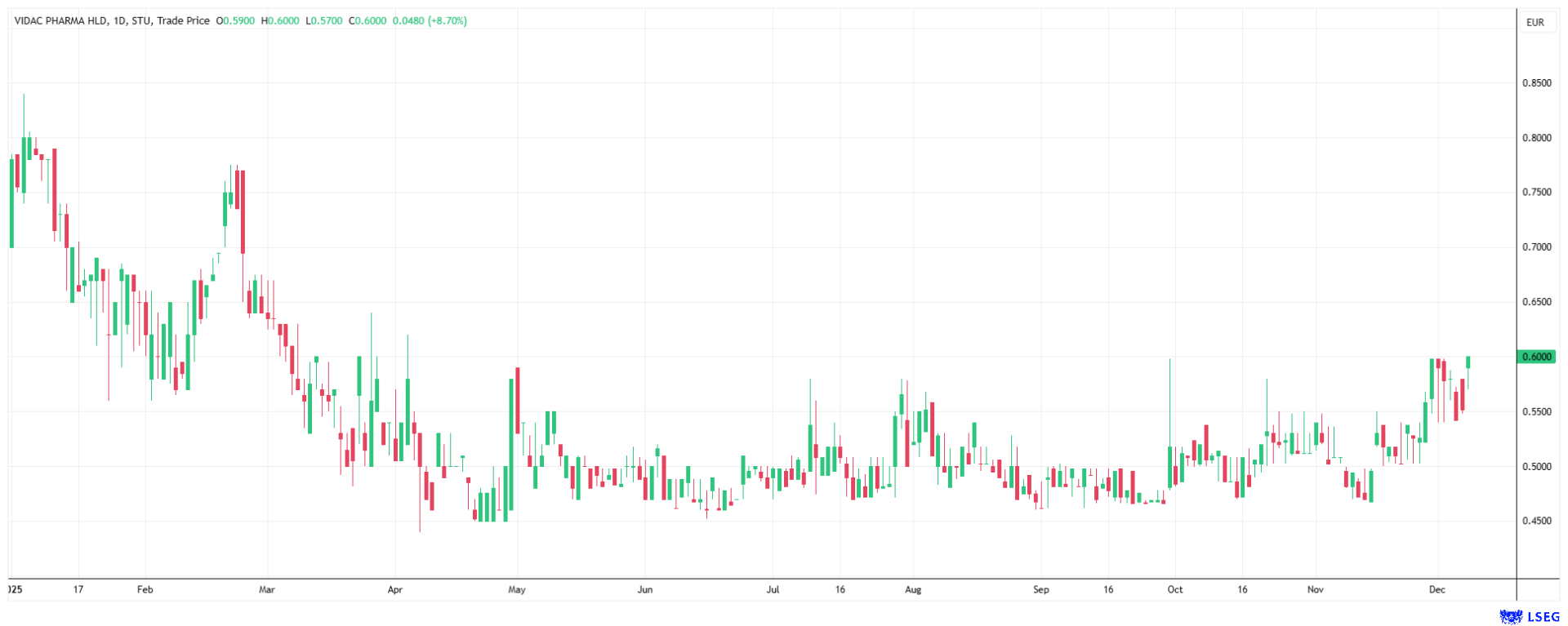
Oncology remains the most valuable sector in healthcare. Investors who bet on Roche and Pfizer are buying security and dividends. But those looking for the high flyer for 2026 will find the greatest leverage with specialists like Vidac Pharma. The Company has understood that cancer can not only be fought, but also starved. If this experiment succeeds in human patients, the path from niche to world leader could be very short. The stock has consolidated over the past few months and is currently poised to reach new highs. Opportunity-oriented investors should keep an eye on this stock.
Watch YouTube videoConflict of interest
Pursuant to §85 of the German Securities Trading Act (WpHG), we point out that Apaton Finance GmbH as well as partners, authors or employees of Apaton Finance GmbH (hereinafter referred to as "Relevant Persons") may hold shares or other financial instruments of the aforementioned companies in the future or may bet on rising or falling prices and thus a conflict of interest may arise in the future. The Relevant Persons reserve the right to buy or sell shares or other financial instruments of the Company at any time (hereinafter each a "Transaction"). Transactions may, under certain circumstances, influence the respective price of the shares or other financial instruments of the Company.
In addition, Apaton Finance GmbH is active in the context of the preparation and publication of the reporting in paid contractual relationships.
For this reason, there is a concrete conflict of interest.
The above information on existing conflicts of interest applies to all types and forms of publication used by Apaton Finance GmbH for publications on companies.
Risk notice
Apaton Finance GmbH offers editors, agencies and companies the opportunity to publish commentaries, interviews, summaries, news and the like on news.financial. These contents are exclusively for the information of the readers and do not represent any call to action or recommendations, neither explicitly nor implicitly they are to be understood as an assurance of possible price developments. The contents do not replace individual expert investment advice and do not constitute an offer to sell the discussed share(s) or other financial instruments, nor an invitation to buy or sell such.
The content is expressly not a financial analysis, but a journalistic or advertising text. Readers or users who make investment decisions or carry out transactions on the basis of the information provided here do so entirely at their own risk. No contractual relationship is established between Apaton Finance GmbH and its readers or the users of its offers, as our information only refers to the company and not to the investment decision of the reader or user.
The acquisition of financial instruments involves high risks, which can lead to the total loss of the invested capital. The information published by Apaton Finance GmbH and its authors is based on careful research. Nevertheless, no liability is assumed for financial losses or a content-related guarantee for the topicality, correctness, appropriateness and completeness of the content provided here. Please also note our Terms of use.