January 19th, 2026 | 07:25 CET
Armored steel meets swarm intelligence: Why Rheinmetall and Hensoldt must retool - and why NEO Battery Materials could become a hidden winner of the drone war
The war in Ukraine has shattered military doctrines that were considered irrefutable in NATO headquarters for decades within a matter of months. The shocking realization: even the most modern battle tank is an easy target for a drone that costs less than a tank of fuel for the colossus. We are witnessing a tectonic shift in warfare away from classic weapons such as tanks and howitzers toward asymmetric threats that are decided by software, sensors, and, above all, range. In this new environment, established defense giants such as Rheinmetall and Hensoldt must reinvent themselves to avoid becoming obsolete. But while these corporations are slow to turn their tankers around, NEO Battery Materials is positioning itself as an agile player at the critical interface of modern warfare: batteries for drone swarms, independent of Chinese supply chains.
time to read: 3 minutes | Author: Nico Popp
ISIN: RHEINMETALL AG | DE0007030009 , HENSOLDT AG INH O.N. | DE000HAG0005 , NEO BATTERY MATERIALS LTD | CA62908A1003
Table of contents:
Author

Nico Popp
At home in Southern Germany, the passionate stock exchange expert has been accompanying the capital markets for about twenty years. With a soft spot for smaller companies, he is constantly on the lookout for exciting investment stories.
Tag cloud
Shares cloud
Rheinmetall and Hensoldt: The shield against the swarm
Rheinmetall, long perceived primarily as a "weapons manufacturer" for heavy steel, has recognized the signs of the times. CEO Armin Papperger is driving forward the transformation into an integrated technology group. However, as analysts point out, Rheinmetall's core business remains physically heavy and logistically complex. The Company supplies the platforms, but these platforms need eyes and ears to survive the drone barrage.
This is where Hensoldt comes in. The Company is the sensory nervous system of Western defense. Modern radar systems and electronic warfare are a critical part of the answer to drone attacks, as they detect the threat before impact. Hensoldt provides the technology to dispel the "fog of war." But both Rheinmetall and Hensoldt face a fundamental issue that is causing concern in the boardrooms: their dependence on critical components and raw materials, which often still come from geopolitically unstable regions. The fragility of NATO, exemplified by the race for Greenland's raw materials, reveals the Achilles' heel of high-tech armaments.
The energy dilemma: China's stranglehold
However, the real bottleneck in modern warfare is the battery. A drone is only as effective as its range and payload. Until now, China has played a dominant position in commercial-scale battery manufacturing. Beijing's recent export restrictions on drone components and battery technology have painfully reminded the West that it has placed itself in a dangerous position of dependency. A modern drone war cannot be won if the enemy controls access to the most powerful energy storage devices.
NATO is desperately searching for "friend-shoring solutions" – supply chains that are located in secure jurisdictions and are technologically superior. It is no longer just about price, but about physical availability and technological superiority. NEO Battery Materials is filling this vacuum with an aggressiveness that perfectly matches the current spirit of the times.
NEO Battery Materials: Fuel for the next generation
With its proprietary silicon anode technology, NEO Battery Materials addresses the very weak point of Western drone systems: energy density and weight. As Canadian Defence Review (CDR) reports, NEO's technology enables significantly longer flight times and higher payloads – in a military context, this is crucial and can save lives. Through its partnership with Nascent Materials, NEO is directly targeting the development of specialized batteries for defense drones. The Company is thus not only supplying materials, but also positioning itself as a strategic system supplier.
However, the decisive advantage for investors and military planners is geopolitics. With its production base in North America and South Korea, NEO operates largely independently of China. At a time when security of supply is paramount, this independence is valued at a massive premium. The fact that the Company recently recruited high-ranking military personnel, including a retired admiral and major general from South Korea, as advisors underscores the seriousness of its ambitions in the defense sector.
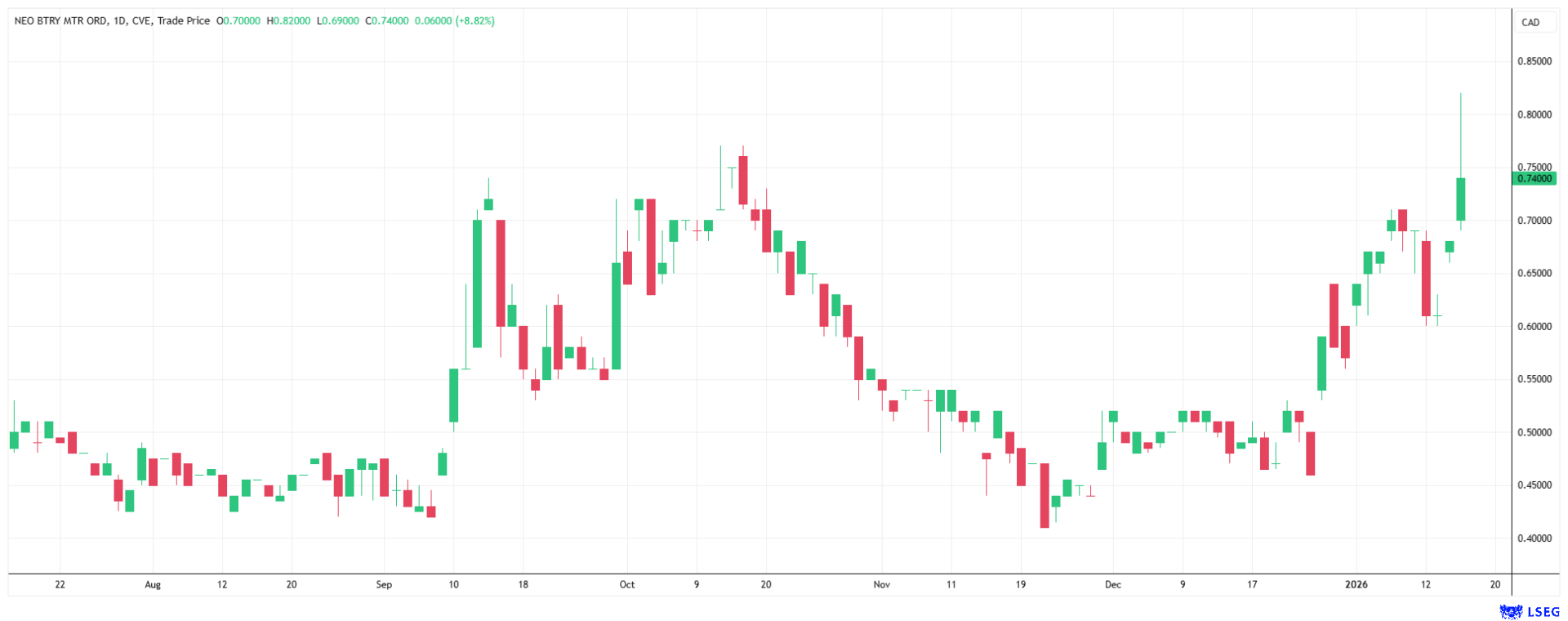
NEO Battery Materials' stock is already beginning to reflect this revaluation. While the broader market is still debating interest rates, "smart money" is buying the suppliers of the future. NEO is betting on the realization that the next war will not be decided by the strongest tank, but by the most enduring drone. In an environment where NATO needs to reorganize its supply chains from Greenland to South Korea, NEO Battery Materials is one of the few players that already has the technological answer to Chinese dominance ready for the market. The Company has recently celebrated new operational successes month after month and is now in the ramp-up phase. The timing could hardly be better: the share price is also at a multi-month high and is poised to break into new territory. While Rheinmetall and Hensoldt are reaching their capacity limits and are only slowly adapting to the new wars, NEO Battery Materials is perfectly in tune with the spirit of the times.
Watch YouTube videoConflict of interest
Pursuant to §85 of the German Securities Trading Act (WpHG), we point out that Apaton Finance GmbH as well as partners, authors or employees of Apaton Finance GmbH (hereinafter referred to as "Relevant Persons") currently hold or hold shares or other financial instruments of the aforementioned companies and speculate on their price developments. In this respect, they intend to sell or acquire shares or other financial instruments of the companies (hereinafter each referred to as a "Transaction"). Transactions may thereby influence the respective price of the shares or other financial instruments of the Company.
In this respect, there is a concrete conflict of interest in the reporting on the companies.
In addition, Apaton Finance GmbH is active in the context of the preparation and publication of the reporting in paid contractual relationships.
For this reason, there is also a concrete conflict of interest.
The above information on existing conflicts of interest applies to all types and forms of publication used by Apaton Finance GmbH for publications on companies.
Risk notice
Apaton Finance GmbH offers editors, agencies and companies the opportunity to publish commentaries, interviews, summaries, news and the like on news.financial. These contents are exclusively for the information of the readers and do not represent any call to action or recommendations, neither explicitly nor implicitly they are to be understood as an assurance of possible price developments. The contents do not replace individual expert investment advice and do not constitute an offer to sell the discussed share(s) or other financial instruments, nor an invitation to buy or sell such.
The content is expressly not a financial analysis, but a journalistic or advertising text. Readers or users who make investment decisions or carry out transactions on the basis of the information provided here do so entirely at their own risk. No contractual relationship is established between Apaton Finance GmbH and its readers or the users of its offers, as our information only refers to the company and not to the investment decision of the reader or user.
The acquisition of financial instruments involves high risks, which can lead to the total loss of the invested capital. The information published by Apaton Finance GmbH and its authors is based on careful research. Nevertheless, no liability is assumed for financial losses or a content-related guarantee for the topicality, correctness, appropriateness and completeness of the content provided here. Please also note our Terms of use.