March 4th, 2026 | 07:30 CET
Antimony Resources: 10,000 m of drilling, CAD 7 million in cash, USD 3 billion in raw material potential – Why this stock is hot
While the global commodities world is fixated on the price development of copper, gold, and tungsten, a revolution is taking place on a completely different front. Antimony, classified as a critical raw material by both the EU and the US, has become a geopolitical bargaining chip and thus one of the most exciting investment opportunities of the coming years. In this environment, a small Canadian company is making headway. Antimony Resources is developing one of North America's most promising antimony deposits at its Bald Hill project in New Brunswick. A new zone was recently discovered during construction work, while work on the first resource estimate is ongoing. Measured by its potential, the current market valuation appears more than moderate.
time to read: 4 minutes | Author: Armin Schulz
ISIN: ANTIMONY RESOURCES CORP | CA0369271014 | CSE: ATMY , OTCQB: ATMYF
Table of contents:
Author

Armin Schulz
Born in Mönchengladbach, he studied business administration in the Netherlands. In the course of his studies he came into contact with the stock exchange for the first time. He has more than 25 years of experience in stock market business.
Tag cloud
Shares cloud
The facts: What was found at Bald Hill
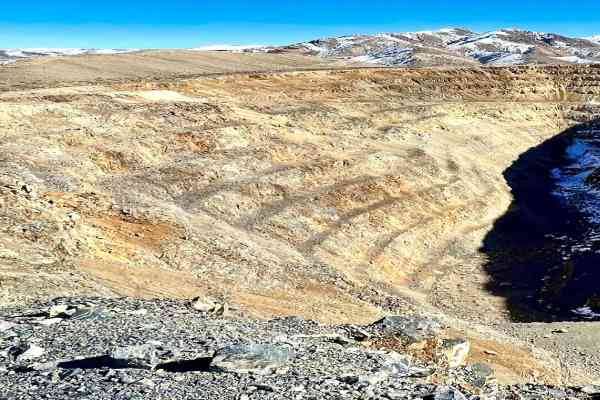
The latest developments at the Bald Hill project read like a textbook example of successful exploration. In February 2026, the company announced the discovery of a new mineralization zone. During construction work on an access road west of the main deposit, the field team encountered massive stibnite, the main ore for antimony extraction. Named after the first prospector on site, the "Marcus (West) Zone" extends over a length of at least 25 m according to initial prospecting. Jim Atkinson, CEO of Antimony Resources, commented on the find, saying, "It is obvious that this is a highly mineralized area and the 'flaky' stibnite is very attractive."
What underscores the significance of this discovery is its ease of verification. Shallow drilling can be easily carried out by turning the drill direction, according to the company announcement. Up to six shallow drill holes are planned to a depth of between 30 and 50 m.
The already known "South Zone" also continues to deliver positive surprises. There, the exploration team was able to identify stibnite mineralization in the bedrock over a length of approximately 150 m. A trench from 2010 yielded values of 2.90% antimony over 8.18 m, including 5.79% over 1.75 m and 8.47% over 1.53 m.
The hard numbers: What has been drilled so far
In total, Antimony Resources drilled over 8,000 m in 34 holes in 2025. High-grade antimony mineralization was intersected in 75-80% of the holes. Noteworthy sections include 2.38% antimony over 9.6 m and 6.79% antimony over 2.3 m. As a result of this drilling campaign, the main zone was extended to a strike length of over 700 m, and the depth of the mineralization was confirmed to be at least 400 m. Average thicknesses are 3-4 m, with average grades in the range of 3-4% antimony.
A 2025 NI 43-101 technical report estimates the potential of the area already drilled at approximately 2.7 million tonnes with a grade between 3-4% antimony.
This results in a contained amount of 80,000 to 106,000 tons of antimony.
The roadmap: When will the first resource be available?
The current year, 2026, is all about definition drilling. The plan is to drill 10,000 m with several drilling rigs; a second rig has already been brought in, and a third is to follow shortly. Jim Atkinson commented on this in an interview: "Throughout 2026, we will continue to work with consultants to discuss the resource calculations, which we hope to complete by the end of 2026 or early 2027. As part of this consultation, a roadmap for the approval process, including an environmental impact assessment, will also be developed. This work has already begun."
The market: Why antimony is suddenly in the spotlight
China dominated global production for a long time with a share of over 75%. Then, at the end of 2024, Beijing imposed export restrictions that fundamentally changed the market. Jim Atkinson summarizes the situation: "China produced over 75% of the world's antimony supply, but in December 2024, China banned all exports of antimony. The other major producer, Russia, is under sanctions. This makes antimony a very important, geopolitically critical metal. The supply shortage caused by China's measures has led to an increase in the price of antimony to USD 60,000 per ton on the metal exchanges."
The price has since stabilized at a historically high level. For a project like Bald Hill, this means a fundamentally improved economic calculation. Added to this is its strategic importance. The US has allocated funds in its defense budget for the establishment of strategic raw material reserves, and the Canadian provincial government of New Brunswick is actively working on a strategy for critical minerals.
The discrepancy: project potential versus market valuation
A potential resource target of 80,000 to 106,000 tons of contained antimony is offset by a current antimony price of approximately USD 30,000 per ton. The pure raw material value in the ground is therefore in the range of USD 2.4 to USD 3.2 billion. Added to this is the leverage provided by the new discoveries. The Marcus (West) Zone and the expanded South Zone are not yet included in the potential estimates. The nearly 2.5 km long antimony anomaly in the ground is a clear indication of the untapped potential.
Location advantages and management
The concession area is conveniently located between Sussex, Fredericton, and Saint John and is accessible via regional highways. Drilling is possible year-round. Jim Atkinson's experience and enthusiasm are evident: "I had the privilege of visiting the Bald Hill site and observing the work in the Marcus (West) Zone. The excavator operator and the geologists work very well together, forming an extremely efficient team." Financing is also secured: "The planned exploration program is fully funded with over USD 7 million in the account."
With a current share price of CAD 1.02, the company has a market capitalization of approximately CAD 105 million. This illustrates the discrepancy between the value of the raw materials in the ground and the value currently attributed to the company.
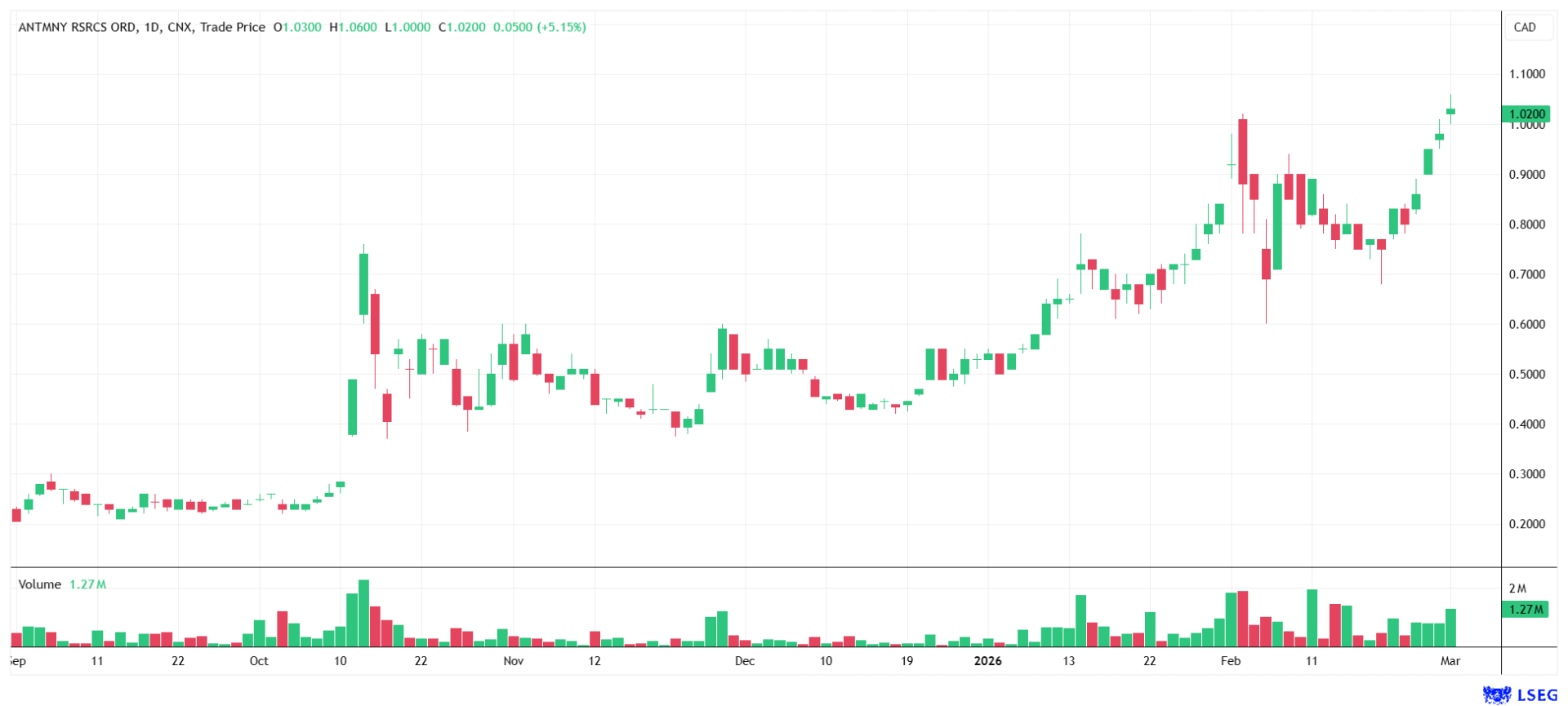
Antimony Resources presents itself as an exploration company with a high-grade project in a secure jurisdiction that benefits from a geopolitical megatrend. Recent discoveries underscore the tremendous potential of the area. While the 10,000 m definition drilling is heading towards the first official resource estimate, the market does not yet appear to have fully priced in the strategic importance and potential value of the project. This presents an exceptional opportunity for investors who want to participate early in a systemically important raw materials project.
Conflict of interest
Pursuant to §85 of the German Securities Trading Act (WpHG), we point out that Apaton Finance GmbH as well as partners, authors or employees of Apaton Finance GmbH (hereinafter referred to as "Relevant Persons") currently hold or hold shares or other financial instruments of the aforementioned companies and speculate on their price developments. In this respect, they intend to sell or acquire shares or other financial instruments of the companies (hereinafter each referred to as a "Transaction"). Transactions may thereby influence the respective price of the shares or other financial instruments of the Company.
In this respect, there is a concrete conflict of interest in the reporting on the companies.
In addition, Apaton Finance GmbH is active in the context of the preparation and publication of the reporting in paid contractual relationships.
For this reason, there is also a concrete conflict of interest.
The above information on existing conflicts of interest applies to all types and forms of publication used by Apaton Finance GmbH for publications on companies.
Risk notice
Apaton Finance GmbH offers editors, agencies and companies the opportunity to publish commentaries, interviews, summaries, news and the like on news.financial. These contents are exclusively for the information of the readers and do not represent any call to action or recommendations, neither explicitly nor implicitly they are to be understood as an assurance of possible price developments. The contents do not replace individual expert investment advice and do not constitute an offer to sell the discussed share(s) or other financial instruments, nor an invitation to buy or sell such.
The content is expressly not a financial analysis, but a journalistic or advertising text. Readers or users who make investment decisions or carry out transactions on the basis of the information provided here do so entirely at their own risk. No contractual relationship is established between Apaton Finance GmbH and its readers or the users of its offers, as our information only refers to the company and not to the investment decision of the reader or user.
The acquisition of financial instruments involves high risks, which can lead to the total loss of the invested capital. The information published by Apaton Finance GmbH and its authors is based on careful research. Nevertheless, no liability is assumed for financial losses or a content-related guarantee for the topicality, correctness, appropriateness and completeness of the content provided here. Please also note our Terms of use.