January 16th, 2026 | 07:25 CET
Antimony Resources: Three powerful drivers form the perfect antimony wave
While much of the investment world is rushing to tungsten and lithium, a great opportunity is emerging in the shadows. Antimony, a metal essential for flame retardants, defense, and electronics, is characterized by an overwhelming dependence on China and recurring export restrictions. Against this backdrop, Antimony Resources is advancing its flagship Bald Hill project in Canada with notable precision. The combination of exceptional geology, rising geopolitical urgency, and operational momentum could make the Company the unlikely winner of a new era of raw materials.
time to read: 5 minutes | Author: Armin Schulz
ISIN: ANTIMONY RESOURCES CORP | CA0369271014
Table of contents:
Author

Armin Schulz
Born in Mönchengladbach, he studied business administration in the Netherlands. In the course of his studies he came into contact with the stock exchange for the first time. He has more than 25 years of experience in stock market business.
Tag cloud
Shares cloud
The dependencies
The history of critical raw materials is often one of dependency. In the case of antimony, a brittle, silvery-white semi-metal, this dependency has reached dangerous levels. Over 70% of global production comes from China, with further significant shares coming from politically volatile regions. In the fall of 2024, Beijing tightened the reins and drastically restricted exports. This came as a shock to supply chains from the semiconductor industry to the Department of Defense. Suddenly, a wider audience became aware that the West had a major gap in this area.
It is precisely in this vacuum that Antimony Resources is positioning itself with the Bald Hill Project in New Brunswick, Canada. But this is not merely a hope for political tailwinds. The project combines three fundamental value drivers that transform it from a pure geopolitical bet into a sound commodity investment story.
Driver 1: The incorruptible language of geology
It all starts in the ground. And what the exploration team led by CEO Jim Atkinson, an experienced geologist, is finding at Bald Hill speaks for itself. Modern methods reveal that this historically known deposit is exceptional.
At its heart is a mineralized structure over 700 m long and at least 400 m deep, which is open in all directions. The drill results do not read like the cautious hints of an early explorer, but like the confirmation of a high-grade system. Averages of 3-4% antimony were reported, with individual sections reaching spectacular values such as 20.9% antimony over 2.29 m. In the most recent campaign, mineralized rock was encountered in almost every drill hole.
"Our 2025 exploration program at Bald Hill has been very successful, and the results are promising," summarizes CEO Jim Atkinson. "The presence of several thick zones of antimony-bearing stibnite discovered in recent drilling will be an important factor in the final resource calculation."
A specially created 3D model identifies at least four clearly distinct mineralized bodies. Based on this model and all data available through July 2025, a conceptual potential has been estimated. This results in 2.7 million tons of material with a grade of 3-4% antimony, which would correspond to 81,000 to 108,000 tons of contained metal. This is double the last estimate from 2014. The Company is transparent in communicating that this is a potential volume, not a resource. The aggressive 2026 drill program is intended to close this gap.
But the real surprise may lie outside the main zone. During field work, the team discovered two new, promising areas: the Bald Hill South and Marcus zones. Such new discoveries indicate a significantly larger mineralized system than previously assumed.
Driver 2: Geopolitical tailwinds turn into a storm
Impressive geology alone does not make for an investment story. Context is crucial. And it could hardly be more favorable for antimony. The metal is on the lists of critical raw materials of the US, Canada, and the EU. Its applications are diverse and often critical as a flame retardant in plastics and electronics, as a hardener in lead alloys for batteries and ammunition, and in semiconductor compounds for infrared sensors.
The defense industry is a particularly strong driver of demand. Modern combat equipment, from flame-retardant textiles to night vision devices and ammunition, would be virtually inconceivable without antimony. Against the backdrop of rising defense spending and the urge to secure supply chains, projects in stable countries such as Canada are gaining strategic value that goes beyond the pure metal price.
China is not only exporting less, it is also controlling the remaining flow. Reports suggest that shipments to the US have faced heightened regulatory scrutiny and delays. This deliberate shortage is creating a market environment in which new, reliable producers can command a significant premium. Antimony Resources is not just building any mine; it is building a potential strategic asset for North American industries.
Driver 3: Operational strength and financial flexibility
Even the best project is useless without the ability to implement it. Here, Antimony Resources demonstrates remarkable operational discipline. The Company is not pursuing a rush-job approach, but rather a clear, fully financed roadmap.
At the end of 2025, Antimony Resources completed a financing totaling approximately CAD 9.4 million. "These restrictions by China have increased market volatility and driven prices to an all-time high. Antimony is essential for the military. Our goal is to develop our Bald Hill antimony deposit and become a major supplier of antimony to North America," said Atkinson. This capital secures the ambitious exploration program for 2026, which includes 10,000 m of drilling with up to three drill rigs.
But it is not just about drilling. Work is already underway in parallel that often causes time-consuming surprises in later project phases. Environmental baseline surveys have been initiated, discussions with authorities about approval processes are underway, and metallurgical tests are planned to confirm the suspected simple processing. This parallel approach to "de-risking" demonstrates professional project management.
The schedule is ambitious but reasonable. Sufficient data for calculating an initial mineral resource estimate should be available in 2026, a crucial milestone for the valuation of any exploration company. Continuous news about drilling results, model updates, and progress in metallurgical testing will ensure a steady flow of information.
The synthesis: More than the sum of its parts
Each of these three drivers - the high-grade, growing geology, the powerful geopolitical tailwind, and the operational and financial execution capabilities - would be remarkable on its own. However, when combined, they create a synergistic effect.
For investors, this presents a compelling opportunity. A company that is tapping into one of the most acute supply gaps in critical raw materials with a first-class project and, at the same time, has the tools and plan to take advantage of this opportunity. The coming months will be crucial in converting the geological potential into a hard resource certified to international standards.
The stock is currently trading at CAD 0.72.
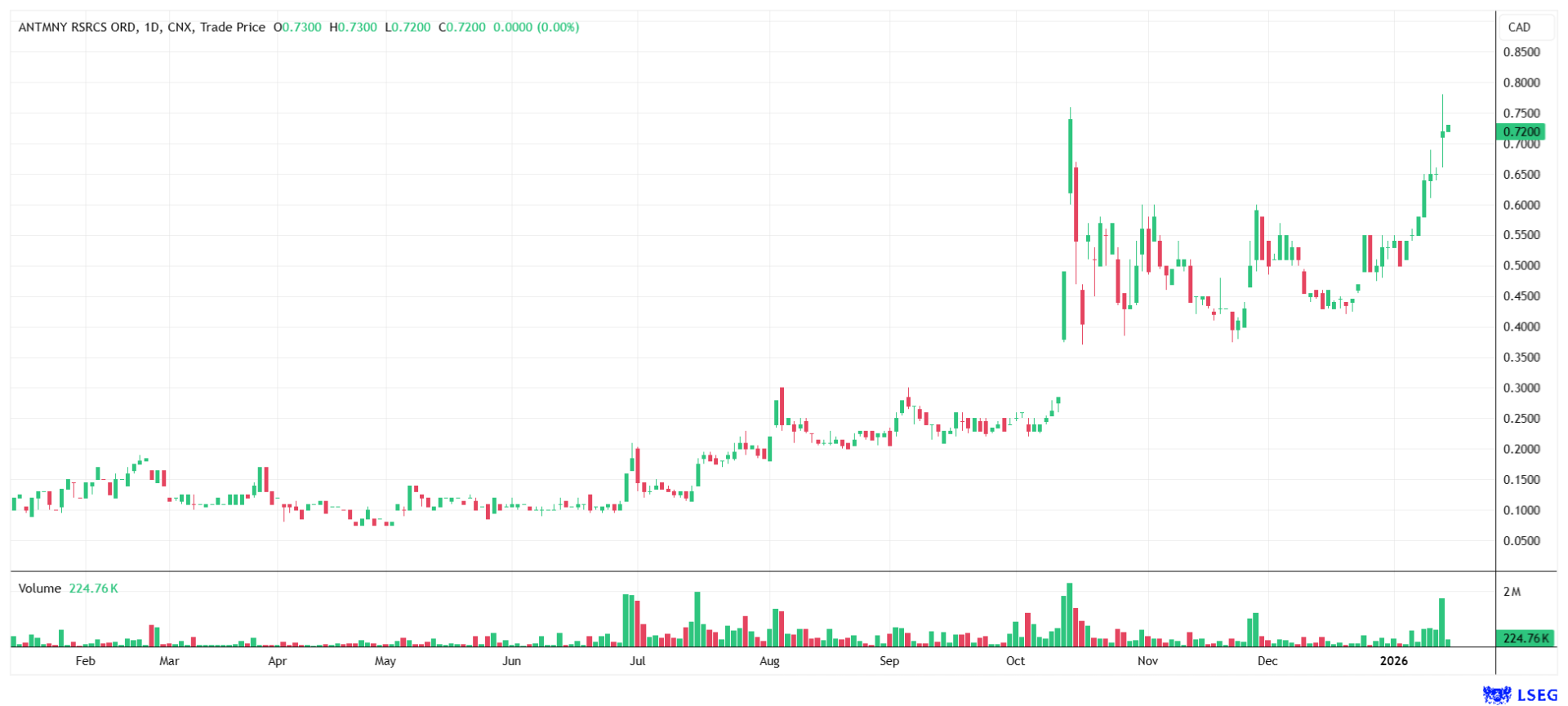
Antimony Resources is at a turning point. Not only does the Company own a geologically outstanding antimony project in a top jurisdiction, but it also operates in a perfect macroeconomic and geopolitical environment. Structural supply shortages, driven by Chinese restrictions, are meeting robust industrial and strategic demand. If management succeeds in translating the conceptual potential of Bald Hill 2026 into a solid resource estimate, the market could view the Company in a whole new light. For commodity investors, this is a story that should not be ignored.
Conflict of interest
Pursuant to §85 of the German Securities Trading Act (WpHG), we point out that Apaton Finance GmbH as well as partners, authors or employees of Apaton Finance GmbH (hereinafter referred to as "Relevant Persons") currently hold or hold shares or other financial instruments of the aforementioned companies and speculate on their price developments. In this respect, they intend to sell or acquire shares or other financial instruments of the companies (hereinafter each referred to as a "Transaction"). Transactions may thereby influence the respective price of the shares or other financial instruments of the Company.
In this respect, there is a concrete conflict of interest in the reporting on the companies.
In addition, Apaton Finance GmbH is active in the context of the preparation and publication of the reporting in paid contractual relationships.
For this reason, there is also a concrete conflict of interest.
The above information on existing conflicts of interest applies to all types and forms of publication used by Apaton Finance GmbH for publications on companies.
Risk notice
Apaton Finance GmbH offers editors, agencies and companies the opportunity to publish commentaries, interviews, summaries, news and the like on news.financial. These contents are exclusively for the information of the readers and do not represent any call to action or recommendations, neither explicitly nor implicitly they are to be understood as an assurance of possible price developments. The contents do not replace individual expert investment advice and do not constitute an offer to sell the discussed share(s) or other financial instruments, nor an invitation to buy or sell such.
The content is expressly not a financial analysis, but a journalistic or advertising text. Readers or users who make investment decisions or carry out transactions on the basis of the information provided here do so entirely at their own risk. No contractual relationship is established between Apaton Finance GmbH and its readers or the users of its offers, as our information only refers to the company and not to the investment decision of the reader or user.
The acquisition of financial instruments involves high risks, which can lead to the total loss of the invested capital. The information published by Apaton Finance GmbH and its authors is based on careful research. Nevertheless, no liability is assumed for financial losses or a content-related guarantee for the topicality, correctness, appropriateness and completeness of the content provided here. Please also note our Terms of use.