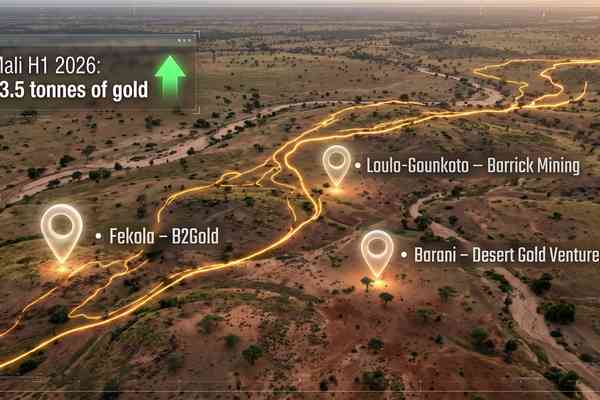
Gold has made an impressive comeback in recent quarters. Escalating geopolitical conflicts, fragile supply chains, continued high global government debt, and expansive fiscal programs in the US and Europe are fueling doubts about the long-term stability of paper currencies. Central banks are expanding their gold reserves, and institutional investors are increasing their strategic allocations. The price is trading close to historic highs, and this is precisely where a decisive lever comes into play. The higher the price level, the greater the profitability of new projects. Margins are expanding disproportionately, payback periods are shortening, and internal rates of return are skyrocketing. Developers with advanced projects, such as Desert Gold Ventures, are thus increasingly becoming the focus of the capital market.
time to read: 3 minutes | Author: Stefan Feulner
ISIN: DESERT GOLD VENTURES | CA25039N4084
Table of contents:
Author

Stefan Feulner
The native Franconian has more than 20 years of stock exchange experience and a broadly diversified network.
He is passionate about analyzing a wide variety of business models and investigating new trends.
Tag cloud
Shares cloud
Premium location in the Senegal-Mali Shear Zone
The company's flagship project is located in the Senegal-Mali Shear Zone (SMSZ), one of Africa's most productive gold corridors. Several deposits containing millions of ounces of gold have been discovered and brought into production along this structure in recent decades.
Desert Gold controls approximately 440 km² of contiguous land here, strategically positioned between active large-scale mines. Geological continuity is a key factor here. Gold-bearing structures extend regionally across license boundaries where neighbors have developed significant deposits; the statistical probability of further discoveries on adjacent land increases.
The project currently has a resource of approximately 1.1 million ounces with average grades of about 1.1 to 1.2 g/t. The high proportion of near-surface oxide mineralization is particularly attractive. This allows for uncomplicated open-pit mining with a favorable cost structure.
Of the more than 30 gold zones identified, only 5 have been included in the official resource estimate to date. Each additional zone with similar parameters could significantly expand the resource without proportionally increasing infrastructure costs.
2026 as a year of transformation – From explorer to producer
While many junior companies continue to model resources, Desert Gold is pushing ahead with operational implementation. Infrastructure preparations are underway at the fully approved Barani East project. At the same time, a modular processing plant is being built.
The goal is clearly defined with the transition to production. Historically, this step is considered one of the strongest valuation catalysts in the commodities sector.
The preliminary economic assessment (PEA) underscores the robustness of the project. Assuming a gold price of around USD 3,000 per ounce, the internal rate of return is around 57%. The net present value (NPV), discounted at 10%, is around USD 60 million after taxes. This contrasts with a market valuation of around USD 25 million.
Since a large portion of the costs are fixed, every additional dollar in the gold price has a disproportionately positive effect on the project value. If prices rise significantly above the calculation basis, the net present value increases massively.
The projected total costs of around USD 1,150 per ounce allow for comfortable margins at current price levels. The payback period is less than two years. The plan is to achieve a processing capacity of up to 1,200 tons per day and production of over 113,000 ounces within the first decade.
At the same time, existing inferred resources are to be upgraded to higher categories. A further 900,000 ounces are believed to be contained in the resources that have only been inferred to date. If these are successfully upgraded, either the mine life will be extended, or the production rate could be increased – both of which are clear value drivers.
Second growth axis in Côte d'Ivoire
The Tiegba Gold project in Côte d'Ivoire provides the company with an additional exploration option. The concession area covers almost 300 km², of which less than 20% has been explored to date.
Historical soil samples have revealed significant gold anomalies along a trend several kilometers long. The geological structures are similar to known gold districts in the region. Calc-alkaline intrusions and structure-controlled quartz vein systems are considered classic indicators of economic gold mineralization.
This project is currently still purely exploratory in nature, but that is precisely where the opportunity profile lies. The intrinsic value of Desert Gold is already supported by the SMSZ project. Tiegba thus acts as additional leverage for new discoveries.
Financing secured – Analysts see upside potential
A financing round completed in February for CAD 7.18 million, which was significantly oversubscribed, strengthens the balance sheet at a crucial stage. The funds are sufficient to implement plant construction, infrastructure, and the next tasks without having to raise additional capital in the short term. This reduces dilution risks surrounding the planned start of production.
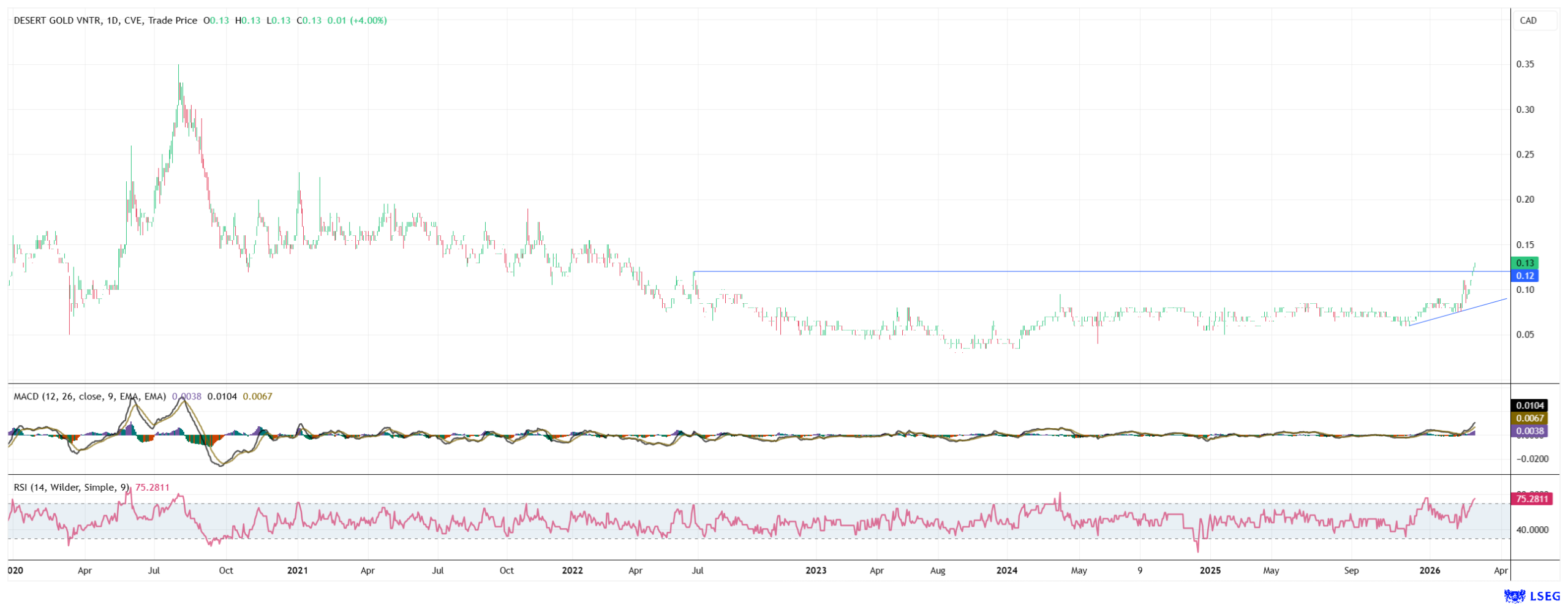
Analysts are also providing tailwinds. The experts at GBC AG rate the stock as a "Buy" and see a price target of EUR 0.50 for 2026. At the current price level, this represents considerable upside potential.
In an environment of structurally high gold prices, Desert Gold combines high-quality geology with an advanced development strategy. The planned transition to production could serve as a catalyst for a revaluation. At the same time, the exploration pipeline offers additional leverage. For risk-conscious investors with an eye on the gold sector, this presents an attractive risk-reward ratio.
Conflict of interest
Pursuant to §85 of the German Securities Trading Act (WpHG), we point out that Apaton Finance GmbH as well as partners, authors or employees of Apaton Finance GmbH (hereinafter referred to as "Relevant Persons") may hold shares or other financial instruments of the aforementioned companies in the future or may bet on rising or falling prices and thus a conflict of interest may arise in the future. The Relevant Persons reserve the right to buy or sell shares or other financial instruments of the Company at any time (hereinafter each a "Transaction"). Transactions may, under certain circumstances, influence the respective price of the shares or other financial instruments of the Company.
In addition, Apaton Finance GmbH is active in the context of the preparation and publication of the reporting in paid contractual relationships.
For this reason, there is a concrete conflict of interest.
The above information on existing conflicts of interest applies to all types and forms of publication used by Apaton Finance GmbH for publications on companies.
Risk notice
Apaton Finance GmbH offers editors, agencies and companies the opportunity to publish commentaries, interviews, summaries, news and the like on news.financial. These contents are exclusively for the information of the readers and do not represent any call to action or recommendations, neither explicitly nor implicitly they are to be understood as an assurance of possible price developments. The contents do not replace individual expert investment advice and do not constitute an offer to sell the discussed share(s) or other financial instruments, nor an invitation to buy or sell such.
The content is expressly not a financial analysis, but a journalistic or advertising text. Readers or users who make investment decisions or carry out transactions on the basis of the information provided here do so entirely at their own risk. No contractual relationship is established between Apaton Finance GmbH and its readers or the users of its offers, as our information only refers to the company and not to the investment decision of the reader or user.
The acquisition of financial instruments involves high risks, which can lead to the total loss of the invested capital. The information published by Apaton Finance GmbH and its authors is based on careful research. Nevertheless, no liability is assumed for financial losses or a content-related guarantee for the topicality, correctness, appropriateness and completeness of the content provided here. Please also note our Terms of use.