February 23rd, 2026 | 07:45 CET
Almonty Industries – Main beneficiary of the tungsten shock
The price of tungsten has quadrupled within a year. China dominates over 80% of production, is cutting subsidies, tightening export rules, and struggling with declining ore grades. At the same time, demand from the defense, semiconductor, and data center sectors continues to drive the market. The West is looking for alternatives, and one of the largest mines outside China is about to ramp up production. Could this give rise to a strategic raw materials player that could serve up to 40% of non-Chinese demand?
time to read: 3 minutes | Author: Stefan Feulner
ISIN: ALMONTY INDUSTRIES INC. | CA0203987072
Table of contents:
Author

Stefan Feulner
The native Franconian has more than 20 years of stock exchange experience and a broadly diversified network.
He is passionate about analyzing a wide variety of business models and investigating new trends.
Tag cloud
Shares cloud
Geopolitical bottleneck instead of raw materials hype
The price of tungsten has quadrupled within a year. Unlike classic commodity cycles, this time there is no speculative exaggeration behind it, but rather a structural market shift.
China controls around 85% of global production and dominates large parts of the processing industry. Export restrictions, stricter dual-use rules for raw materials that can be used for military purposes, and the elimination of government subsidies have noticeably reduced supply. Several Chinese mines have had to close, while ore grades are declining. At the same time, production costs are rising.
China is not only the largest producer, but also the largest consumer, accounting for around 65% of global demand. Imports doubled in 2024 and are likely to have continued growing strongly. This is intensifying global competition for available supply.
Tungsten is extremely heat- and wear-resistant, making it indispensable for aerospace, semiconductors, high-precision tools, and defense technology. In times of geopolitical tension, the metal is no longer simply traded but strategically secured.
The West is seeking alternatives
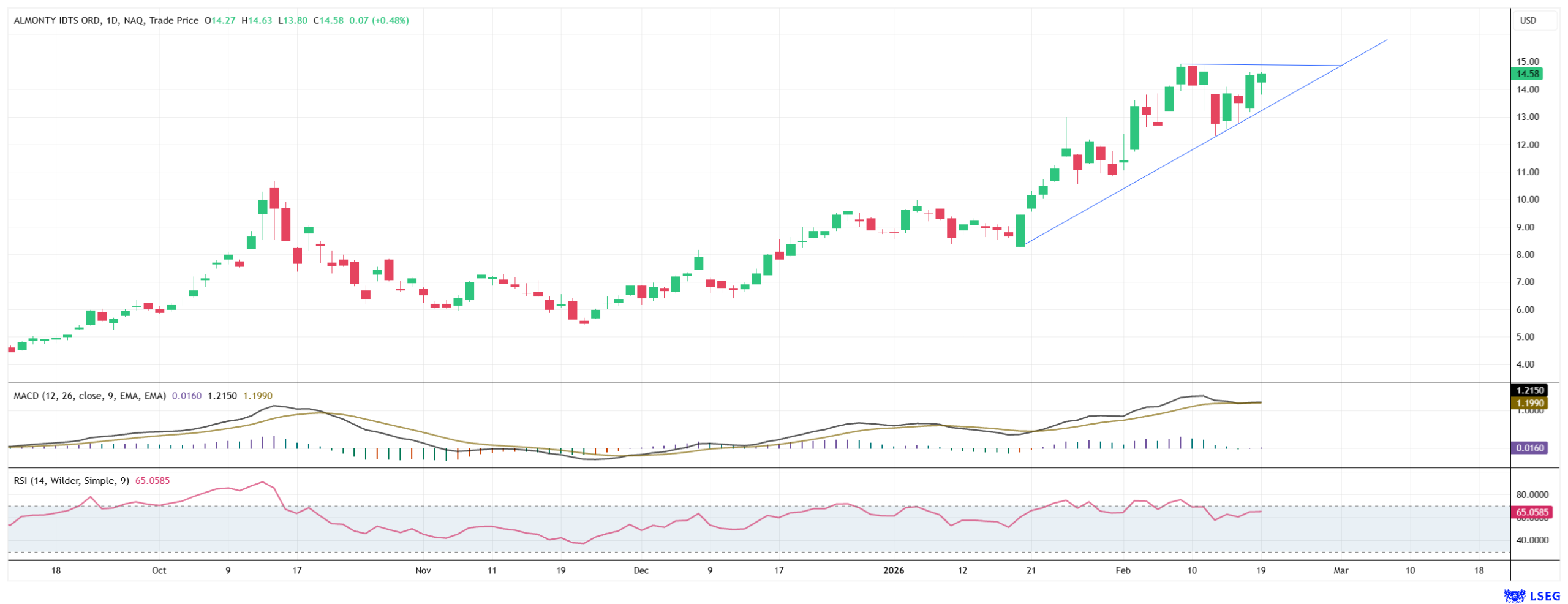
The US plans to ban Chinese tungsten from defense procurement starting in 2027. Europe is also planning strategic raw material stockpiles. This is creating a tangible supply gap outside China. This is precisely where Almonty Industries is positioning itself as a Western-oriented supplier with projects in South Korea, Portugal, and the US. While the market debates supply bottlenecks, the company is delivering operational results.
At the heart of this is the Sangdong mine in South Korea, one of the largest deposits outside China. The first ore transport to the processing plant was reported at the end of 2025. Commercial production is scheduled to start in the first quarter of 2026, with a second expansion phase planned for 2027. Sangdong could potentially supply over 460,000 MTU annually.
Business model with strategic leverage
The investment case lies not only in rising prices, but also in strategic positioning along geopolitical fault lines. Almonty already operates a producing tungsten mine in Portugal. Sangdong now follows with a large-volume capacity boost in a politically stable region with existing infrastructure, which is a decisive factor in reducing operational risks. At the same time, the US footprint has been expanded with a project in Montana, which is also scheduled to go into production in 2026. In addition, there is a high-grade molybdenum project as an additional option.
With the ramp-up of Sangdong, the company could potentially serve around 40% of non-Chinese tungsten demand. This shifts its role from project developer to strategic supplier.
The expansion is financially backed, with over USD 219 million gross raised in the US in 2025, supplemented by the listing on NASDAQ. Long-term purchase agreements with the US defense industry ensure visibility and political involvement.
The personnel structure is also noteworthy. Former high-ranking military and security experts occupy key positions. This is no coincidence, but rather a reflection of a changed reality in the commodities market. Critical metals are increasingly being viewed as security goods.
Operationally, the new mine is expected to be competitive thanks to efficiency gains, especially compared to Chinese suppliers, whose prices have been distorted by subsidies for decades. With the elimination of these government support mechanisms, the cost structure in the global market is now being reassessed.
One of the big winners of structural change
Experts expect prices to remain close to their current record levels in the medium term. If this new price basis becomes established and Western countries build up their stocks, the market environment will change permanently.
Tungsten is virtually irreplaceable. There are no easy alternatives in defense, semiconductor manufacturing, and high-precision technology.
In a world of increasing bloc formation, it is not only the price that counts, but also the origin of the critical raw material.
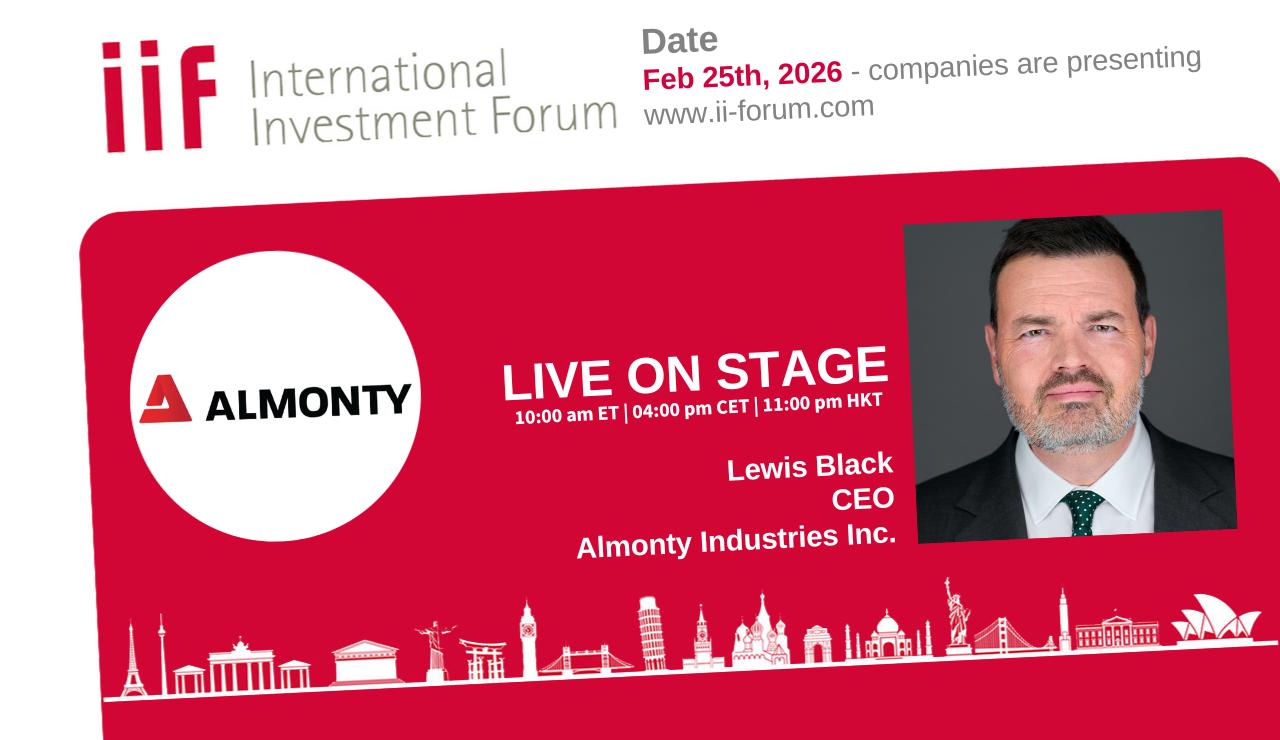
With production starting in South Korea, expansion in the US, and existing production in Europe, Almonty is positioning itself precisely where security of supply is politically desirable. In a market that is shifting from free trade to strategic control, the company could be one of the key winners of the new raw materials era.
Conflict of interest
Pursuant to §85 of the German Securities Trading Act (WpHG), we point out that Apaton Finance GmbH as well as partners, authors or employees of Apaton Finance GmbH (hereinafter referred to as "Relevant Persons") may hold shares or other financial instruments of the aforementioned companies in the future or may bet on rising or falling prices and thus a conflict of interest may arise in the future. The Relevant Persons reserve the right to buy or sell shares or other financial instruments of the Company at any time (hereinafter each a "Transaction"). Transactions may, under certain circumstances, influence the respective price of the shares or other financial instruments of the Company.
In addition, Apaton Finance GmbH is active in the context of the preparation and publication of the reporting in paid contractual relationships.
For this reason, there is a concrete conflict of interest.
The above information on existing conflicts of interest applies to all types and forms of publication used by Apaton Finance GmbH for publications on companies.
Risk notice
Apaton Finance GmbH offers editors, agencies and companies the opportunity to publish commentaries, interviews, summaries, news and the like on news.financial. These contents are exclusively for the information of the readers and do not represent any call to action or recommendations, neither explicitly nor implicitly they are to be understood as an assurance of possible price developments. The contents do not replace individual expert investment advice and do not constitute an offer to sell the discussed share(s) or other financial instruments, nor an invitation to buy or sell such.
The content is expressly not a financial analysis, but a journalistic or advertising text. Readers or users who make investment decisions or carry out transactions on the basis of the information provided here do so entirely at their own risk. No contractual relationship is established between Apaton Finance GmbH and its readers or the users of its offers, as our information only refers to the company and not to the investment decision of the reader or user.
The acquisition of financial instruments involves high risks, which can lead to the total loss of the invested capital. The information published by Apaton Finance GmbH and its authors is based on careful research. Nevertheless, no liability is assumed for financial losses or a content-related guarantee for the topicality, correctness, appropriateness and completeness of the content provided here. Please also note our Terms of use.