January 22nd, 2026 | 06:55 CET
AI and the uranium comeback: How American Atomics is becoming the winner of the energy transition and what that has to do with Meta Platforms and Infineon
The era of artificial intelligence (AI) is not only an era of enormous productivity gains, but above all an era of infrastructure and gigantic energy consumption. While the last decade was dominated by software, the future will be all about hardware. Generative AI and the path toward artificial general intelligence (AGI) are transforming data from an intangible asset into a massive consumer of power. Analysts at Goldman Sachs estimate that investments by major US tech companies in energy infrastructure could reach the astronomical sum of over USD 500 billion by 2027. This new reality is forcing a two-pronged energy strategy: on the one hand, the massive expansion of storage and efficiency technologies, and on the other, the inevitable return to the only CO2-free energy source that reliably provides base load – nuclear power. We explain what tech titan Meta Platforms and chip manufacturer Infineon have to do with this development and why American Atomics is considered a highly speculative but strategically brilliant bet on the uranium comeback.
time to read: 3 minutes | Author: Nico Popp
ISIN: AMERICAN ATOMICS INC | CA0240301089 , META PLATFORMS INC | US30303M1027 , INFINEON TECH.AG NA O.N. | DE0006231004
Table of contents:
Author

Nico Popp
At home in Southern Germany, the passionate stock exchange expert has been accompanying the capital markets for about twenty years. With a soft spot for smaller companies, he is constantly on the lookout for exciting investment stories.
Tag cloud
Shares cloud
Meta Platforms: From social network to AI giant
To understand the extent of the energy hunger, one must look at Meta Platforms. The Company is radically transforming itself from a pure social media provider to an operator of gigantic "AI factories." According to recent reports, Meta plans to invest around USD 600 billion by 2028, primarily in the construction of new US data centers and their energy self-sufficiency. CEO Mark Zuckerberg has recognized that computing power will become the hardest currency of the future – and that this currency must be backed by energy.
The AI training runs for the next generation of Llama models, generating peak loads that bring conventional power grids to their knees. Data from the International Energy Agency (IEA) predicts that global electricity consumption by data centers will double to over 1,000 terawatt hours by 2030. Meta is responding to this not only as a customer, but also as an active shaper of the energy infrastructure, increasingly seeking its own independent power sources.
Infineon: The silent power in the server room
But before electricity can be converted into computing power, it must be controlled efficiently. This is where Infineon Technologies comes into play. The German semiconductor company supplies the essential components without which modern AI servers would not exist. The new power semiconductors based on silicon carbide (SiC) and gallium nitride (GaN) are the key to reducing waste heat in server racks and dramatically increasing energy efficiency.
Infineon is also benefiting from the boom in battery energy storage systems (BESS), which serve as buffers for the volatile load peaks of AI clusters. The market for lithium-ion batteries in data centers is forecast to grow significantly through 2034, which is driving massive demand for Infineon's battery management systems (BMS). Infineon is thus the "pick-and-shovel" play for the electrical side of AI infrastructure – indispensable, technologically leading, but dependent on the availability of cheap base load power.
American Atomics and the uranium comeback
This is where the circle closes with uranium. Batteries can store energy, but they cannot generate it for weeks on end. There is no alternative to nuclear energy for the continuous operation of AI gigafactories. The World Nuclear Association forecasts a deficit of up to 50 million pounds of uranium per year by 2030. American Atomics is addressing this massive supply deficit. The Company aims to fill the gap in US uranium caused by the AI boom and the decoupling from Russian imports.
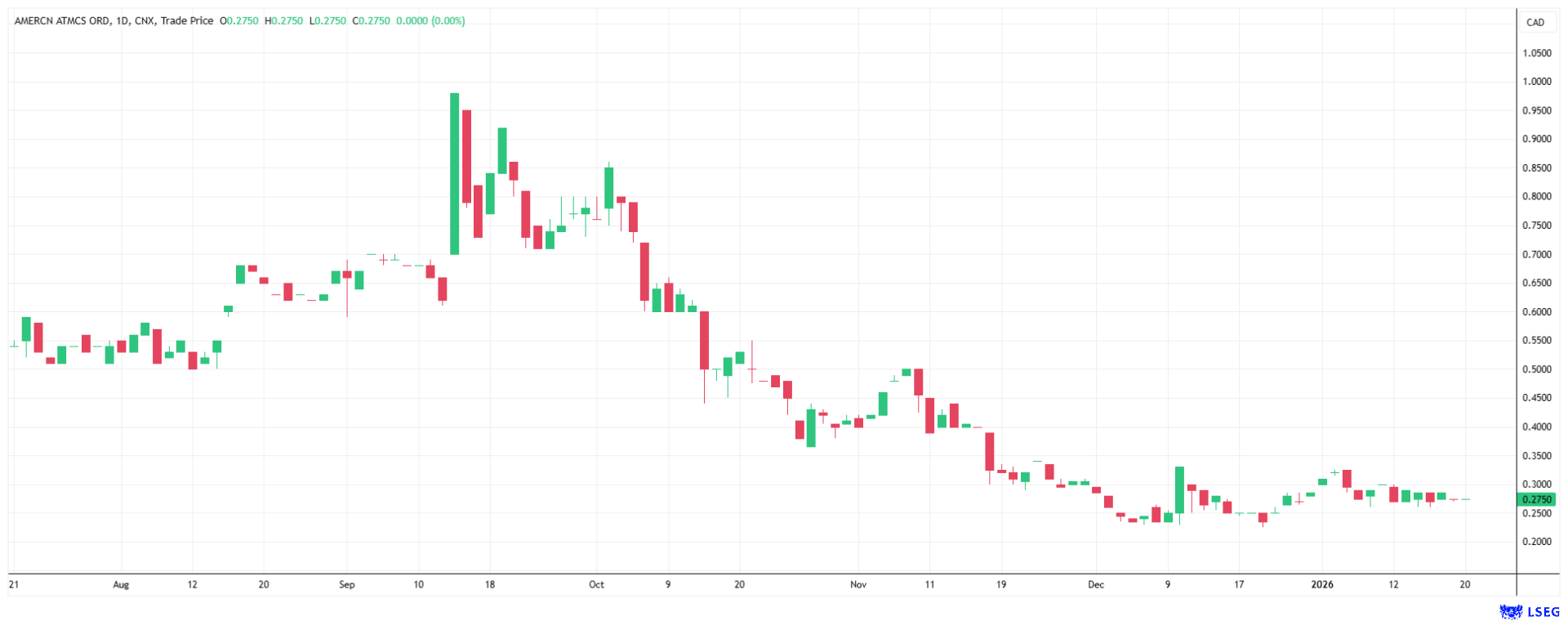
American Atomics' assets are no accident. The Company recently secured high-grade uranium claims in the state of Utah, a historic stronghold of uranium mining, through a letter of intent. Particularly exciting for investors: the new Big Indian project in Lisbon Valley is located just over 100 km from the White Mesa Mill, the only fully licensed and operational conventional uranium mill in the US. This strategic location eliminates the often serious logistical risk for junior miners and should make a potential production decision easier.
American Atomics is also diversifying its risk with a portfolio of lithium and rare earth projects in Quebec. But the real driver for the stock is uranium. The renaissance of nuclear power, driven by tech giants such as Microsoft, which already wants to reactivate the Three Mile Island reactor, and Meta, is creating a supercycle for uranium mined directly in the US.
Conclusion: Betting on the necessity of nuclear power
For investors, there is a clear hierarchy of opportunities. Meta and Infineon are the blue-chip investments for participating in the growth of AI infrastructure. But those looking for maximum leverage on the physical bottleneck resource should look to American Atomics. The Company is currently still valued as an explorer, but it operates in a market where the product – safe, US uranium – is becoming a prerequisite for technological progress. The equation is simple: without nuclear power, there can be no AI dominance. American Atomics is sitting on the fuel for this future. In an environment where security of supply is prioritized over price, American Atomics offers attractive opportunities.
Watch YouTube videoConflict of interest
Pursuant to §85 of the German Securities Trading Act (WpHG), we point out that Apaton Finance GmbH as well as partners, authors or employees of Apaton Finance GmbH (hereinafter referred to as "Relevant Persons") may hold shares or other financial instruments of the aforementioned companies in the future or may bet on rising or falling prices and thus a conflict of interest may arise in the future. The Relevant Persons reserve the right to buy or sell shares or other financial instruments of the Company at any time (hereinafter each a "Transaction"). Transactions may, under certain circumstances, influence the respective price of the shares or other financial instruments of the Company.
In addition, Apaton Finance GmbH is active in the context of the preparation and publication of the reporting in paid contractual relationships.
For this reason, there is a concrete conflict of interest.
The above information on existing conflicts of interest applies to all types and forms of publication used by Apaton Finance GmbH for publications on companies.
Risk notice
Apaton Finance GmbH offers editors, agencies and companies the opportunity to publish commentaries, interviews, summaries, news and the like on news.financial. These contents are exclusively for the information of the readers and do not represent any call to action or recommendations, neither explicitly nor implicitly they are to be understood as an assurance of possible price developments. The contents do not replace individual expert investment advice and do not constitute an offer to sell the discussed share(s) or other financial instruments, nor an invitation to buy or sell such.
The content is expressly not a financial analysis, but a journalistic or advertising text. Readers or users who make investment decisions or carry out transactions on the basis of the information provided here do so entirely at their own risk. No contractual relationship is established between Apaton Finance GmbH and its readers or the users of its offers, as our information only refers to the company and not to the investment decision of the reader or user.
The acquisition of financial instruments involves high risks, which can lead to the total loss of the invested capital. The information published by Apaton Finance GmbH and its authors is based on careful research. Nevertheless, no liability is assumed for financial losses or a content-related guarantee for the topicality, correctness, appropriateness and completeness of the content provided here. Please also note our Terms of use.