October 8th, 2026 | 07:00 CEST
Tungsten Supply Crisis: Almonty Reshapes Defense Supply Chains – Rheinmetall Needs Reliable Sources, Tungsten West Wins Funding
Requirements from the US Department of Defense are forcing Western industry to rethink its approach to critical raw materials: Starting in January 2027, US procurement regulations will prohibit the use of Chinese-sourced tungsten in tungsten powders, heavy alloys, and defense components manufactured from them, and will require a complete chain of custody traceability back to the mining site. According to the US Geological Survey, China controls about 80% of global mine production and, due to export controls, has recently even become a net importer of tungsten metal and ore. As a result, the defense industry faces an acute supply shortage. Producers outside China are doing everything they can to secure long-term supply chains for Western customers. As a leading tungsten company, Almonty stands out in particular with promising projects and a full pipeline.
time to read: 4 minutes
|
Author:
Nico Popp
ISIN:
ALMONTY INDUSTRIES INC. | CA0203987072 | NASDAQ: ALM , RHEINMETALL AG | DE0007030009 , TUNGSTEN WEST PLC | GB00BP6QM557
Table of contents:
Author

Nico Popp
At home in Southern Germany, the passionate stock exchange expert has been accompanying the capital markets for about twenty years. With a soft spot for smaller companies, he is constantly on the lookout for exciting investment stories.
Tag cloud
Shares cloud
Rheinmetall's Munitions Production Relies on Reliable Sources of Raw Materials
The defense contractor Rheinmetall requires tungsten for the production of kinetic energy projectiles and modern armor-piercing ammunition. The penetrating power of the 120 mm cannons, such as those used in the Leopard 2 and M1 Abrams main battle tanks, relies heavily on tungsten heavy alloys with extremely high density. A single APFSDS-T round contains several kilograms of such an alloy. According to S&P Global, global demand for tungsten is expected to rise by about 10% between 2026 and 2030 alone. A halt in shipments from Asia could severely impact Western defense capabilities even in the fifth year of the war in Ukraine.
Tungsten West: Billion-Dollar Contract and Government Aid in England
In Europe, Tungsten West is reactivating a tungsten mine at Hemerdon in Devon, England. Under the development plan, the facility is expected to produce an average of about 330,000 MTU per year once operational. One MTU (metric ton unit) is equivalent to 10 kg of tungsten trioxide. The British project is receiving extensive government and private-sector support to ensure a smooth operational ramp-up. The government's National Wealth Fund alone is investing up to GBP 71 million. The US processor Elmet Technologies, which itself receives USD 450 million in support from the US Department of Defense, has secured 1,000 metric tons of tungsten trioxide per year under an 8-year contract. At current prices, the contract is worth more than GBP 1.4 billion. The company uses sensor-based sorting systems to process its low-grade ores as efficiently as possible. Tungsten West aims to reach full commercial capacity by 2027. However, local environmental regulations require continuous investment in process optimization and the establishment of a reclamation fund. Tungsten West has not yet reached its goal.
Almonty: Start of Production and Scaling Up in Sangdong
Next up is Almonty Industries. The US-based tungsten company operates two producing mines, Panasqueira and Sangdong, as well as other projects that can deliver in the short and medium term. The Sangdong mine was operated by Korea Tungsten until the early 1990s. With grades ranging from 0.45% (reserves) to 0.51% WO₃ (measured and indicated resources), it is now one of the world's highest-grade tungsten deposits. Almonty estimates a mine life of more than 45 years, while internal studies see potential for a significantly longer life. The company completed construction of Phase I after extensive investment and shipped its first concentrates for export in September. In Phase I, 640,000 metric tons of ore pass through the processing facilities annually; starting in 2027, Phase II is expected to double this to 1.2 million metric tons of ore. Upon completion of Phase II, Sangdong is expected to produce approximately 460,000 MTU annually, thereby covering a significant portion of Western market demand.
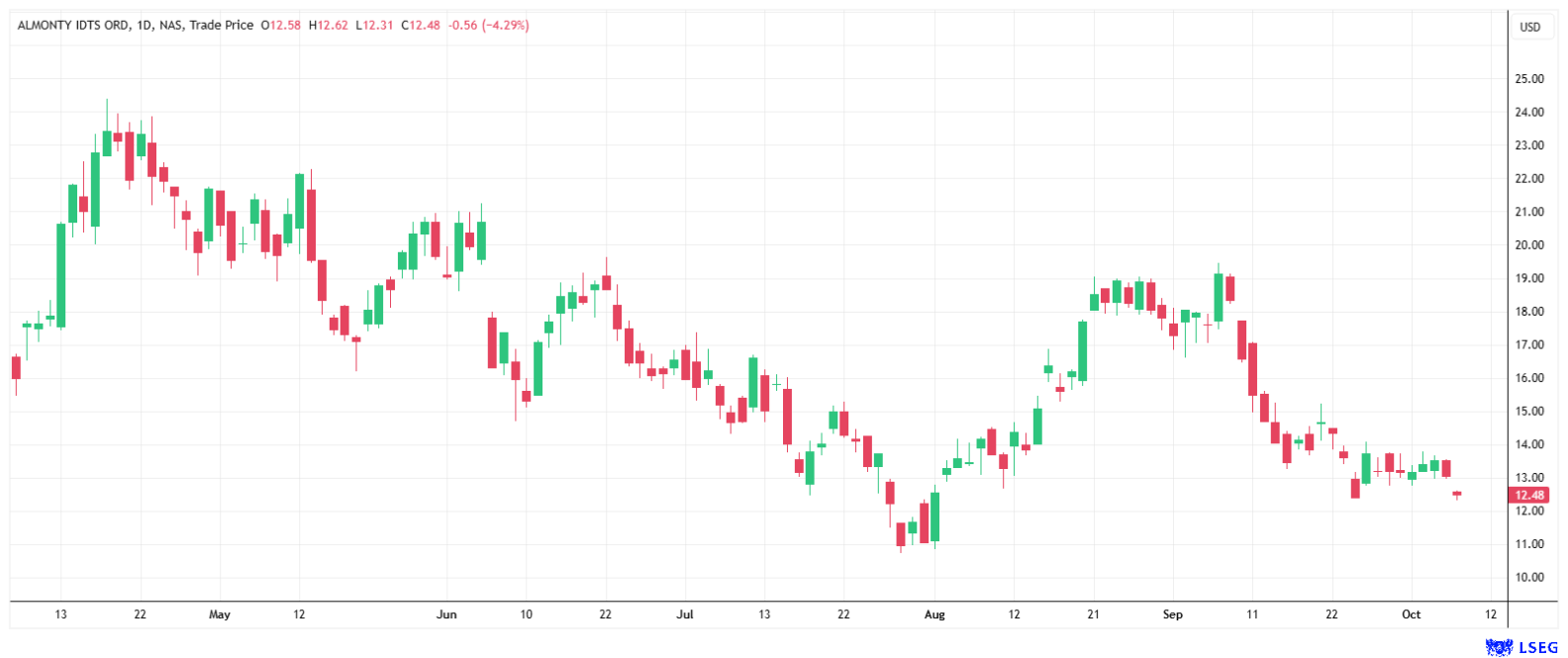
To secure long-term revenue from this massive mine, the company signed a supply agreement with the US powder manufacturer Global Tungsten & Powders, part of the Austrian Plansee Group. This agreement commits approximately 90% of the production volume from the first expansion phase to the customer in Pennsylvania over 21 years. A guaranteed minimum price of USD 235 per MTU protects Almonty from market fluctuations and secures significant base revenue. At the same time, management is deliberately leaving the volumes from the upcoming Phase II unbound. This will allow the company to benefit more from future spot-market price increases, but it also means the company bears the price risk. In many other tungsten companies, the government is stepping in as an investor. Almonty, by contrast, has financed its growth so far primarily through private investors in the capital market.
Almonty Advances Projects Across Multiple Continents
Almonty is now active far beyond Korea. In Portugal, the historic Panasqueira mine is expected to supply up to 124,000 MTU per year in the future with the development of Level 4; a drilling program is currently underway for this purpose. At the same time, the company is developing a deeper molybdenum deposit in Sangdong. The South Korean steel group SeAH M&S has already committed to purchasing all molybdenum production over the mine's lifespan at a minimum price of USD 19.00 per pound. With the acquisition of the Gentung Browns Lake project in the US state of Montana in November 2025, Almonty also secured its first significant tungsten asset on US soil.
In September, Almonty added two additional projects. The first is a joint venture with the Rwandan government to collect, process, and export tungsten ore and tailings from local producers, as well as explore new deposits. The second is a multi-year offtake agreement with Wolfram Bergbau und Hütten AG, a subsidiary of the Swedish industrial group Sandvik. To this end, Almonty is processing tailings from its decommissioned Los Santos mine in Spain using its own technology and will supply approximately 1,720 metric tons of tungsten trioxide. In the future, this process could also be used in other regions of Europe to secure valuable tungsten. In June, Almonty financed these far-reaching plans in part through an oversubscribed convertible senior notes offering worth USD 800 million. Its interest rate: a modest 2.25%.
Almonty: Catalysts, New Rating and Residual Risks
Analysts at Stifel initiated coverage of Almonty in late September with a clear "Buy" rating and a price target of USD 25. The US analysts base their argument on a structural shift in the global tungsten market, which they say faces massive supply shortages due to China's strict export controls and domestic mining restrictions. This restrictive policy has driven tungsten prices up by about 775% since early 2025. Analyses by S&P Global also indicate that, outside of China, an unmet supply deficit of approximately 16,000 metric tons of tungsten trioxide will persist through 2030, regardless of new projects. Risks include potential operational delays during the ramp-up, fluctuating ore grades, customer concentration, and foreign exchange effects. The market conditions for Almonty, which is already in production and expanding capacity on a large scale, are unique. The stock remains an exciting option.
Conflict of interest
Pursuant to §85 of the German Securities Trading Act (WpHG), we point out that Apaton Finance GmbH as well as partners, authors or employees of Apaton Finance GmbH (hereinafter referred to as "Relevant Persons") currently hold or hold shares or other financial instruments of the aforementioned companies and speculate on their price developments. In this respect, they intend to sell or acquire shares or other financial instruments of the companies (hereinafter each referred to as a "Transaction"). Transactions may thereby influence the respective price of the shares or other financial instruments of the Company.
In this respect, there is a concrete conflict of interest in the reporting on the companies.
In addition, Apaton Finance GmbH is active in the context of the preparation and publication of the reporting in paid contractual relationships.
For this reason, there is also a concrete conflict of interest.
The above information on existing conflicts of interest applies to all types and forms of publication used by Apaton Finance GmbH for publications on companies.
Risk notice
Apaton Finance GmbH offers editors, agencies and companies the opportunity to publish commentaries, interviews, summaries, news and the like on news.financial. These contents are exclusively for the information of the readers and do not represent any call to action or recommendations, neither explicitly nor implicitly they are to be understood as an assurance of possible price developments. The contents do not replace individual expert investment advice and do not constitute an offer to sell the discussed share(s) or other financial instruments, nor an invitation to buy or sell such.
The content is expressly not a financial analysis, but a journalistic or advertising text. Readers or users who make investment decisions or carry out transactions on the basis of the information provided here do so entirely at their own risk. No contractual relationship is established between Apaton Finance GmbH and its readers or the users of its offers, as our information only refers to the company and not to the investment decision of the reader or user.
The acquisition of financial instruments involves high risks, which can lead to the total loss of the invested capital. The information published by Apaton Finance GmbH and its authors is based on careful research. Nevertheless, no liability is assumed for financial losses or a content-related guarantee for the topicality, correctness, appropriateness and completeness of the content provided here. Please also note our Terms of use.