December 8th, 2025 | 07:00 CET
True sustainability in the portfolio: JinkoSolar, Nordex, and the smart niche player RE Royalties
"Green" is no longer a mark of quality on the stock market, but rather a minimum requirement. However, those who mindlessly invest in anything with a solar panel or wind turbine in its logo will often have learned a costly lesson by 2025. The sector is becoming more differentiated: on the one hand, the industrial heavyweights are struggling with price wars and supply chains. On the other hand, specialized financiers are emerging who are closing precisely these gaps and often operating more profitably than the manufacturers themselves. Anyone seeking real returns must now make a clear selection: between mass-market players, turnaround candidates, and intelligent niche specialists.
time to read: 3 minutes | Author: Nico Popp
ISIN: RE ROYALTIES LTD | CA75527Q1081 , JINKOSOLAR ADR/4 DL-00002 | US47759T1007 , NORDEX SE O.N. | DE000A0D6554
Table of contents:
Author

Nico Popp
At home in Southern Germany, the passionate stock exchange expert has been accompanying the capital markets for about twenty years. With a soft spot for smaller companies, he is constantly on the lookout for exciting investment stories.
Tag cloud
Shares cloud
JinkoSolar: Scale with margin pressure
When talking about photovoltaics, there is no getting around JinkoSolar. The Chinese module giant is the embodiment of large-scale expansion in renewable energy. Jinko is flooding the global markets with its highly efficient N-Type TOPCon technology and aggressively defending its market leadership. However, the figures for the third quarter of 2025 reveal the cost of this growth. Revenue fell dramatically year-on-year to around RMB 16.2 billion (approximately USD 2.3 billion), as module prices fell faster than sales volumes could rise.
For investors, the situation is serious: Instead of a profit, the Company posted a net loss of around USD 105 million in the third quarter – a stark contrast to the previous year. The strategy is clear: to push competitors out of the market through volume and, as the "last man standing," dictate prices. This is strategically sound, but for shareholders, the current red figures represent a test of patience that offers little return in the short term.
Nordex: The successful turnaround
The mood is quite different at Hamburg-based wind turbine manufacturer Nordex. Here, the motto is no longer "survival" but "reaping the rewards." After years of suffering from skyrocketing raw material costs and supply chain chaos across the entire wind industry, Nordex made an impressive turnaround in 2025. The books are full, and turbine prices have stabilized. However, profitability is even more important. In the third quarter of 2025, the EBITDA margin jumped to a strong 8.0% – a top result for a company that had been burning through cash for a long time.
Order intake shows that demand for onshore wind power remains strong. Nordex is benefiting from the fact that project developers in Europe and North America are no longer primarily focused on price, but on reliable delivery. The stock has shed its status as a problem child and has become a profitable basic investment in the wind sector. The fact that margins are finally climbing to healthy levels justifies the new confidence.
RE Royalties provides the smart money for the energy transition
While Jinko is posting losses and Nordex is supplying the hardware, RE Royalties is providing the capital for green projects – in a way that is unique in the renewable energy sector. The Canadian company does not grant traditional bank loans or issue new shares to finance projects. Instead, it buys into the revenue streams of solar, wind, and storage parks directly through license fees or royalties. The model is ingeniously simple: RE Royalties provides money for construction and, in return, receives a percentage of gross revenue - often over the entire lifetime of the plant.
The portfolio has now grown to over 100 royalties and projects, which reduces cluster risk. Although the latest quarterly figures showed a slight decline in revenue, the reason for this is positive: customers have repaid loans early or triggered royalties. This brings cash into the coffers, which can then be reinvested. This allows the experienced team at RE Royalties to gradually turn an even bigger wheel in renewables.
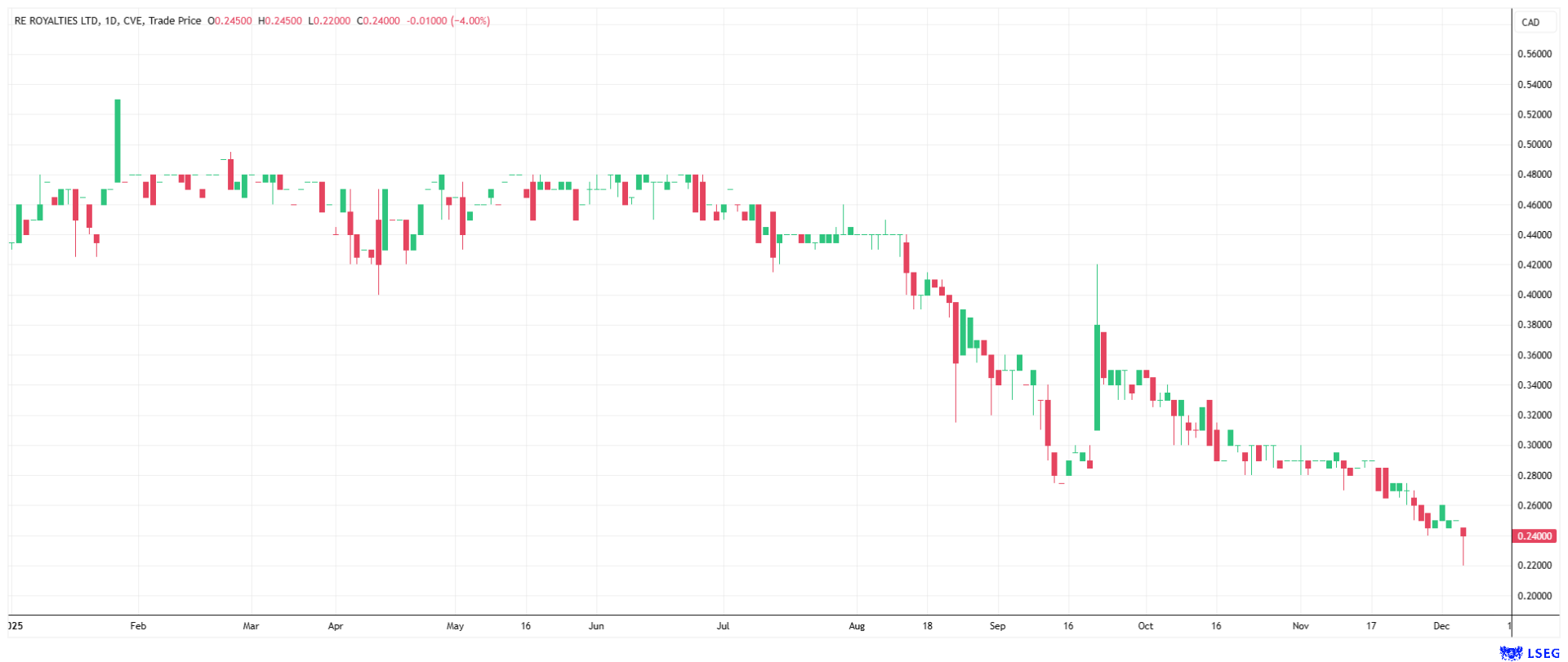
RE Royalties prefers to finance this growth through green bonds. This is extremely clever. Just a few weeks ago, the Company completed a bond tranche with a 9% interest rate. The fact that professional investors are very interested in lending money to RE Royalties at this interest rate is a sign of confidence. With a current market capitalization of less than CAD 20 million, the stock is still flying under the radar of many investors. But the model is highly scalable: rising electricity prices and more projects automatically mean more royalties without increasing RE Royalties' cost base.
RE Royalties: Dividend yield of almost 10% is convincing
This also makes RE Royalties' stock interesting - the Company acts like a toll station on the highway. No matter who builds the wind turbines or supplies the modules, as long as the electricity flows, RE Royalties collects its share. For investors looking for dividends and growth away from volatile hardware manufacturers, this micro-cap is a real discovery. The dividend yield of almost 10% makes RE Royalties a solid stock with a lot of imagination. Investors should take a closer look at this exciting small-cap.
Watch YouTube videoConflict of interest
Pursuant to §85 of the German Securities Trading Act (WpHG), we point out that Apaton Finance GmbH as well as partners, authors or employees of Apaton Finance GmbH (hereinafter referred to as "Relevant Persons") may hold shares or other financial instruments of the aforementioned companies in the future or may bet on rising or falling prices and thus a conflict of interest may arise in the future. The Relevant Persons reserve the right to buy or sell shares or other financial instruments of the Company at any time (hereinafter each a "Transaction"). Transactions may, under certain circumstances, influence the respective price of the shares or other financial instruments of the Company.
In addition, Apaton Finance GmbH is active in the context of the preparation and publication of the reporting in paid contractual relationships.
For this reason, there is a concrete conflict of interest.
The above information on existing conflicts of interest applies to all types and forms of publication used by Apaton Finance GmbH for publications on companies.
Risk notice
Apaton Finance GmbH offers editors, agencies and companies the opportunity to publish commentaries, interviews, summaries, news and the like on news.financial. These contents are exclusively for the information of the readers and do not represent any call to action or recommendations, neither explicitly nor implicitly they are to be understood as an assurance of possible price developments. The contents do not replace individual expert investment advice and do not constitute an offer to sell the discussed share(s) or other financial instruments, nor an invitation to buy or sell such.
The content is expressly not a financial analysis, but a journalistic or advertising text. Readers or users who make investment decisions or carry out transactions on the basis of the information provided here do so entirely at their own risk. No contractual relationship is established between Apaton Finance GmbH and its readers or the users of its offers, as our information only refers to the company and not to the investment decision of the reader or user.
The acquisition of financial instruments involves high risks, which can lead to the total loss of the invested capital. The information published by Apaton Finance GmbH and its authors is based on careful research. Nevertheless, no liability is assumed for financial losses or a content-related guarantee for the topicality, correctness, appropriateness and completeness of the content provided here. Please also note our Terms of use.