March 9th, 2026 | 07:50 CET
Africa's hardest currency: New perspectives from Barrick Mining, Compass Gold, and Desert Gold
A noticeable shift is currently taking place in African mining, as mineral resources are increasingly being viewed as the continent's hardest currency. This trend was highlighted at the African Mining Indaba in Cape Town in February, where the concept of a "Bank of African Settlements" was discussed. The stated goal of this initiative is to establish mineral resources as bankable assets to reduce dependence on volatile fiat currencies such as the US dollar. For many African nations, this is a direct response to the harsh reality that some local currencies have depreciated by as much as 900% against the US dollar over the past two decades. At the same time, market data supports this trend, with foreign central banks' gold reserves exceeding their holdings of US government bonds for the first time since 1996. Combined with growing efforts toward political self-determination and the expansion of reliable infrastructure, this shift is opening up attractive opportunities for investors. In this environment, industry heavyweight Barrick Mining is consolidating its industrial base in Mali, while emerging explorers such as Compass Gold and Desert Gold are actively searching for new deposits.
time to read: 3 minutes | Author: Nico Popp
ISIN: BARRICK MINING CORPORATION | CA06849F1080 | NYSE:B , TSX: ABX , COMPASS GOLD CORPORATION | CA20451T4054 | TSXV: CVB , DESERT GOLD VENTURES INC | CA25039N4084 | TSXV: DAU , OTCQB: DAUGF
Table of contents:
Author

Nico Popp
At home in Southern Germany, the passionate stock exchange expert has been accompanying the capital markets for about twenty years. With a soft spot for smaller companies, he is constantly on the lookout for exciting investment stories.
Tag cloud
Shares cloud
Barrick Mining secures industrial base in Mali
The Barrick Mining Group is one of the most important companies in West Africa and demonstrates how operational strength coupled with diplomatic skill can pay off in a challenging environment. An important signal to global markets was the settlement of the dispute with the Malian government over the Loulo-Gounkoto complex, which accounts for about one-third of the country's industrial gold production. After months of uncertainty, Barrick Mining regained full operational control at the end of 2025 and extended its mining license for another ten years. The agreement included a payment of USD 253 million to the state and acceptance of the new mining law. Financially, the producer is in an excellent position after this breakthrough. For the full year 2025, Barrick reported operating cash flow of USD 7.69 billion, ended the year with a net cash position of USD 2 billion, and increased its quarterly dividend by 140% to USD 0.42 per share. This new stability gives not only the company but the entire region a boost of confidence that benefits smaller exploration companies.
Compass Gold and the power of democratized geodata
While Barrick stands for industrial scaling, Compass Gold leverages technological innovations for its exploration. The company controls an area of over 1,100 km² in southern Mali and benefits significantly from the democratization of geological data. Free access to this information is a core demand of African mining activists in order to promote local exploration and reduce the starting disadvantage compared to large corporations. Through systematic access to high-resolution aeromagnetic surveys and the use of AI-supported models, Compass Gold has already identified several near-surface targets that had previously been overlooked. The current focus is on the Massala project on the Tarabala trend. Management firmly expects the authorities to grant a license for small mines by the end of March 2026. This streamlined approach delivers compelling economic metrics in times of high precious metal prices and offers a quick alternative to the lengthy approval processes of traditional large-scale projects. In February 2026, the company secured CAD 5.4 million, which will be used to develop a processing plant.
Desert Gold Ventures on its way to becoming an African producer
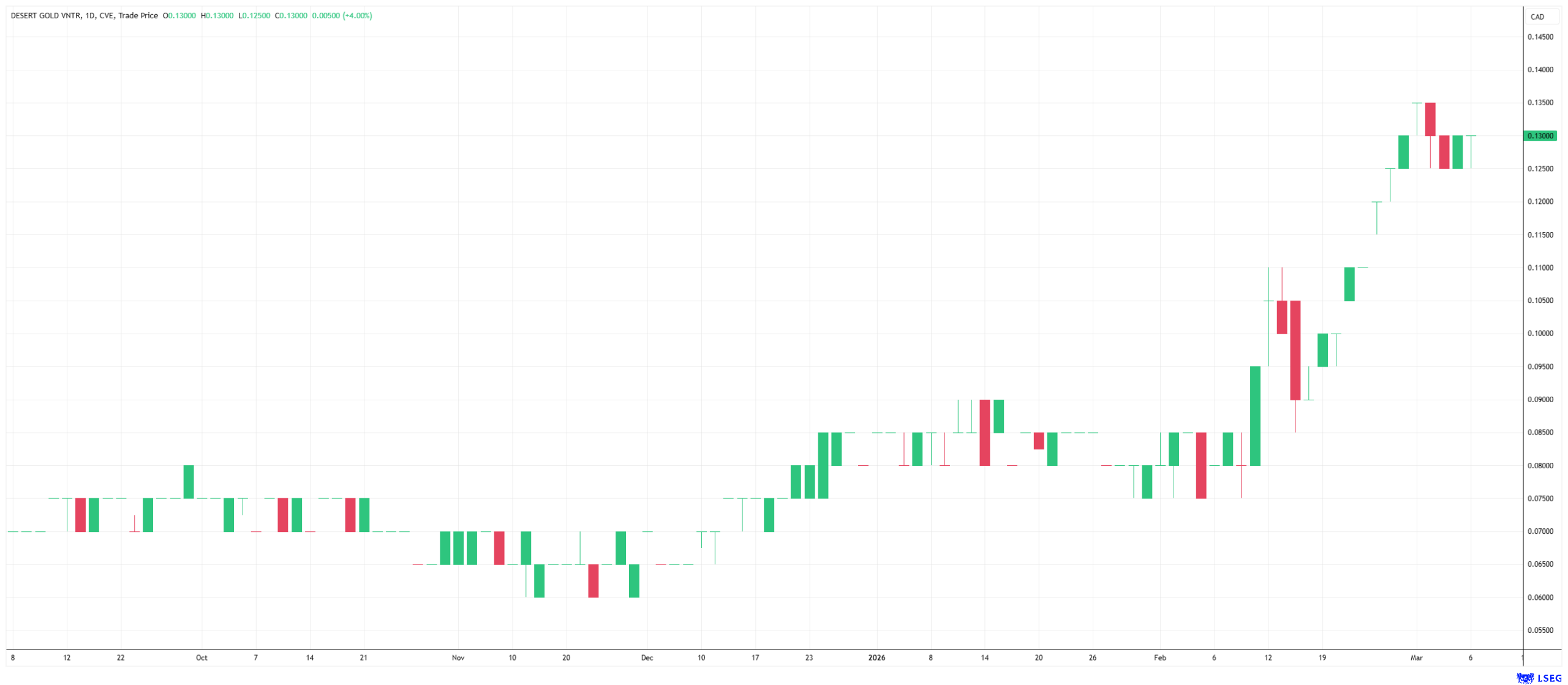
Desert Gold Ventures is positioning itself in the immediate vicinity of these players as the discoverer of the next major gold deposit. Desert's flagship project is located in the Senegal-Mali shear zone, in close proximity to Barrick's Loulo and B2Gold's Fekola large-scale mines. The defined resources of approximately 1.1 million ounces of gold form the geological basis for the planned start of production in the current year. In order to rapidly advance development, the company has completed oversubscribed financing of CAD 7.18 million. What is particularly noteworthy about this measure is the targeted mobilization of African capital, which underscores the company's local roots and ensures long-term acceptance of its operations in the region. CEO Jared Scharf emphasizes that the involvement of local partners and the creation of local jobs are crucial to ensuring a long-term operating license.
Modular approach enables high returns
Desert Gold is implementing a pragmatic concept to make the transition from pure explorer to profitable producer. By using a modular processing plant at the Barani East project, the company is keeping initial investment costs extremely low at around USD 20.4 million and enabling rapid cash flow. In a strong market environment, with the gold price reaching record highs of over USD 5,140 per ounce, the project offers outstanding profit margins. Analyses show that, assuming a spot price of USD 4,070, the net present value jumps to a strong USD 124 million, and the return significantly exceeds the 100% mark. At the same time, the projected total cost of the project is only USD 1,137 per ounce, which promises enormous operational profitability. As Desert Gold is investing heavily in local African value creation and can generate revenue quickly thanks to low barriers to entry, the stock currently offers risk-tolerant investors extremely attractive return opportunities in the emerging African mining sector.
Watch YouTube videoConflict of interest
Pursuant to §85 of the German Securities Trading Act (WpHG), we point out that Apaton Finance GmbH as well as partners, authors or employees of Apaton Finance GmbH (hereinafter referred to as "Relevant Persons") currently hold or hold shares or other financial instruments of the aforementioned companies and speculate on their price developments. In this respect, they intend to sell or acquire shares or other financial instruments of the companies (hereinafter each referred to as a "Transaction"). Transactions may thereby influence the respective price of the shares or other financial instruments of the Company.
In this respect, there is a concrete conflict of interest in the reporting on the companies.
In addition, Apaton Finance GmbH is active in the context of the preparation and publication of the reporting in paid contractual relationships.
For this reason, there is also a concrete conflict of interest.
The above information on existing conflicts of interest applies to all types and forms of publication used by Apaton Finance GmbH for publications on companies.
Risk notice
Apaton Finance GmbH offers editors, agencies and companies the opportunity to publish commentaries, interviews, summaries, news and the like on news.financial. These contents are exclusively for the information of the readers and do not represent any call to action or recommendations, neither explicitly nor implicitly they are to be understood as an assurance of possible price developments. The contents do not replace individual expert investment advice and do not constitute an offer to sell the discussed share(s) or other financial instruments, nor an invitation to buy or sell such.
The content is expressly not a financial analysis, but a journalistic or advertising text. Readers or users who make investment decisions or carry out transactions on the basis of the information provided here do so entirely at their own risk. No contractual relationship is established between Apaton Finance GmbH and its readers or the users of its offers, as our information only refers to the company and not to the investment decision of the reader or user.
The acquisition of financial instruments involves high risks, which can lead to the total loss of the invested capital. The information published by Apaton Finance GmbH and its authors is based on careful research. Nevertheless, no liability is assumed for financial losses or a content-related guarantee for the topicality, correctness, appropriateness and completeness of the content provided here. Please also note our Terms of use.