March 9th, 2026 | 07:30 CET
Energy Shock? Linde, Veolia, and AHT Syngas Offer Strategic Solutions
The stock market and economy are more volatile than ever. The reasons for this are the military escalation in the Middle East and the de facto closure of the Strait of Hormuz. With crude oil prices exceeding USD 90 per barrel and, according to analysts, potentially rising to over USD 150 in a prolonged crisis scenario, the industry is facing a serious challenge. In this environment, the dynamics of the energy transition are also changing: decarbonization is no longer just a regulatory goal for companies, but has become a survival strategy for their own competitiveness. While the industrial gases group Linde forms the technological backbone of decarbonization with its expertise in hydrogen logistics, Veolia Environnement secures resources and even generates crisis-proof cash flows through the management of global material cycles. A.H.T. Syngas is also a good fit with the companies mentioned above. Its gasification plants convert industrial waste streams directly at their source into cost-effective synthesis gas and green hydrogen – a decentralized technology that is more relevant today than ever before.
time to read: 3 minutes | Author: Nico Popp
ISIN: LINDE PLC | IE000S9YS762 , VEOLIA ENVIRONNE. EO 5 | FR0000124141 , A.H.T. SYNGAS TECH. EO 1 | NL0010872388
Table of contents:
Author

Nico Popp
At home in Southern Germany, the passionate stock exchange expert has been accompanying the capital markets for about twenty years. With a soft spot for smaller companies, he is constantly on the lookout for exciting investment stories.
Tag cloud
Shares cloud
Linde as a gas blue chip
Linde closed the past fiscal year very strongly and can therefore be considered an anchor of stability in a volatile market environment. As the world's largest industrial gas company, Linde is a key player in decarbonization and covers the entire hydrogen value chain from production to storage. At the heart of the company's strategy is the transition from being a pure supplier to becoming an integral part of its customers' industrial infrastructure. Through its on-site model, Linde builds and operates plants directly at the customer's site, which is secured by long-term contracts with terms of 15 to 20 years. These agreements guarantee fixed purchase volumes and make Linde immune to short-term fluctuations.
A clear competitive advantage lies in its dense infrastructure, as demonstrated by the operation of the first commercial cavern storage facility for hydrogen in Texas. For the full year 2025, Linde reported revenue of USD 33.99 billion and achieved a strong operating margin of 29.8%. To rapidly advance large-scale decarbonization, Linde is positioning blue hydrogen as a bridge technology and investing USD 1.8 billion in the OCI Blue Ammonia Project in Texas, for example.
Veolia secures material cycles and cash flows
Veolia Environnement is the market leader in the management of water, waste, and energy cycles. According to its current strategic plan, the company is positioning itself as a pioneer in ecological transformation, thus offering reliable cash flows. Its business model is based on a stable core business, which accounts for around 70% of revenue, and dynamic growth drivers such as water technology and hazardous waste treatment.
As the core business is protected by long contract terms averaging 11 years and high inflation indexation of 70%, Veolia can pass on rising costs to its customers almost in full during times of crisis.
A.H.T. Syngas as an agile innovation leader
Within the trio, A.H.T. Syngas Technology takes on the role of agile innovator. While Linde and Veolia are large-scale infrastructure providers, A.H.T. offers decentralized solutions that provide a direct response to dependence on global energy supply chains. A.H.T. Syngas' core product is compact biomass gasification plants that produce tar-free synthesis gas that can be used immediately to generate electricity and heat. A.H.T. achieved a technological milestone in 2025 with the granting of a patent for hydrogen production through the thermal gasification of solid biomass in a fixed-bed reactor.
In contrast to conventional electrolysis, where high electricity prices drive up costs, A.H.T. uses biogenic residues, which are often associated with disposal costs and therefore have a negative price. For investors, however, the strategic realignment is the decisive lever. The company is transforming itself from a plant manufacturer to an integrated energy service provider. It sells the energy it generates directly to medium-sized end customers within the framework of contracting models, which generates regular and highly profitable revenues. A framework agreement with a Japanese customer for 20 plants worth EUR 160 million serves as proof of the market readiness of this technology outside Japan.
A synthesis of resilience and radical self-sufficiency
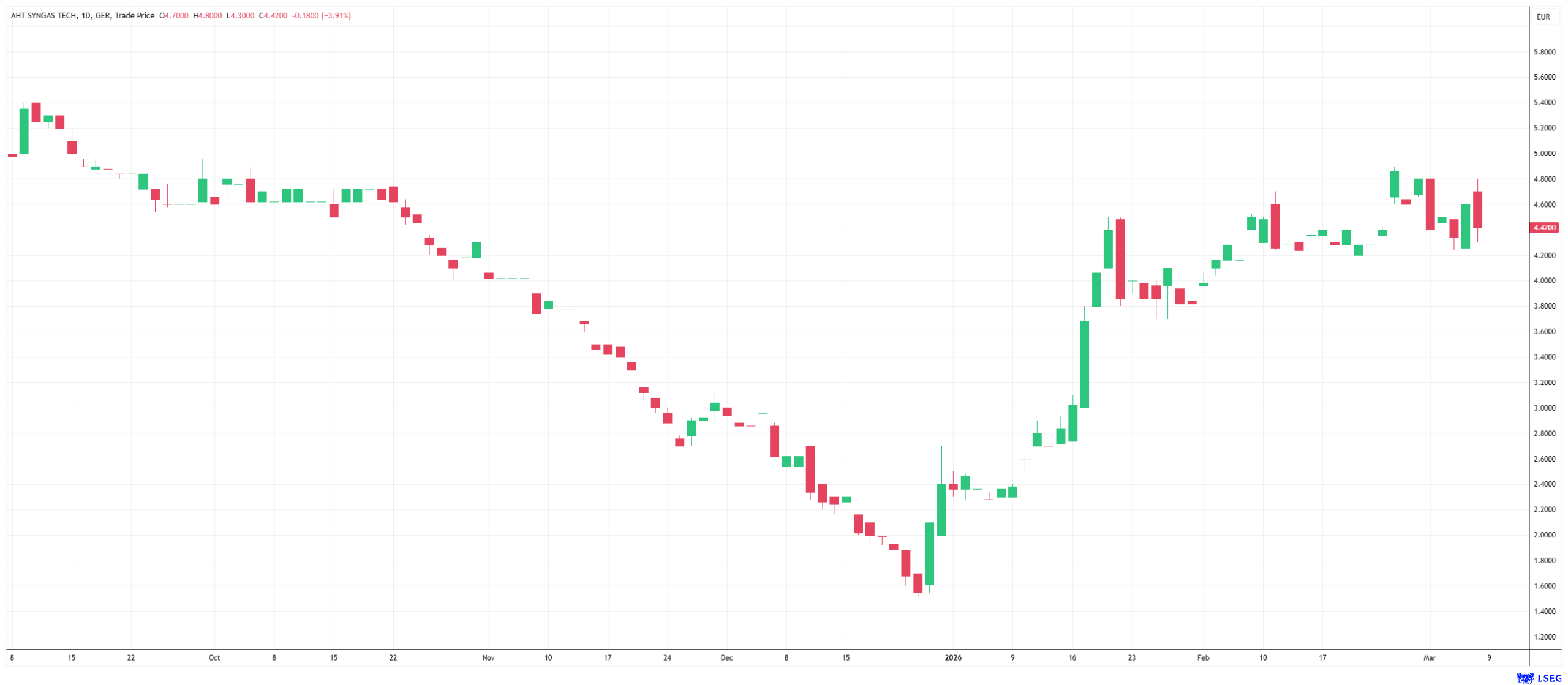
Investors can take advantage of opportunities with the companies mentioned, depending on their risk appetite. The Linde and Veolia groups are classic core investments that offer the necessary stability in the volatile market environment of the current oil price shock. Both companies benefit from their pricing power and long-term contracts. A.H.T. Syngas, on the other hand, is positioned as the favorite with the greatest upside potential for more speculative investors. GBC analysts see a price target of EUR 8.50 for the stock, which would mean a doubling based on the current market capitalization of only EUR 10 to 12 million. With its clear cost advantage over traditional electrolysis and its transformation into an energy producer, A.H.T. enables industrial companies to achieve energy self-sufficiency that is unrivaled in the current market environment. If the market also recognizes this, the stock, which had a good start to the year, should continue to have tailwinds.
Watch YouTube videoConflict of interest
Pursuant to §85 of the German Securities Trading Act (WpHG), we point out that Apaton Finance GmbH as well as partners, authors or employees of Apaton Finance GmbH (hereinafter referred to as "Relevant Persons") may hold shares or other financial instruments of the aforementioned companies in the future or may bet on rising or falling prices and thus a conflict of interest may arise in the future. The Relevant Persons reserve the right to buy or sell shares or other financial instruments of the Company at any time (hereinafter each a "Transaction"). Transactions may, under certain circumstances, influence the respective price of the shares or other financial instruments of the Company.
In addition, Apaton Finance GmbH is active in the context of the preparation and publication of the reporting in paid contractual relationships.
For this reason, there is a concrete conflict of interest.
The above information on existing conflicts of interest applies to all types and forms of publication used by Apaton Finance GmbH for publications on companies.
Risk notice
Apaton Finance GmbH offers editors, agencies and companies the opportunity to publish commentaries, interviews, summaries, news and the like on news.financial. These contents are exclusively for the information of the readers and do not represent any call to action or recommendations, neither explicitly nor implicitly they are to be understood as an assurance of possible price developments. The contents do not replace individual expert investment advice and do not constitute an offer to sell the discussed share(s) or other financial instruments, nor an invitation to buy or sell such.
The content is expressly not a financial analysis, but a journalistic or advertising text. Readers or users who make investment decisions or carry out transactions on the basis of the information provided here do so entirely at their own risk. No contractual relationship is established between Apaton Finance GmbH and its readers or the users of its offers, as our information only refers to the company and not to the investment decision of the reader or user.
The acquisition of financial instruments involves high risks, which can lead to the total loss of the invested capital. The information published by Apaton Finance GmbH and its authors is based on careful research. Nevertheless, no liability is assumed for financial losses or a content-related guarantee for the topicality, correctness, appropriateness and completeness of the content provided here. Please also note our Terms of use.