January 7th, 2026 | 07:00 CET
Trade war over batteries: China's export restrictions force the West to act – and position NEO Battery Materials as a potential game changer for AeroVironment and DroneShield
The geopolitical map of the technology sector is currently being redrawn. After China drastically tightened export controls in recent weeks on critical drone components and high-performance batteries, Western defense companies are increasingly facing supply chain risks. In this strategic environment, the Canadian company NEO Battery Materials is evolving from a pure technology developer into a strategically relevant industrial partner. With the recently announced market readiness of its silicon-based battery technology, NEO offers a non-Chinese alternative that could become highly attractive for drone manufacturers such as AeroVironment and counter-drone specialists like DroneShield, as they seek to reduce dependence on Asian supply chains and secure long-term production reliability.
time to read: 3 minutes | Author: Nico Popp
ISIN: NEO BATTERY MATERIALS LTD | CA62908A1003 , AEROVIRONMENT DL -_0001 | US0080731088 , DRONESHIELD LTD | AU000000DRO2
Table of contents:
Author

Nico Popp
At home in Southern Germany, the passionate stock exchange expert has been accompanying the capital markets for about twenty years. With a soft spot for smaller companies, he is constantly on the lookout for exciting investment stories.
Tag cloud
Shares cloud
The structural deficit: When China tightens the screws
For years, the Western defense industry relied heavily on cost-efficient battery components from the Far East. But that era has come to an abrupt end. **With new export controls on graphite anode materials and related equipment, China has increased pressure on Western battery manufacturers that traditionally depend on Chinese supply chains. Developers of silicon-based anodes outside China, such as NEO Battery Materials, are less directly exposed to these restrictions, which is becoming strategically relevant. For the Pentagon and NATO partners, the focus has clearly shifted toward "friend-shoring" and supply-chain resilience. It is no longer just about price, but about the sheer availability of energy storage devices that are not under Beijing's control.
For manufacturers of loitering munitions, such as so-called kamikaze drones or surveillance devices, batteries are essential. An aircraft is only as good as the energy density of its batteries, and this is precisely where the elimination of premium Chinese components creates a gap that is difficult to close with conventional Western graphite technology. The market is crying out for an alternative that is not only politically secure but also technically superior, in order to compensate for range disadvantages.
NEO Battery Materials: Market readiness at the right time
NEO Battery Materials is now entering this scenario. In recent weeks, the Company has taken the decisive step from research to commercialization. This week's announcement of its "Official Vendor Status" with an Asian Fortune 500 automotive group, which the Company has not disclosed, is the ultimate industrial accolade, showing that the technology no longer only works in the lab, but is scalable and robust. But even more exciting than the automotive sector in the short term is the drone market.
NEO Battery Materials relies on silicon anodes, which have a much higher storage capacity than conventional graphite solutions. For drones, this means a direct, physical competitive advantage: with NBMSiDE technology, aircraft can stay in the air significantly longer or carry heavier payloads without increasing weight. NEO Battery no longer just offers materials for batteries, but is positioning itself directly as a partner for the defense industry with specialized battery solutions. With its ability to supply batteries with extreme fast-charging properties and high energy density, NEO is solving the most pressing problem facing Western drone fleets at the very moment when the old supply chain is breaking down.
Connectivity to AeroVironment and DroneShield
The strategic logic for collaborating with the industry giants is clear. AeroVironment, the manufacturer of the famous Switchblade drones, requires batteries for its next-generation missiles that maximize range, minimize weight, and avoid exposure to Chinese export restrictions. Although AeroVironment already has a supplier in Amprius Technologies, NEO Battery Materials aims to be better with its solutions developed in North America and South Korea. Integrating NEO technology would allow drone manufacturers to significantly increase the operational life of their systems – a selling point that often decides the outcome of military tenders.
The development is also relevant for DroneShield, the drone defense specialist. Although DroneShield primarily builds jammers, modern, portable anti-drone guns such as the "DroneGun" require lightweight, reliable power sources for field deployment. In an integrated Western defense ecosystem, NEO Battery Materials acts as the technological enabler that supplies all areas with the necessary energy, independently of China, with manufacturing capacities in South Korea.
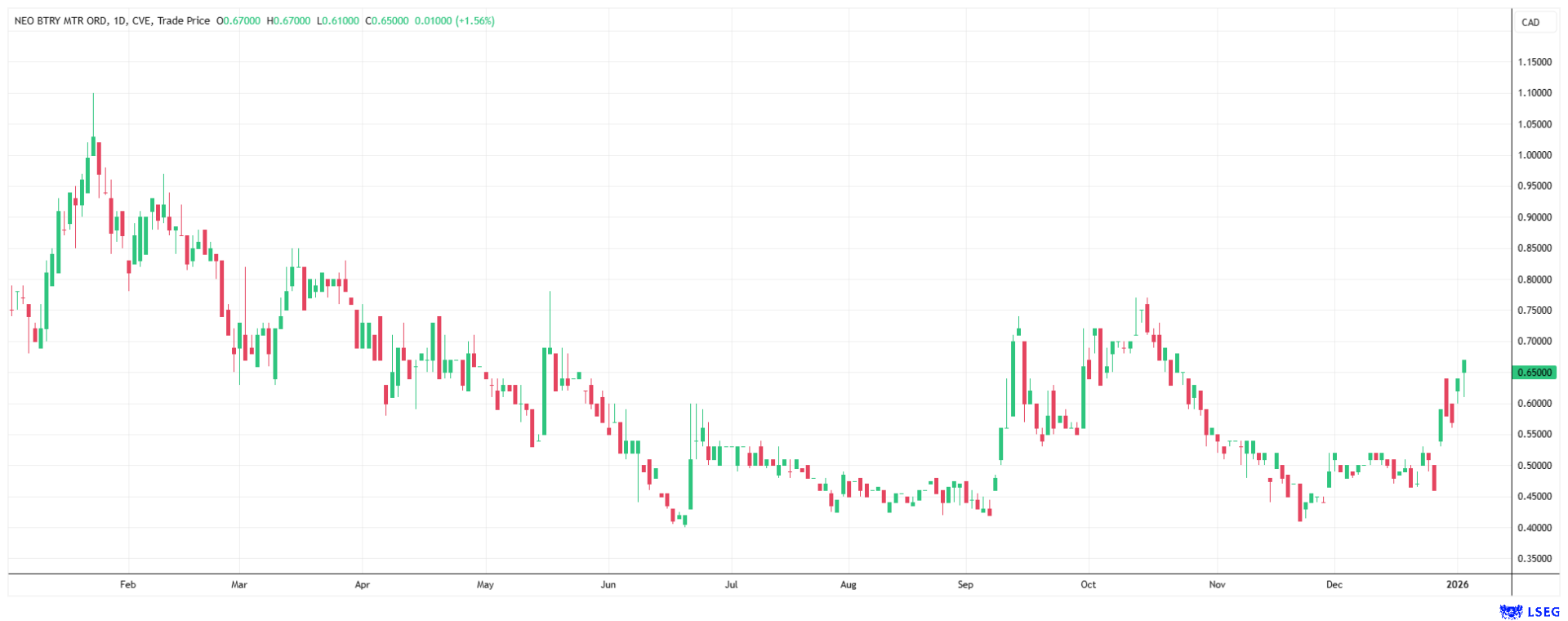
For investors, NEO Battery Materials thus offers a rare constellation. While AeroVironment and DroneShield are already trading at billion-dollar valuations for their end products, NEO is still primarily perceived by the market as a materials researcher, even though the Company has now crossed the critical threshold to become a commercial supplier. Those who believe that the West must regain its drone autonomy will find in NEO Battery Materials the fundamental building block of this new security architecture. The stock has recently risen significantly, while operational progress is also attracting attention. NEO Battery Materials stock could be an exciting bet for 2026.
Watch YouTube videoConflict of interest
Pursuant to §85 of the German Securities Trading Act (WpHG), we point out that Apaton Finance GmbH as well as partners, authors or employees of Apaton Finance GmbH (hereinafter referred to as "Relevant Persons") may hold shares or other financial instruments of the aforementioned companies in the future or may bet on rising or falling prices and thus a conflict of interest may arise in the future. The Relevant Persons reserve the right to buy or sell shares or other financial instruments of the Company at any time (hereinafter each a "Transaction"). Transactions may, under certain circumstances, influence the respective price of the shares or other financial instruments of the Company.
In addition, Apaton Finance GmbH is active in the context of the preparation and publication of the reporting in paid contractual relationships.
For this reason, there is a concrete conflict of interest.
The above information on existing conflicts of interest applies to all types and forms of publication used by Apaton Finance GmbH for publications on companies.
Risk notice
Apaton Finance GmbH offers editors, agencies and companies the opportunity to publish commentaries, interviews, summaries, news and the like on news.financial. These contents are exclusively for the information of the readers and do not represent any call to action or recommendations, neither explicitly nor implicitly they are to be understood as an assurance of possible price developments. The contents do not replace individual expert investment advice and do not constitute an offer to sell the discussed share(s) or other financial instruments, nor an invitation to buy or sell such.
The content is expressly not a financial analysis, but a journalistic or advertising text. Readers or users who make investment decisions or carry out transactions on the basis of the information provided here do so entirely at their own risk. No contractual relationship is established between Apaton Finance GmbH and its readers or the users of its offers, as our information only refers to the company and not to the investment decision of the reader or user.
The acquisition of financial instruments involves high risks, which can lead to the total loss of the invested capital. The information published by Apaton Finance GmbH and its authors is based on careful research. Nevertheless, no liability is assumed for financial losses or a content-related guarantee for the topicality, correctness, appropriateness and completeness of the content provided here. Please also note our Terms of use.