March 10th, 2026 | 07:15 CET
Valuation anomaly in the drone sector: Solid returns with Volatus Aerospace, Hensoldt, and DroneShield
The global security architecture has been facing a turning point since well before the outbreak of the conflict involving Iran. Developments on NATO's eastern flank show that the dominance of heavy weapon systems is increasingly being challenged by low-cost, unmanned aerial vehicles. In this new reality, a drone costing USD 500 can destroy a battle tank worth USD 10 million. This development is forcing the defense industry to rethink its approach. Conventional air defense systems are often overwhelmed by the sheer number and low radar signature of enemy drones. Innovative solutions are needed to detect, assess, and neutralize threats. So-called interceptor drones for the targeted neutralization of hostile aerial targets are becoming the focus of attention for the military and procurement authorities. Hensoldt, DroneShield, and Volatus Aerospace have positioned themselves as innovative solution providers in this highly specialized niche. We show where the most attractive opportunities lie for investors and pay particular attention to an up-and-coming company from Canada.
time to read: 3 minutes | Author: Nico Popp
ISIN: VOLATUS AEROSPACE INC | CA92865M1023 | TSXV: FLT , OTCQB: TAKOF , HENSOLDT AG INH O.N. | DE000HAG0005 , DRONESHIELD LTD | AU000000DRO2
Table of contents:
Author

Nico Popp
At home in Southern Germany, the passionate stock exchange expert has been accompanying the capital markets for about twenty years. With a soft spot for smaller companies, he is constantly on the lookout for exciting investment stories.
Tag cloud
Shares cloud
Hensoldt delivers sensory precision
The German defense electronics group Hensoldt has everything it takes to identify the smallest threats in complex environments, often saturated with interference signals. Crucial to this are radar systems from the PrecISR family and advanced AESA technology, which can distinguish drones from natural objects even with minimal radar cross-section and in poor weather conditions. The current demand for these sensors is also reflected in the books: In fiscal year 2025, Hensoldt's order intake rose by around 62% to EUR 4.71 billion, resulting in a historic order backlog of EUR 8.8 billion. This growth was accompanied by adjusted free cash flow of EUR 347 million. In order to respond even more quickly to modern threats, Hensoldt is now integrating cost-efficient interceptor drones directly into its platforms in a strategic partnership with Tytan Technologies, which significantly reduces the response time to drone swarms.
DroneShield stops drones using artificial intelligence
As soon as a threat is detected by radar, DroneShield takes over and neutralizes it. The Australian company is a recognized market leader in AI-powered electronic countermeasures and offers defense through targeted electronic jamming. Instead of matching known signal libraries, DroneShield uses neural networks to detect hostile flying objects based on patterns in the radio frequency spectrum, even if they are modified or completely new. This technological advantage has translated into strong organic growth. Revenue rose by 276% in 2025 to AUD 216.5 million, which is equivalent to approximately USD 140 million. To serve its sales pipeline of approximately AUD 2.3 billion, DroneShield has expanded its manufacturing capacity from AUD 500 million to over AUD 2.4 billion per year. The company is also increasingly benefiting from civilian contracts for the protection of critical infrastructure or major events such as the upcoming World Cup. However, DroneShield has long been a star on the stock market – and its valuation is correspondingly ambitious.
Volatus Aerospace as a strategic integrator
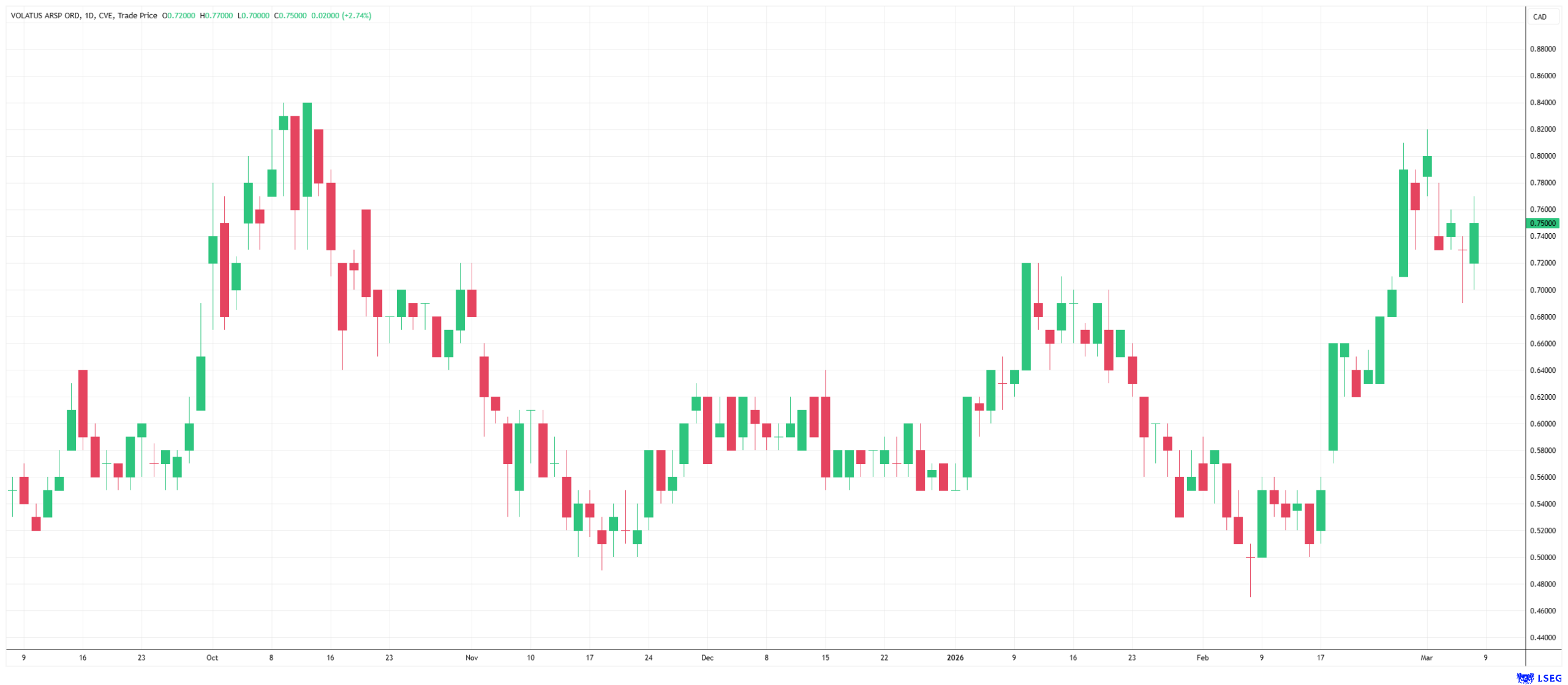
Volatus Aerospace, on the other hand, is less well known. Among the better-known providers of drone technology, Volatus Aerospace assumes the role of an agile system integrator. The Canadian company serves end customers such as border authorities and the military, offering intelligence, surveillance, and reconnaissance (ISR) services as a comprehensive solution. By additionally providing unmanned aerial systems and integrating third-party technologies, Volatus ensures that identified targets are efficiently neutralized using precise interceptor solutions. The company is growing rapidly and recorded a jump in revenue of over 60% to CAD 10.6 million in the third quarter of 2025. **With cash reserves of around CAD 40 million, Volatus is currently financing the expansion of its innovation center in Mirabel to ramp up its own production of long-range drones for NATO-aligned customers. In early March 2026, Volatus also reinforced its strategic leadership position with the launch of SKYDRA. This digital platform for drone defense enables emergency responders to simulate and manage complex operational defense scenarios in real time.
Valuation anomaly offers entry opportunities
For investors, the current phase at Volatus offers attractive opportunities, as the market for drone defense systems is poised for rapid growth over the coming years, according to research firms such as Fortune Business Insights. While Hensoldt is considered an established core investment and DroneShield is trading at a high premium, which reflects its current market leadership, Volatus currently appears almost unbeatable in terms of valuation. With a revenue multiple of only 7.9x for the expected fiscal year 2026, Volatus is clearly undervalued in direct comparison to its highly valued peer, DroneShield, which is trading at 14.7x. Analysts at Ventum Capital Markets see the system integrator, with its years of experience in the drone business, as a clear entry opportunity, as the global wave of military buildup in the field of drone defense is likely to continue to drive revenue. The potential of large government contracts is still underestimated by the market. Investors who recognize the operational potential of interceptor solutions and asymmetric defense will find Volatus Aerospace to be a stock that could be on the verge of a revaluation.
Watch YouTube videoConflict of interest
Pursuant to §85 of the German Securities Trading Act (WpHG), we point out that Apaton Finance GmbH as well as partners, authors or employees of Apaton Finance GmbH (hereinafter referred to as "Relevant Persons") currently hold or hold shares or other financial instruments of the aforementioned companies and speculate on their price developments. In this respect, they intend to sell or acquire shares or other financial instruments of the companies (hereinafter each referred to as a "Transaction"). Transactions may thereby influence the respective price of the shares or other financial instruments of the Company.
In this respect, there is a concrete conflict of interest in the reporting on the companies.
In addition, Apaton Finance GmbH is active in the context of the preparation and publication of the reporting in paid contractual relationships.
For this reason, there is also a concrete conflict of interest.
The above information on existing conflicts of interest applies to all types and forms of publication used by Apaton Finance GmbH for publications on companies.
Risk notice
Apaton Finance GmbH offers editors, agencies and companies the opportunity to publish commentaries, interviews, summaries, news and the like on news.financial. These contents are exclusively for the information of the readers and do not represent any call to action or recommendations, neither explicitly nor implicitly they are to be understood as an assurance of possible price developments. The contents do not replace individual expert investment advice and do not constitute an offer to sell the discussed share(s) or other financial instruments, nor an invitation to buy or sell such.
The content is expressly not a financial analysis, but a journalistic or advertising text. Readers or users who make investment decisions or carry out transactions on the basis of the information provided here do so entirely at their own risk. No contractual relationship is established between Apaton Finance GmbH and its readers or the users of its offers, as our information only refers to the company and not to the investment decision of the reader or user.
The acquisition of financial instruments involves high risks, which can lead to the total loss of the invested capital. The information published by Apaton Finance GmbH and its authors is based on careful research. Nevertheless, no liability is assumed for financial losses or a content-related guarantee for the topicality, correctness, appropriateness and completeness of the content provided here. Please also note our Terms of use.