January 26th, 2026 | 07:10 CET
The critical metal: Why Antimony Resources could become a geopolitical player
While the stock market revolves around AI chips, precious metals, and lithium, another crisis is brewing beneath the surface of global industry. The supply of antimony, a metal essential for flame retardants, the defense industry, and semiconductors, hangs by a thread due to Chinese export policy. This is bringing projects in stable regions into focus. In the midst of this strategic realignment, Antimony Resources from Canada is delivering remarkable drilling results. The question is no longer whether the West needs alternative sources, but how quickly special projects such as Antimony Resources can provide them.
time to read: 4 minutes | Author: Armin Schulz
ISIN: ANTIMONY RESOURCES CORP | CA0369271014
Table of contents:
Author

Armin Schulz
Born in Mönchengladbach, he studied business administration in the Netherlands. In the course of his studies he came into contact with the stock exchange for the first time. He has more than 25 years of experience in stock market business.
Tag cloud
Shares cloud
Dependency: A dangerous one-way street
The dependency is alarming: over 70% of global antimony production comes from China, with the next largest producers being Russia and Tajikistan. For Western industrialized nations, this means a dangerous vulnerability in their supply chains. Antimony is not a metal that can be easily replaced. It makes flame retardants in electronics and building materials effective, hardens lead in batteries, and is indispensable in military applications ranging from ammunition to infrared optics. Recent Chinese export restrictions have ruthlessly exposed this systemic weakness and driven prices to record highs.
Bald Hill: More than just promising samples
Antimony Resources is positioning itself precisely in this area of tension with its flagship Bald Hill project in New Brunswick, Canada. What the Company is currently presenting is more than just a series of good drill results. It is the blueprint for a possible, economically compelling counterweight to the current market concentration. The data from the latest Phase 2 drilling campaign speaks for itself. Multiple antimony-bearing zones were encountered in 5 of the 6 drill holes evaluated. One of these, drill hole BH-25-22, even has 6 individual mineralization zones. The thicknesses and grades are impressive. Antimony grades of 2.07% over 27.05 m or 2.75% over 18.35 m are not uncommon. High-grade intervals such as 11.4% over 1.65 m underscore the potential.
CEO Jim Atkinson summarizes the significance of this consistency: "The presence of multiple thick zones of antimony-bearing stibnite discovered in recent drilling will be an important factor in the final resource calculation." These repeatedly found mineralizations over a strike of 700 m and to a depth of 400 m indicate a robust and coherent system. This is the basic prerequisite for future mining operations.
The comparison: A completely different economic model
To understand Bald Hill's exceptional position, it is worth taking a look at Idaho, USA. This is where the large-scale Perpetua project is being developed, often cited as the North American benchmark for antimony. However, the average antimony content of the total deposit there is in the low single-digit percentage range, in some cases even below 0.5%. The planned start-up phase operates with even lower concentrations.
This reveals two fundamentally different development models. While the US project relies on a huge, low-grade body that requires massive investments in the high triple-digit million range, Bald Hill is pursuing a "small but fine" approach. The estimated grades of 3-4% on average, with peaks well above that, indicate a compact body that can be mined underground. The economic logic is simple. Less rock needs to be moved and processed to produce the same amount of valuable metal. Initial rough estimates by the Company put the required investment in the range of CAD 200-250 million. This could lead to exceptionally low production costs, which would be a real competitive advantage.
From potential to resource: The 2026 roadmap
The current NI 43-101 technical report quantifies the conceptual potential of the already defined Main Zone at approximately 2.7 million tonnes of material with an antimony content of between 3–4%. This would correspond to approximately 81,000 to 108,000 tonnes of contained antimony, which is double the last estimate from 2014. However, the Company rightly emphasises that this does not yet represent an economic resource, but rather a target range for the upcoming exploration.
And this is precisely where the roadmap for 2026 becomes crucial. The Company is fully financed after raising nearly CAD 9.5 million at the end of 2025. This capital will enable an aggressive 10,000 m drilling program with up to three drilling rigs. The goal is clear: The data is to be consolidated so that an initial official resource estimate can be presented this year or in early 2027. This milestone would translate speculation into reliable figures and raise the project to a new level of valuation.
Location advantage: More than just geology
At the same time, management is already working on the next hurdle: approvals. "Throughout 2026, we will continue to work with consultants to discuss the resource calculations, which we hope to complete by the end of 2026 or early 2027. As part of this consultation, a roadmap for the approval process, including an environmental impact assessment, will also be developed. This work has already begun," says Atkinson. Once these goals have been achieved, the project's location will play another trump card. The province of New Brunswick has announced its own "Critical Minerals Strategy" and signaled its active support for projects that fit into this strategy. A cooperative government approach can mean a significant time advantage in what is often a lengthy approval marathon.
The potential: Far from over
But Bald Hill's potential does not end at the boundaries of the Main Zone. Field teams have identified two additional antimony-bearing structures to the south and west of the main zone. The newly discovered "West Zone" (also known as the Marcus Zone) was found during routine trail work. This stroke of luck underscores the exploration potential of the entire concession area. These zones will be drilled for the first time in 2026. In addition, a 2 km geochemical anomaly corridor extends across the property, the center of which is virtually unexplored. The story of Bald Hill could have further chapters to come.
The stock is currently trading at CAD 0.67.
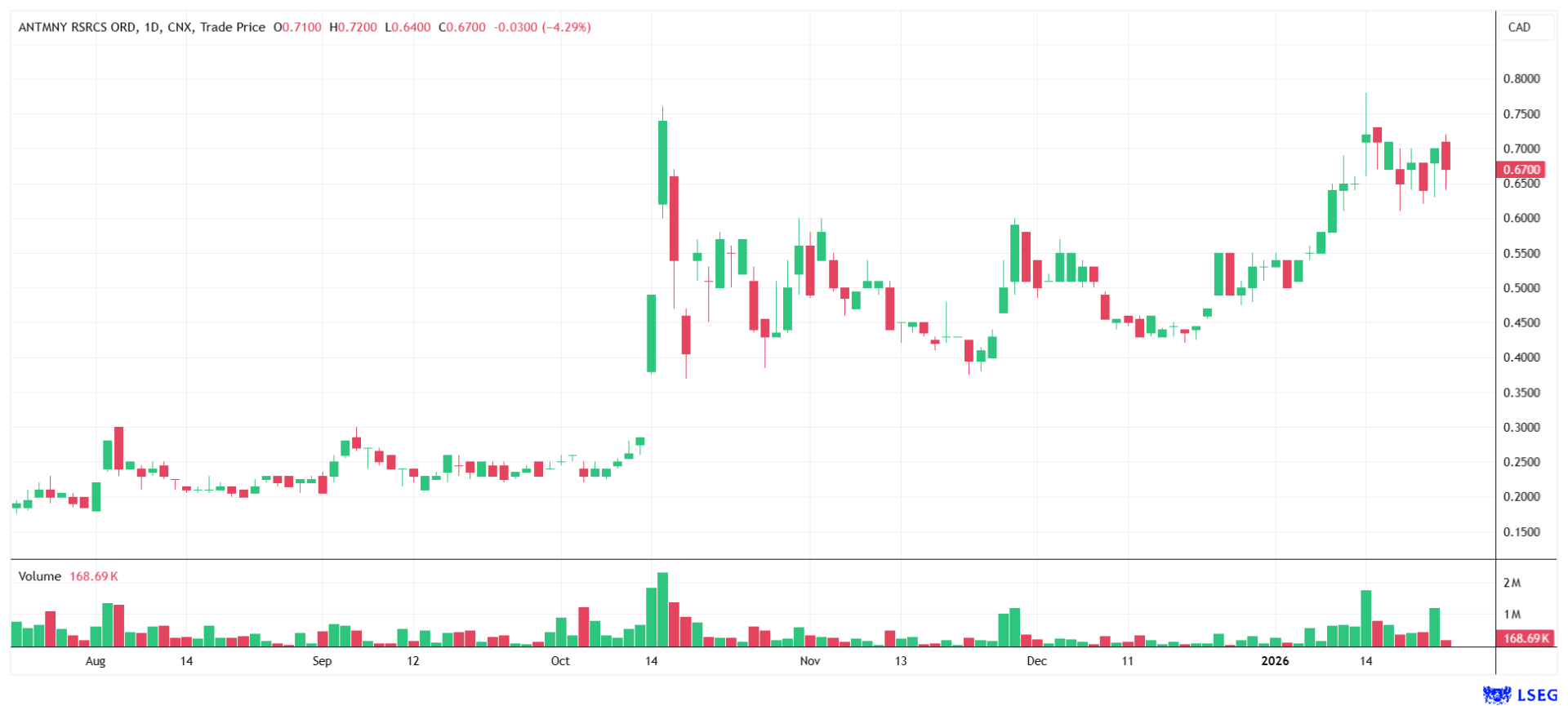
The convergence of several powerful trends makes Antimony Resources a remarkable story. A critical metal with structural supply shortages meets a project with exceptionally high grades in a supportive jurisdiction. The fully funded, transparent roadmap to resource estimation provides investors with a clear roadmap. Should the team achieve its targeted milestones, it will position itself not only as an exploration success, but as a strategic building block for a more independent Western industry, with all that that could mean for valuation.
Conflict of interest
Pursuant to §85 of the German Securities Trading Act (WpHG), we point out that Apaton Finance GmbH as well as partners, authors or employees of Apaton Finance GmbH (hereinafter referred to as "Relevant Persons") currently hold or hold shares or other financial instruments of the aforementioned companies and speculate on their price developments. In this respect, they intend to sell or acquire shares or other financial instruments of the companies (hereinafter each referred to as a "Transaction"). Transactions may thereby influence the respective price of the shares or other financial instruments of the Company.
In this respect, there is a concrete conflict of interest in the reporting on the companies.
In addition, Apaton Finance GmbH is active in the context of the preparation and publication of the reporting in paid contractual relationships.
For this reason, there is also a concrete conflict of interest.
The above information on existing conflicts of interest applies to all types and forms of publication used by Apaton Finance GmbH for publications on companies.
Risk notice
Apaton Finance GmbH offers editors, agencies and companies the opportunity to publish commentaries, interviews, summaries, news and the like on news.financial. These contents are exclusively for the information of the readers and do not represent any call to action or recommendations, neither explicitly nor implicitly they are to be understood as an assurance of possible price developments. The contents do not replace individual expert investment advice and do not constitute an offer to sell the discussed share(s) or other financial instruments, nor an invitation to buy or sell such.
The content is expressly not a financial analysis, but a journalistic or advertising text. Readers or users who make investment decisions or carry out transactions on the basis of the information provided here do so entirely at their own risk. No contractual relationship is established between Apaton Finance GmbH and its readers or the users of its offers, as our information only refers to the company and not to the investment decision of the reader or user.
The acquisition of financial instruments involves high risks, which can lead to the total loss of the invested capital. The information published by Apaton Finance GmbH and its authors is based on careful research. Nevertheless, no liability is assumed for financial losses or a content-related guarantee for the topicality, correctness, appropriateness and completeness of the content provided here. Please also note our Terms of use.