January 23rd, 2026 | 07:05 CET
The battle for resources is being fought in the data room: How Aspermont Uses AI to Boost the Returns of Rio Tinto, Alamos Gold & Co.
It is the greatest paradox of the modern economy: while demand for copper, lithium, and rare earths is exploding due to trade wars and the insatiable appetite of the AI industry, building a new mine has never been more difficult. Large mining corporations are increasingly failing not because of geology, but because of bureaucracy, environmental regulations, and, in remote regions of the world, geopolitical pitfalls. In this new era, where a legally binding permit is often more valuable than spectacular drilling results, validated information is becoming the most critical resource in the commodities sector. Analyst firms such as McKinsey and the International Energy Agency (IEA) warn of a massive structural supply deficit, as the development of new mines in the West often requires more than a decade of legal wrangling. It is precisely in this area of tension that the Australian media and tech company Aspermont is positioning itself as the decisive problem solver. With a treasure trove of data spanning centuries of industrial history and a new alliance with industry giant Rio Tinto, the Company is transforming itself from a media company into a kind of "Google of mining" – offering investors an opportunity based on intelligence rather than luck.
time to read: 3 minutes | Author: Nico Popp
ISIN: ASPERMONT LTD | AU000000ASP3 , RIO TINTO PLC LS-_10 | GB0007188757 , ALAMOS GOLD (NEW) | CA0115321089
Table of contents:
Author

Nico Popp
At home in Southern Germany, the passionate stock exchange expert has been accompanying the capital markets for about twenty years. With a soft spot for smaller companies, he is constantly on the lookout for exciting investment stories.
Tag cloud
Shares cloud
Rio Tinto and the need to innovate
The example of Rio Tinto illustrates how serious the situation is for large producers. The mining titan is feeling the full force of regulation, as capital alone cannot buy permits. With projects blocked in the US and Serbia, Rio Tinto is forced to radically adjust its strategy and break new technological ground to remain competitive. It is no longer enough to know where the ore is located – you also have to know where you are allowed to extract it.
Rio Tinto has recognized that the answers to these complex questions are often hidden in unstructured data sets. Through a groundbreaking partnership with Aspermont, the Company has been using its proprietary data platform since last year to reevaluate historical geological data and regional risk profiles using AI. For Rio Tinto, this is the key to identifying forgotten projects and avoiding costly missteps in unstable regions at an early stage.
Alamos Gold and the value of the right jurisdiction
Alamos Gold impressively demonstrates why data on jurisdictions is more important today than pure ore grades. The gold producer is considered the operational winner of focusing on "safe jurisdictions." By disciplinedly concentrating on politically stable regions such as Canada, Alamos generates record cash flows and immunizes itself against the geopolitical upheavals that paralyze its larger competitors.
Projects such as Island Gold show that the market pays a significant premium for security, but finding such gems is like looking for a needle in a haystack. This is where the circle closes with Aspermont: what Alamos intuitively does right through decades of experience, Aspermont plans to systematize and make searchable for the entire market through its data platform. Investors are increasingly recognizing that the real leverage lies not in risk, but in eliminating information asymmetry.
Aspermont's AI transformation: From archive to prediction
Aspermont sits on a treasure trove that no competitor can replicate: an archive of over 560 years of cumulative market history across all media brands, built up by leading publications such as the Mining Journal. The Company has been undergoing a radical transformation from a pure publisher to a data intelligence provider that uses AI to convert these vast amounts of data into valuable signals for investors and corporations. The new business model aims to sell high-margin B2B subscriptions for these data analyses, which massively increases the quality of revenues.
GBC analysts see this transformation as a massive value driver and rate the stock as a "Buy" in their current research. Aspermont benefits twice: firstly, from the rising demand for commodity information and, secondly, from the scalability of digital business models, which are typically valued at significantly higher multiples than traditional mining companies. While Rio Tinto digs for copper, Aspermont does "data mining" in its own archive. For investors, the stock is thus the ultimate "pick-and-shovel play" in the information age. Regardless of which commodity is currently booming, knowledge about where and how to extract it safely will always have its price.
Aspermont shares as a hidden gem
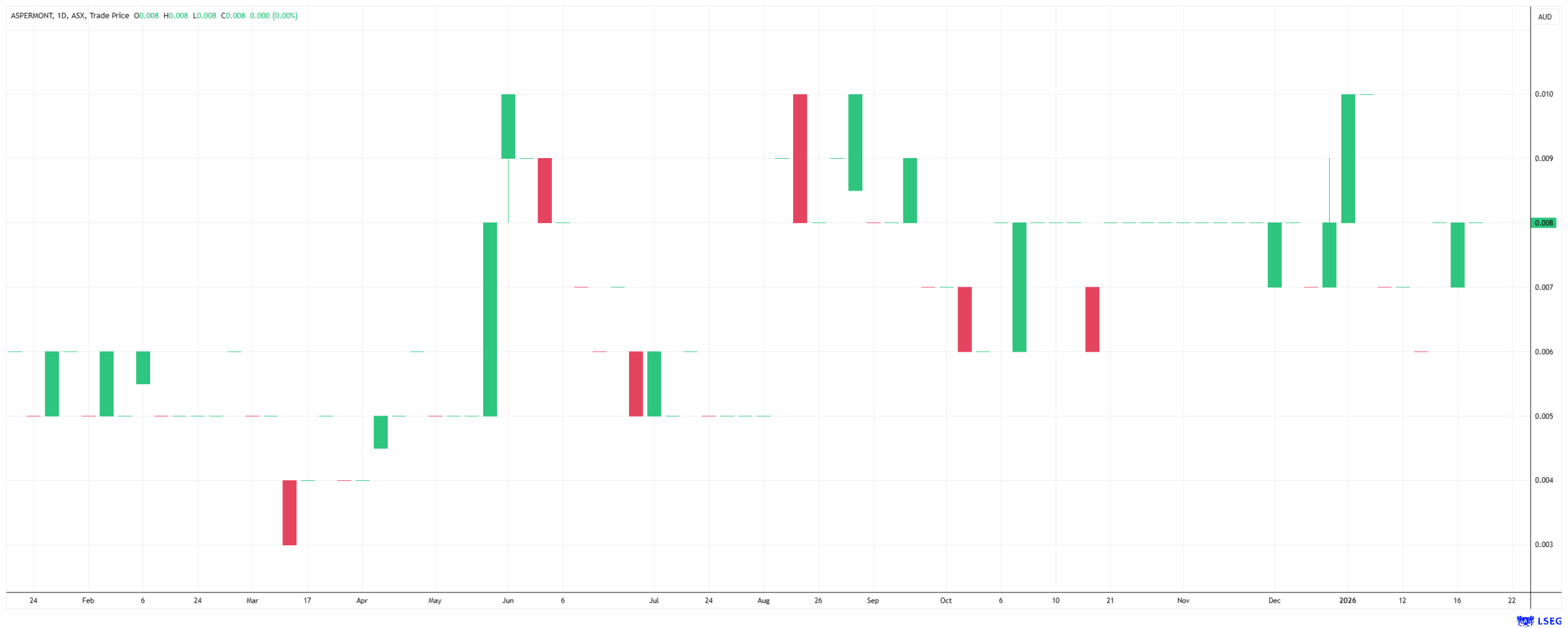
Aspermont's share price rose after the announcement of its collaboration with Rio Tinto in the field of AI last August and has since been trending sideways with a positive bias. The big push has not yet materialized. However, this may also be because, like many Australian stocks, Aspermont is purely a penny stock in visual terms. If the Company decides to consolidate its number of shares, this is likely to automatically attract more attention to the stock. Operationally, Aspermont has long been on the right track. Now that it has managed to convince Rio Tinto, a heavyweight in the industry, the remaining operational risks appear to be significantly lower. The stock remains a hidden gem.
Watch YouTube videoConflict of interest
Pursuant to §85 of the German Securities Trading Act (WpHG), we point out that Apaton Finance GmbH as well as partners, authors or employees of Apaton Finance GmbH (hereinafter referred to as "Relevant Persons") may hold shares or other financial instruments of the aforementioned companies in the future or may bet on rising or falling prices and thus a conflict of interest may arise in the future. The Relevant Persons reserve the right to buy or sell shares or other financial instruments of the Company at any time (hereinafter each a "Transaction"). Transactions may, under certain circumstances, influence the respective price of the shares or other financial instruments of the Company.
In addition, Apaton Finance GmbH is active in the context of the preparation and publication of the reporting in paid contractual relationships.
For this reason, there is a concrete conflict of interest.
The above information on existing conflicts of interest applies to all types and forms of publication used by Apaton Finance GmbH for publications on companies.
Risk notice
Apaton Finance GmbH offers editors, agencies and companies the opportunity to publish commentaries, interviews, summaries, news and the like on news.financial. These contents are exclusively for the information of the readers and do not represent any call to action or recommendations, neither explicitly nor implicitly they are to be understood as an assurance of possible price developments. The contents do not replace individual expert investment advice and do not constitute an offer to sell the discussed share(s) or other financial instruments, nor an invitation to buy or sell such.
The content is expressly not a financial analysis, but a journalistic or advertising text. Readers or users who make investment decisions or carry out transactions on the basis of the information provided here do so entirely at their own risk. No contractual relationship is established between Apaton Finance GmbH and its readers or the users of its offers, as our information only refers to the company and not to the investment decision of the reader or user.
The acquisition of financial instruments involves high risks, which can lead to the total loss of the invested capital. The information published by Apaton Finance GmbH and its authors is based on careful research. Nevertheless, no liability is assumed for financial losses or a content-related guarantee for the topicality, correctness, appropriateness and completeness of the content provided here. Please also note our Terms of use.