June 23rd, 2023 | 07:55 CEST
Solar and wind instead of oil and gas - Shell, Saturn Oil + Gas, Lanxess: Germany focuses on decarbonization!
International energy policy is more disparate than ever. While the US, Canada, China, India, South America and Russia focus on exploiting their abundant fossil reserves, resource-poor countries like Germany and select European states are embracing renewable energies. This decision results from an existing shortage or is imposed in the EU alliance, but it fits argumentatively into the picture of rapid decarbonization, a main line of European policy. As a reminder, planet Earth is home to almost 8 billion people, while Europe has only about 700 million inhabitants. With 8.7% of the world's weight, activist climate policy is being pursued in this country. While the goals are laudable, the overall effect of the efforts is rather negligible. But the consequences for Europe's historically built-up prosperity will be considerable. What is important for investors to consider?
time to read: 4 minutes | Author: André Will-Laudien
ISIN: ROYAL DUTCH SHELL A EO-07 | GB00B03MLX29 , ROYAL DUTCH SHELL B EO-07 | GB00B03MM408 , Saturn Oil + Gas Inc. | CA80412L8832 , LANXESS AG | DE0005470405
Table of contents:
Author

André Will-Laudien
Born in Munich, he first studied economics and graduated in business administration at the Ludwig-Maximilians-University in 1995. As he was involved with the stock market at a very early stage, he now has more than 30 years of experience in the capital markets.
Tag cloud
Shares cloud
Shell PLC - Return to the Fossil World
British-Dutch Shell PLC (formerly Royal Dutch Shell) is one of the largest private oil companies. At the recent investor day in New York, the Company celebrated. CEO Sawan excited investors who had previously overlooked Shell. From now on, the investor takes center stage. This is not surprising; as one of the world's largest borrowers, Shell relies on investor capital being readily available, especially after the recent interest rate turnaround. Shell has total assets of around EUR 370 billion, but its equity ratio of 24.8% is not all that lush.
For several years now, Shell has embraced the "environmental agenda", taking into account the guardrails of the green lobby to save itself potential trouble with Brussels and European governments. But with the relocation of its headquarters from the Netherlands to London and the new CEO Wael Sawan, the wind is now blowing from a new direction again. Shell and its shareholders have grown rich on fossil fuels and see opportunities in new energies as somewhat limited. People on the street want cheap fossil fuels and still demand them strongly, no matter how loudly the EU Commission ostensibly promotes e-mobility.
According to the new management's argumentation, the margins in the low-CO2 business averaged only 5 to 8%, while fossil fuels can easily earn four times that amount. The new corporate restructuring is therefore inevitable, but of course, this does not mean that the green shell will be completely removed. The new CEO Sawan assured his audience that in the future, Shell will once again be guided by the return on investment. Sawan had already sent a signal by throwing the previous "green" strategist Ed Daniels out the door and shifting the responsible department to the finance division. Shell is once again a standard oil and gas stock with a current 2023 P/E of 7.5 and a dividend yield of 4%. With its new focus, the stock is certainly not an ESG stock, but it is suitable for a politically neutral long-term investment.
Saturn Oil & Gas - Outstanding cash flow and uplisting
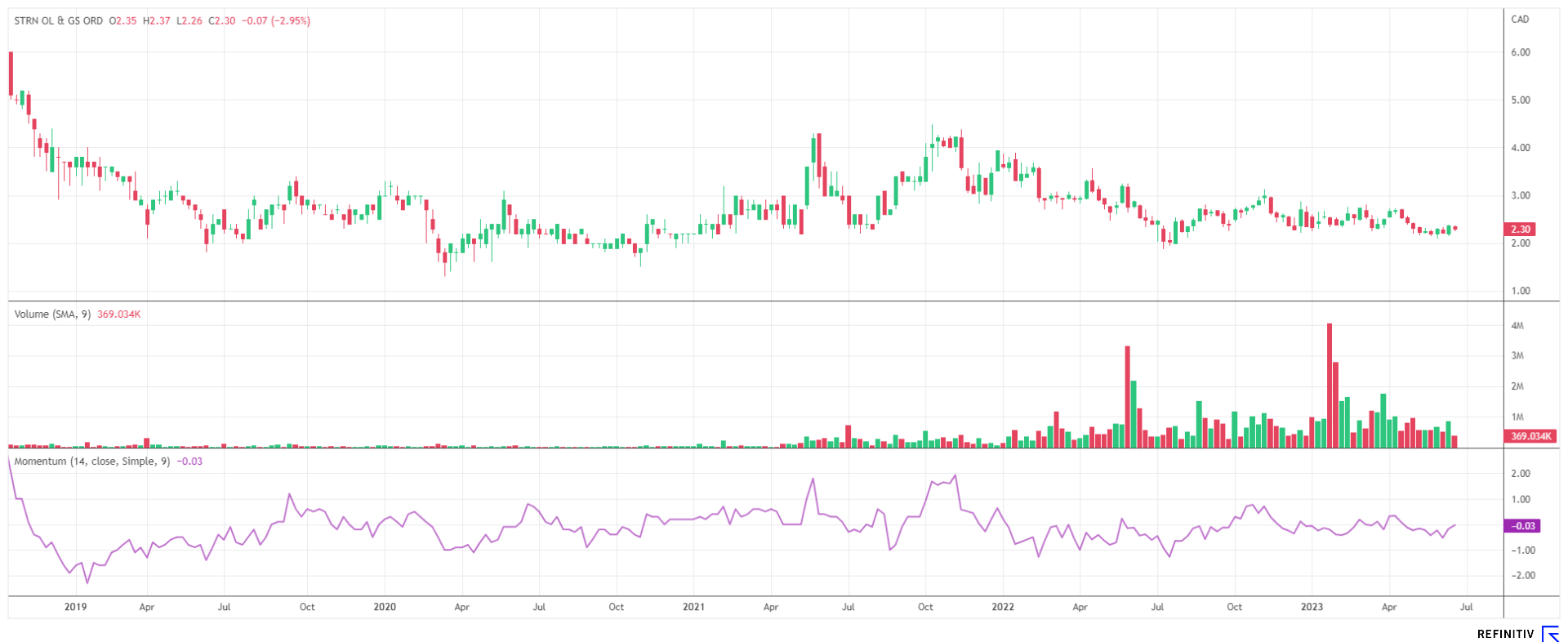
In terms of ESG, a bigger wheel is being turned at Canadian oil producer Saturn Oil & Gas, where meticulous attention is being paid to dismantling production facilities, the best environmental protection and a good understanding of the local population. Through two mega deals in 2022 and early 2023, the Company has swung into new dimensions of production output. Average daily production is now over 30,000 equivalent barrel units consisting of 95% oil and 5% natural gas. This results in an operating profit expectation of CAD 475 million on an EBITDA basis. After deducting reinvestment costs for new properties, this results in a bottom-line cash flow per share of approximately CAD 3, 25% above the current market price.
The debt curve should approach zero quickly by the end of 2025. Admittedly, there are always a few imponderables, such as the recent forest fires, which affected a daily production of about 10,000 BOE over a period of several weeks. By the end of 2023, however, the debt should already be down to about CAD 345 million, as planned. This calculation is based on a WTI average price of around USD 80. Minor forecast adjustments may be necessary here.
It is worth mentioning that Saturn Oil has just been up-listed to the Main Board of the Toronto Stock Exchange (TSX). As a medium-sized oil producer with an enterprise value of just under CAD 870 million, Saturn Oil has clearly left the group of venture companies. At the annual general meeting on June 28, 2023, investors will find out how things will proceed strategically in the next few years. Shortly after that, there should be figures for the 2nd quarter. Five analysts on the Refinitiv Eikon platform expect a 12-month target price of CAD 6.22. There is currently no other oil company in North America that is valued at an EV/EBITDA ratio of only 1.8. A price of CAD 2.25 presents a mid-term opportunity for the stock to double in value.
Lanxess - That was a hefty profit warning
A hefty profit warning from Lanxess caused uncertainty in the European chemical sector at the beginning of the week. Some industry representatives were literally dragged down by the 20% plunge of the Cologne-based company. The already very weak demand in the specialty chemicals sector at the beginning of the year and the continued destocking from important customers had a negative impact on Lanxess' business development in the first half of the year.
Both the expected figures for the first half of the year were revised downwards, and the Company also lowered its outlook for the second half of the year. According to analysts, this means a consensus EBITDA correction of around 30%. "While the weakness in the second quarter was anticipated by investors following various warnings from other companies about longer-than-expected destocking, the magnitude of today's target cut is quite a surprise", commented Goldman analyst Georgina Fraser. JP Morgan is also sceptical about the situation. While Baader and Berenberg recommend buying at this level, Jefferies and DZ Bank only rate it a "hold". At EUR 25.77, the share reached a painful 5-year low. The analysts on Refinitiv Eikon have yet to all react. Here the weighted price target still stands at over EUR 40. Yesterday, Warburg had its say: "Buy" with a new target price of EUR 45 after EUR 58. Those who want to bet on the economic turnaround will find Lanxess a highly cyclical stock.
The oil market is currently guided by economic forecasts. For industry, adjustments are needed from different angles. Shell is turning back the green wheel in favour of yield. Lanxess is a solid turnaround stock in the medium term. Saturn Oil & Gas is a bargain compared to industry, even at slightly lower oil prices.
Conflict of interest
Pursuant to §85 of the German Securities Trading Act (WpHG), we point out that Apaton Finance GmbH as well as partners, authors or employees of Apaton Finance GmbH (hereinafter referred to as "Relevant Persons") currently hold or hold shares or other financial instruments of the aforementioned companies and speculate on their price developments. In this respect, they intend to sell or acquire shares or other financial instruments of the companies (hereinafter each referred to as a "Transaction"). Transactions may thereby influence the respective price of the shares or other financial instruments of the Company.
In this respect, there is a concrete conflict of interest in the reporting on the companies.
In addition, Apaton Finance GmbH is active in the context of the preparation and publication of the reporting in paid contractual relationships.
For this reason, there is also a concrete conflict of interest.
The above information on existing conflicts of interest applies to all types and forms of publication used by Apaton Finance GmbH for publications on companies.
Risk notice
Apaton Finance GmbH offers editors, agencies and companies the opportunity to publish commentaries, interviews, summaries, news and the like on news.financial. These contents are exclusively for the information of the readers and do not represent any call to action or recommendations, neither explicitly nor implicitly they are to be understood as an assurance of possible price developments. The contents do not replace individual expert investment advice and do not constitute an offer to sell the discussed share(s) or other financial instruments, nor an invitation to buy or sell such.
The content is expressly not a financial analysis, but a journalistic or advertising text. Readers or users who make investment decisions or carry out transactions on the basis of the information provided here do so entirely at their own risk. No contractual relationship is established between Apaton Finance GmbH and its readers or the users of its offers, as our information only refers to the company and not to the investment decision of the reader or user.
The acquisition of financial instruments involves high risks, which can lead to the total loss of the invested capital. The information published by Apaton Finance GmbH and its authors is based on careful research. Nevertheless, no liability is assumed for financial losses or a content-related guarantee for the topicality, correctness, appropriateness and completeness of the content provided here. Please also note our Terms of use.