December 10th, 2025 | 07:05 CET
Second hydrogen wave with Linde, BASF, dynaCERT: Why 2026 will be the year of truth
fundamentally from the hype cycles of 2020 and 2021. Back then, enthusiasm was driven largely by visionary PowerPoint presentations rather than real-world progress. The transition to 2026, however, marks the start of a new industrial reality. Investors who have followed the sector for years now recognize a clear shift in market dynamics - one based less on hope and more on regulatory certainty and technological maturity. As Der Aktionär correctly notes, a new tailwind is emerging for industry. We explain what improved framework conditions and the market launch of large-scale plants in Europe could mean for the shares of Linde, BASF, and dynaCERT.
time to read: 4 minutes | Author: Nico Popp
ISIN: LINDE PLC EO 0_001 | IE00BZ12WP82 , BASF SE NA O.N. | DE000BASF111 , DYNACERT INC. | CA26780A1084
Table of contents:
Author

Nico Popp
At home in Southern Germany, the passionate stock exchange expert has been accompanying the capital markets for about twenty years. With a soft spot for smaller companies, he is constantly on the lookout for exciting investment stories.
Tag cloud
Shares cloud
From the "principle of hope" to regulatory certainty
To understand the current market movement, it is worth taking a look back. In 2020, the valuations of many hydrogen companies became completely decoupled from fundamental data. It was a phase of euphoria, when a lack of revenue was not a flaw, but almost a mark of quality for truly trendy hydrogen stocks. Five years later, the wheat has been separated from the chaff. The market has learned that hydrogen is not a sure-fire success, but requires massive infrastructure and political support. It is precisely this support that is now a reality. In the US, the government has created facts with tax incentives for clean hydrogen, making investments plannable. In Europe, the Green Deal is taking shape with funding approvals for large-scale projects. For investors, this means that if you want to profit in 2026, you need to understand who is building the infrastructure, who is using it, and who is building the bridge to it.
Linde takes off with blue hydrogen
In the current market environment, Linde is positioning itself not as a visionary but as an experienced service provider for industry. The gas giant has made a strategic decision that is highly relevant for investors. Instead of waiting exclusively for green hydrogen from renewable energy, which is still expensive, Linde is focusing heavily on blue hydrogen, especially in the US. Hydrogen is extracted from natural gas, while the resulting CO2 is captured and stored. This strategy is no coincidence, but a direct response to the regulatory incentives of the Inflation Reduction Act, which make this technology highly profitable.
Linde is thus demonstrating a strength that pure start-ups often lack: the ability to handle large volumes while remaining profitable. The Company reports that over 90% of its clean hydrogen projects in the US are based on this blue technology. This is good news for conservative investors, as it means secure cash flows instead of technological gambles. Added to this is the operating business with small hydrogen plants, which already recorded record figures in 2024, showing that decarbonization has arrived throughout industry. Linde is building a deep economic moat with its hydrogen business. Through long-term purchase agreements and control over the physical infrastructure, the group is making itself indispensable.
BASF: Industrial transformation as a matter of survival
The situation is different at BASF. For the Ludwigshafen-based chemical giant, hydrogen is not primarily a product to be sold, but rather the key to its own survival and the future viability of Europe as a business location. In March 2025, BASF made a statement with the commissioning of a 54-megawatt electrolyser at its main plant in Ludwigshafen – one of the largest projects of its kind in Germany. This plant, built in partnership with Siemens Energy, is proof that the transformation of the chemical industry has moved from the planning phase to implementation. BASF appears willing to maintain its technological leadership even under the new regulatory framework. The group's stock is a bet on a successful transformation.
dynaCERT builds a technological bridge to the present
While Linde and BASF are classic industrial heavyweights, the Canadian growth company dynaCERT is already filling a crucial gap. The reality of the energy transition is that diesel engines will not disappear overnight. This is exactly where dynaCERT comes in with its HydraGEN™ technology. The system produces hydrogen on demand on board vehicles and injects it into the combustion engine, immediately reducing fuel consumption and emissions in a measurable way. It is a bridging technology for the world's existing fleets, enabling immediate CO2 reduction without having to wait for the widespread availability of hydrogen filling stations.
The year 2025 marks a turning point for dynaCERT. With a successful CAD 5 million financing round in the summer, the Company was able to strengthen its balance sheet and drive expansion forward. The operational progress in Europe is particularly exciting: French ports have begun to use the technology in their cranes and logistics vehicles to achieve emission targets. For the Canadian company's business model, this is proof of concept in an industrial environment that is under high pressure to decarbonize. In addition, the possibility of converting the emission savings achieved into CO2 certificates in the future opens up a second source of income. For risk-conscious investors, dynaCERT shares offer an attractive addition to their portfolio.
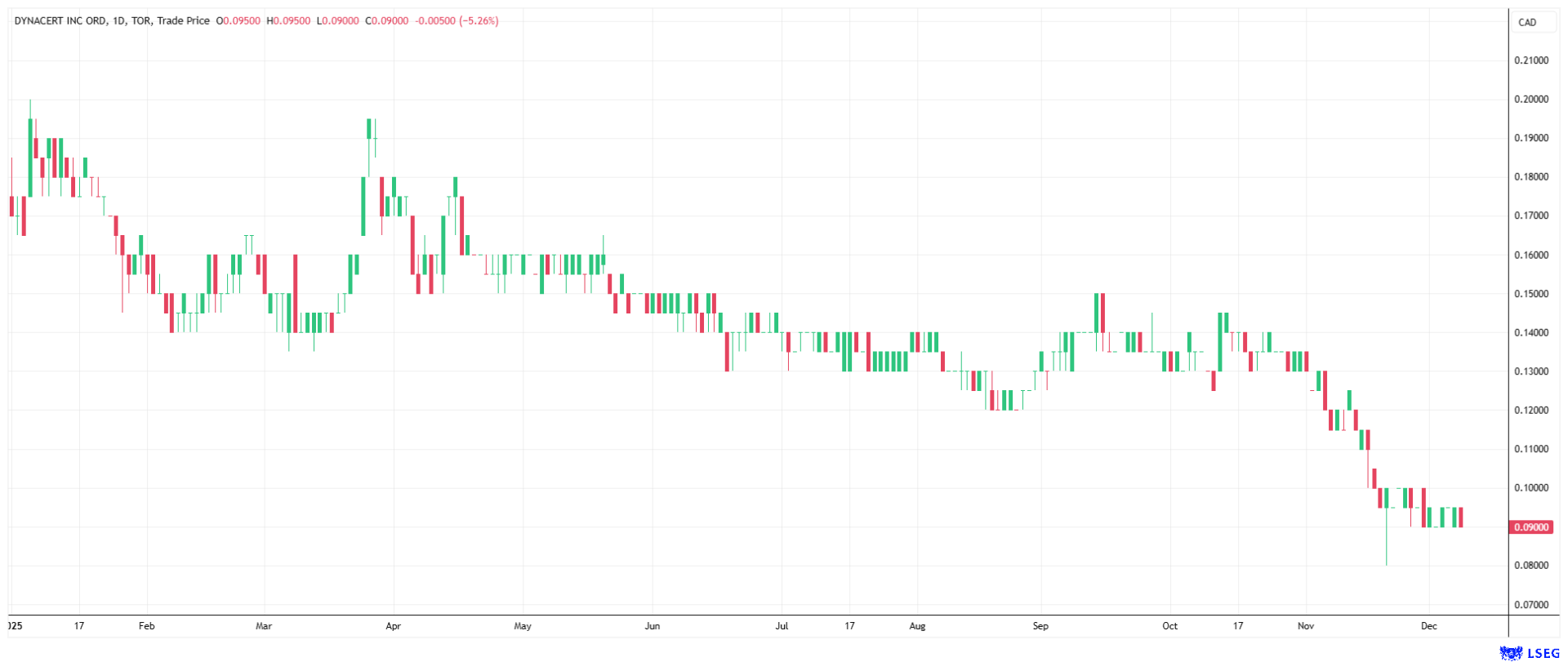
Hydrogen is gaining momentum – Transition technology can benefit
The hydrogen sector is entering a new phase in 2026, as evidenced by major projects, political framework conditions, and stock prices, especially for companies operating in North America. But the EU has also recently achieved a notable success with its new matchmaking portal for hydrogen projects. As the expansion of the hydrogen economy gains momentum, the market for smart transition technology that quickly pays for itself, as in the case of dynaCERT, remains intact.
Watch YouTube videoConflict of interest
Pursuant to §85 of the German Securities Trading Act (WpHG), we point out that Apaton Finance GmbH as well as partners, authors or employees of Apaton Finance GmbH (hereinafter referred to as "Relevant Persons") may hold shares or other financial instruments of the aforementioned companies in the future or may bet on rising or falling prices and thus a conflict of interest may arise in the future. The Relevant Persons reserve the right to buy or sell shares or other financial instruments of the Company at any time (hereinafter each a "Transaction"). Transactions may, under certain circumstances, influence the respective price of the shares or other financial instruments of the Company.
In addition, Apaton Finance GmbH is active in the context of the preparation and publication of the reporting in paid contractual relationships.
For this reason, there is a concrete conflict of interest.
The above information on existing conflicts of interest applies to all types and forms of publication used by Apaton Finance GmbH for publications on companies.
Risk notice
Apaton Finance GmbH offers editors, agencies and companies the opportunity to publish commentaries, interviews, summaries, news and the like on news.financial. These contents are exclusively for the information of the readers and do not represent any call to action or recommendations, neither explicitly nor implicitly they are to be understood as an assurance of possible price developments. The contents do not replace individual expert investment advice and do not constitute an offer to sell the discussed share(s) or other financial instruments, nor an invitation to buy or sell such.
The content is expressly not a financial analysis, but a journalistic or advertising text. Readers or users who make investment decisions or carry out transactions on the basis of the information provided here do so entirely at their own risk. No contractual relationship is established between Apaton Finance GmbH and its readers or the users of its offers, as our information only refers to the company and not to the investment decision of the reader or user.
The acquisition of financial instruments involves high risks, which can lead to the total loss of the invested capital. The information published by Apaton Finance GmbH and its authors is based on careful research. Nevertheless, no liability is assumed for financial losses or a content-related guarantee for the topicality, correctness, appropriateness and completeness of the content provided here. Please also note our Terms of use.