February 21st, 2024 | 07:15 CET
Saturn Oil + Gas, Plug Power, Deutsche Pfandbriefbank - Energy shares and falling knives - where is it worth getting in?
The Canadian company Saturn Oil & Gas has announced its capital and operating budget plans for 2024. The main focus is on sustainable oil and gas production with high capital returns, a structured capital allocation and continuous rapid debt repayment. Plug Power is also gaining momentum and taking strong cost-saving measures to maintain its position at the forefront as a green hydrogen provider. Deutsche Pfandbriefbank (pbb) came under the spotlight last week as investors dumped shares due to its involvement in the US office real estate market. Is this bank a falling knife, or does this week offer a potential entry point? We provide the background.
time to read: 5 minutes
|
Author:
Juliane Zielonka
ISIN:
Saturn Oil + Gas Inc. | CA80412L8832 , PLUG POWER INC. DL-_01 | US72919P2020 , DT.PFANDBRIEFBK AG | DE0008019001
Table of contents:
Author

Juliane Zielonka
Born in Bielefeld, she studied German, English and psychology. The emergence of the Internet in the early '90s led her from university to training in graphic design and marketing communications. After years of agency work in corporate branding, she switched to publishing and learned her editorial craft at Hubert Burda Media.
Tag cloud
Shares cloud
Saturn Oil & Gas announces ambitious capital and operating budget for 2024: Focus on sustainable production and debt repayment
Canadian company Saturn Oil & Gas has announced its capital and operating budget for 2024. "We are very excited about the 2024 capital investment program, the largest budget in Saturn's history, which we will direct towards some of the most economic light oil development projects in North America," commented CEO John Jeffrey. The key objectives for this financial year are sustainable oil and gas production with high capital returns, structured capital allocation and continued rapid debt repayment.
Above all, Saturn's priority is the continuous and sustainable production of oil and gas. The Canadian company forecasts an average production of between 26,500 and 27,500 barrels of oil equivalent per day in 2024, with 80% consisting of oil and natural gas liquids (NGLs). NGLs stand for liquefied natural gas. These compounds are separated from natural gas and traded as separate products, e.g. as fuel, for the production of plastics and as a raw material for the chemical industry. The adjusted high-margin cash flow is expected to be between CAD 300 million and CAD 316 million based on a forecasted WTI oil price of USD 75 per barrel.
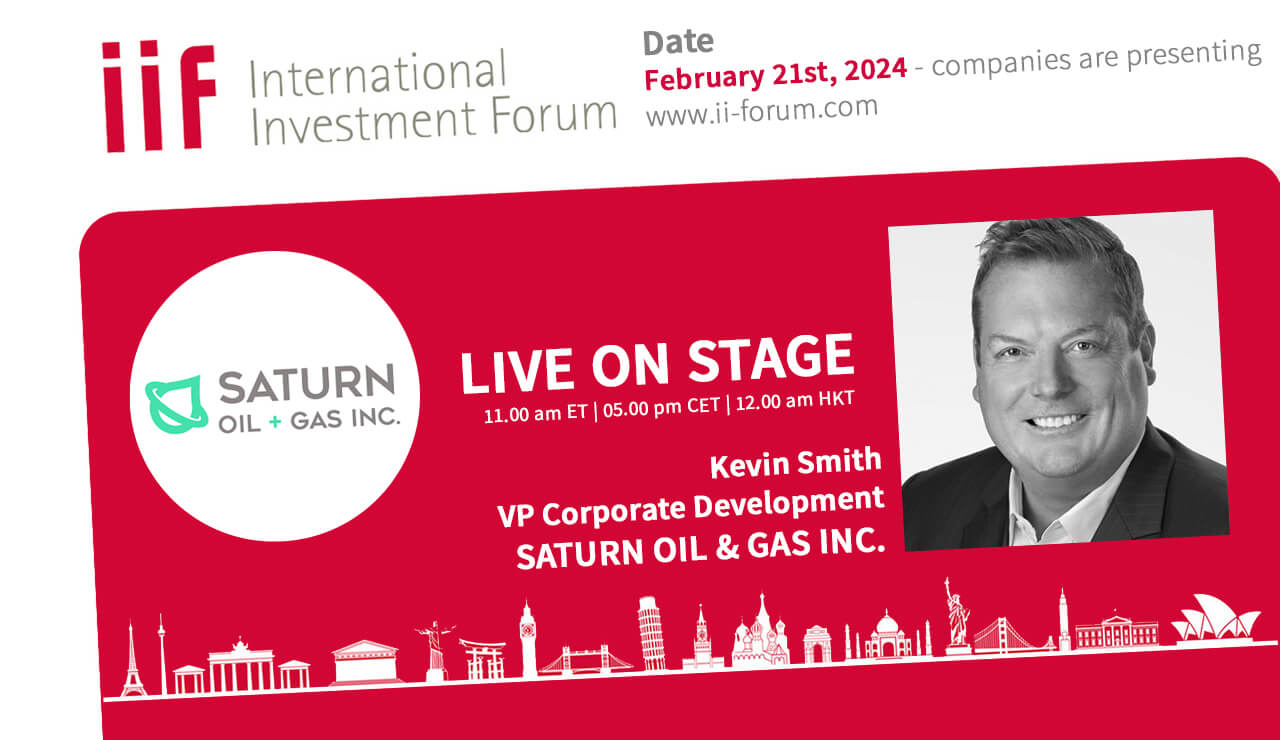
Saturn Oil & Gas is committed to a structured capital allocation: The fully funded development capital budget of approximately CAD 146 million, representing approximately 47% of expected 2024 adjusted funds flow, will be targeted at the Company's extensive portfolio of light oil development opportunities in Saskatchewan and Alberta. Investors can learn the full details today, February 21, at the 10th International Investment Forum, where VP Corporate Development Kevin Smith will present live at 5:00 pm CET. (11:00 am ET, 5:00 PM CET, 12:00 am HKT). Click here to register for free.
As a third goal for 2024, the Canadians are focusing on rapid debt repayment. By directing organic free cash flow to reduce net debt, Saturn aims to reduce debt by 38% to 42% annually. This is intended to reduce the net debt to adjusted EBITDA ratio for 2024 to a range of 0.7x to 0.8x, a significant improvement compared to 1.3x at the end of 2023.
The high leverage for light oil also plays an important role. With oil and NGLs accounting for 80% of production, each additional USD 5/bbl increase in the WTI oil price will add CAD 15 million to free cash flow. These additional funds will be used to accelerate debt repayment. Currently, debt-free status is forecast for the first quarter of 2026. The less debt a company like Saturn Oil & Gas has, the more attractive it becomes to long-term investors.
Plug Power launches initiative to reduce annual operating expenses by USD 75 million
US-based Plug Power Inc., the world's leading provider of hydrogen solutions, is launching its initiative to reduce annual operating expenses by over USD 75 million. The expected one-off implementation costs amount to around USD 15 million. The initiative includes operational consolidation, headcount reductions and other cost-saving measures. The goal is to increase Plug Power's efficiency, improve scalability and enhance its position as an industry leader.
The measures include:
- A key element of this initiative is the consolidation of operations, which aims to optimize resource allocation and streamline processes.
- Plug Power is also planning to adjust the number of employees. Affected employees will be supported with comprehensive severance packages and career transition resources.
- Cost-saving measures include optimizing supply chain management, limiting discretionary spending and using automation and digital technologies to increase operational efficiency. Discretionary spending refers to cash expenditure that is not directly required for the day-to-day running of a business or for commitments such as rent or wages.
"The implementation of this strategic plan is critical for Plug to maintain its market leadership and continue to provide innovative renewable energy solutions," says Andy Marsh, CEO of Plug Power. "We are confident that this strategic realignment will strengthen our competitive position and contribute to our long-term success." The plan to reduce expenditure is necessary to ensure the Company's competitiveness in a changing energy landscape.
Deutsche Pfandbriefbank under pressure due to US real estate market - short sellers strike
European banks are facing growing challenges amid falling commercial real estate prices. They have lent around EUR 1.4 trillion to the struggling sector. German banks are particularly affected, as prices for commercial real estate have fallen at a record pace. Deutsche Pfandbriefbank (pbb) came under the spotlight last week as investors dumped shares due to its involvement in the US office real estate market.
Banks in other countries, including France and the Netherlands, could also be affected by the downturn. Short positions on pbb shares account for at least 8.08% of tradable shares, up from 7.57% at the beginning of the week.
pbb has around 15% of its lending in the US, which could lead to higher risk costs. Last week, the bank doubled its provisioning and responded with announcements to reassure investors. Last week, S&P downgraded pbb's credit rating due to its US activities. According to a study by Moody's, most EU banks are not active in the US commercial real estate business, but German banks are an exception.
Since February 16, short sellers have been increasingly betting on a decline in the stock price of the DAX-listed company. They believe that the bank is in a downward spiral. The share price trend also suggests that the pbb share has not yet bottomed out, despite the banks assurances that its capital buffers are strong and its business profitable.
Saturn Oil & Gas has announced its budget and targets for 2024, including sustainable oil and gas production and rapid debt repayment. Focusing on light oil development projects in North America, the Company plans to increase its production to 26,500 to 27,500 barrels of oil equivalent per day. The projected adjusted cash flow ranges between CAD 300 and 316 million. Saturn is committed to a structured capital allocation with a budget of approximately CAD 146 million for the development of light oil opportunities in Saskatchewan and Alberta. The Company plans to reduce its net debt by 38% to 42% annually. Plug Power has launched an initiative to reduce annual operating expenses by over USD 75 million. The measures include operational consolidation, staff reductions and optimization of supply chain management. The Company plans to further strengthen its competitive position in the renewable energy sector. Deutsche Pfandbriefbank is coming under pressure from the US real estate market, leading to increased short positions. However, the bank emphasizes its strong capital base and profitable business practices to boost investor confidence. One thing is sure: energy production is more profitable than investing in falling knives.
Conflict of interest
Pursuant to §85 of the German Securities Trading Act (WpHG), we point out that Apaton Finance GmbH as well as partners, authors or employees of Apaton Finance GmbH (hereinafter referred to as "Relevant Persons") may hold shares or other financial instruments of the aforementioned companies in the future or may bet on rising or falling prices and thus a conflict of interest may arise in the future. The Relevant Persons reserve the right to buy or sell shares or other financial instruments of the Company at any time (hereinafter each a "Transaction"). Transactions may, under certain circumstances, influence the respective price of the shares or other financial instruments of the Company.
In addition, Apaton Finance GmbH is active in the context of the preparation and publication of the reporting in paid contractual relationships.
For this reason, there is a concrete conflict of interest.
The above information on existing conflicts of interest applies to all types and forms of publication used by Apaton Finance GmbH for publications on companies.
Risk notice
Apaton Finance GmbH offers editors, agencies and companies the opportunity to publish commentaries, interviews, summaries, news and the like on news.financial. These contents are exclusively for the information of the readers and do not represent any call to action or recommendations, neither explicitly nor implicitly they are to be understood as an assurance of possible price developments. The contents do not replace individual expert investment advice and do not constitute an offer to sell the discussed share(s) or other financial instruments, nor an invitation to buy or sell such.
The content is expressly not a financial analysis, but a journalistic or advertising text. Readers or users who make investment decisions or carry out transactions on the basis of the information provided here do so entirely at their own risk. No contractual relationship is established between Apaton Finance GmbH and its readers or the users of its offers, as our information only refers to the company and not to the investment decision of the reader or user.
The acquisition of financial instruments involves high risks, which can lead to the total loss of the invested capital. The information published by Apaton Finance GmbH and its authors is based on careful research. Nevertheless, no liability is assumed for financial losses or a content-related guarantee for the topicality, correctness, appropriateness and completeness of the content provided here. Please also note our Terms of use.