November 26th, 2025 | 07:30 CET
Prices down on Black Friday? SAP and Palantir consolidate, UMT with a strong concept, Deutsche Telekom still cheap!
Nervousness is mounting - as seen in volatility indices, which have risen from 15 to just over 20. As is so often the case in the fall, uncertain forecasts for economic development are causing considerable fluctuations in the stock markets. This is because much remains unclear. Will Trump's tariffs have a positive effect on the US economy, or will courts roll everything back to its original state? How will the situation in Ukraine evolve? Will Germany manage the economic and societal turnaround? These are all reasons why it makes sense to start the new year with fewer stocks. Because, as always, January means back to square one – and a new game! We offer some tips for portfolio optimization.
time to read: 5 minutes | Author: André Will-Laudien
ISIN: SAP SE O.N. | DE0007164600 , PALANTIR TECHNOLOGIES INC | US69608A1088 , UMT UNITED MOBILITY TECHNOLOGY AG | DE000A40ZVU2 , DEUTSCHE TELEKOM ADR 1 | US2515661054
Table of contents:
Author

André Will-Laudien
Born in Munich, he first studied economics and graduated in business administration at the Ludwig-Maximilians-University in 1995. As he was involved with the stock market at a very early stage, he now has more than 30 years of experience in the capital markets.
Tag cloud
Shares cloud
SAP versus Palantir – From cheap to extremely expensive!
Why is Palantir valued 10 times higher than SAP? The mystery is quickly solved when you look at the latest quarterly numbers: Palantir Technologies shows revenue growth of around 48% and is expected to reach an annual rate of approximately USD 4.15 billion for 2025. Even with this strong momentum, the valuation appears extremely ambitious. For 2026, the Company still trades at a P/E ratio above 240, meaning investors are pricing in a massive continuation of its growth story.
Earnings per share are expected to rise from USD 0.19 in 2024 to USD 0.85 in 2026, an increase of over 300% within just two years. The implied 2026 P/E ratio is currently around 80, reflecting an extremely high growth premium.
SAP, the German leader among software companies, can only look on enviously at Palantir's exorbitant price rally of over 1,800% in the last three years. During the same period, shares in the Walldorf-based company rose by only 95%, which is still strong, considering its stable, predictable business model. SAP's annual revenue of just under EUR 37 billion is roughly 10 times higher than that of Palantir, yet **SAP trades at a far more moderate 2026 P/E ratio of around 40 and a price-to-sales ratio of around 9, which reflects the lower growth but also a stable earnings situation. SAP is investing heavily in AI-supported innovations and cloud technology, which are also increasingly in demand among medium-sized companies.
The political and social controversy surrounding Palantir, mainly due to its proximity to US politicians and security agencies, is weighing on the stock, but according to analysts, it plays only a minor role in the share price. SAP, in contrast, is an internationally renowned and established player that is also regarded as a reliable partner for digital transformation in Germany and Europe. Palantir's collaboration with SAP on cloud migrations shows that the two companies can complement each other, but their investment profiles are very different. On the LSEG platform, only 6 out of 26 analysts are on the buy side for Palantir, and the median price expectation of USD 185 is only 14% above the last price. For SAP, 28 out of 33 experts are willing to give a "Buy" recommendation. At EUR 287.50, with traded prices of around EUR 205, there is actually around 40% upside potential. Which stock to buy is certainly a matter of taste: Palantir offers huge future potential, while SAP offers at least a rapidly growing cloud business. We will know in 12 months which was the better choice!
United Mobility Technology AG – AI within reach for small and medium-sized businesses
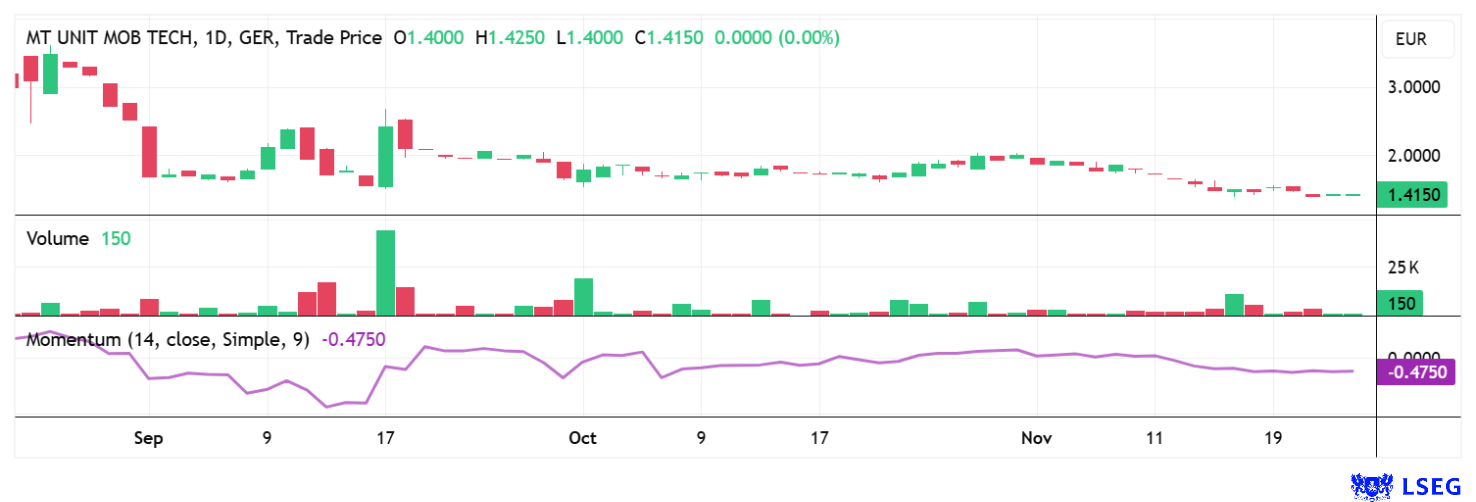
Since MKK was revived in Munich, trading volumes at small-cap UMT United Mobility Technology AG have picked up. The Company has undergone a profound transformation in recent years, evolving from a formerly loss-making payment provider to a focused technology company. After consistently addressing old risks, a clearly structured AI business model emerged, which is now serving its first customers in live operation. At the heart of this new orientation is a modular platform that uses modern large-model frameworks to largely automate workflows in small and medium-sized businesses.
UMT is now positioning itself as a provider of AI-supported process consulting that can deliver productive results without long training phases. The solutions are in high demand, especially in the logistics industry, where many processes are manual. Tasks such as customs clearance, order entry, and dispatching are significantly accelerated and standardized by Vision AI. Initial customers such as Loth and BGM Logistics are already using the systems to process incoming transport orders or complex customs processes without manual preparation. The approach of automatically extracting data from a wide variety of documents and preparing it for decision-making saves considerable working time and reduces error rates.
The SaaS structure established in the B2B sector also ensures predictable, recurring revenue. UMT links its pricing to the specific added value, which is particularly beneficial for medium-sized customers. According to management around CEO Erik Nagel, between 400 and 1,500 hours of working time can be saved annually, which makes the economic benefits clearly tangible. At the same time, the model enables cost-effective entry into AI without high initial investments. UMT aims to expand its European presence by expanding into security-critical industries and forming new partnerships. Based on the scalability of its framework, the Company sees considerable revenue potential in the coming years. Overall, this creates an AI provider that intervenes deeply in operational processes and thus establishes itself as an important long-term partner for medium-sized businesses. Investors interested in AI should take a closer look despite the market capitalization of only EUR 3.5 million, because this could be a 10-bagger in the making!
Potential investors are eagerly awaiting the update on the medium-term strategy at the upcoming IIF Forum on December 3 at 1 p.m. (link: https://ii-forum.com/ text: Click here to register...
Deutsche Telekom – Very cheap due to declines in the US
Attentive stock market traders will not have overlooked the sell-off of Deutsche Telekom shares (designated as a "people's share" in 1996). Since reaching its 2025 high of EUR 35.90 in March, the stock has lost almost 25%, even though analysts expect strong profit growth over the next three years. The situation at the mobile communications subsidiary in the US, where two new providers are now putting considerable pressure on the relatively high price structure, has caused uncertainty. In the US, Deutsche Telekom operates under the Magenta label T-Mobile, holding a market share of 33%, and ranking directly behind the market leader Verizon, which has a 36% share. The US mobile communications market is highly saturated, so growth is heavily concentrated among the three major providers. However, cheaper newcomers are putting pressure on margins. Analysts on the LSEG platform expect earnings per share of EUR 1.97 in 2025, down from EUR 2.27 in 2024. However, this is expected to rise again to EUR 2.19 in 2026. It is also worth noting the dividend yield of over 4%. This makes Deutsche Telekom a stable anchor for any portfolio, and the current lower price effectively offers investors a gift in the form of increased returns.
**The stock markets continue to be significantly influenced by capital flows, which are concentrated on artificial intelligence, future technologies, and software. After a series of moderate setbacks, there is once again scope for tactically minded investors to build up selected exposures. In the German small-cap sector, UMT AG is increasingly coming into focus as a newly positioned AI stock, which could lead to significant momentum in the short term. While Palantir remains fundamentally highly valued, SAP and Deutsche Telekom currently appear very attractively priced in relative terms.
Conflict of interest
Pursuant to §85 of the German Securities Trading Act (WpHG), we point out that Apaton Finance GmbH as well as partners, authors or employees of Apaton Finance GmbH (hereinafter referred to as "Relevant Persons") currently hold or hold shares or other financial instruments of the aforementioned companies and speculate on their price developments. In this respect, they intend to sell or acquire shares or other financial instruments of the companies (hereinafter each referred to as a "Transaction"). Transactions may thereby influence the respective price of the shares or other financial instruments of the Company.
In this respect, there is a concrete conflict of interest in the reporting on the companies.
In addition, Apaton Finance GmbH is active in the context of the preparation and publication of the reporting in paid contractual relationships.
For this reason, there is also a concrete conflict of interest.
The above information on existing conflicts of interest applies to all types and forms of publication used by Apaton Finance GmbH for publications on companies.
Risk notice
Apaton Finance GmbH offers editors, agencies and companies the opportunity to publish commentaries, interviews, summaries, news and the like on news.financial. These contents are exclusively for the information of the readers and do not represent any call to action or recommendations, neither explicitly nor implicitly they are to be understood as an assurance of possible price developments. The contents do not replace individual expert investment advice and do not constitute an offer to sell the discussed share(s) or other financial instruments, nor an invitation to buy or sell such.
The content is expressly not a financial analysis, but a journalistic or advertising text. Readers or users who make investment decisions or carry out transactions on the basis of the information provided here do so entirely at their own risk. No contractual relationship is established between Apaton Finance GmbH and its readers or the users of its offers, as our information only refers to the company and not to the investment decision of the reader or user.
The acquisition of financial instruments involves high risks, which can lead to the total loss of the invested capital. The information published by Apaton Finance GmbH and its authors is based on careful research. Nevertheless, no liability is assumed for financial losses or a content-related guarantee for the topicality, correctness, appropriateness and completeness of the content provided here. Please also note our Terms of use.