October 22nd, 2025 | 06:55 CEST
NEO Battery Materials – Batteries as the key to technological sovereignty
The situation sounds challenging! The global energy transition and the rise of autonomous systems are driving demand for high-performance batteries to historic highs. However, the dependence of Western industries on Chinese supply chains remains a geopolitical risk factor of the first order. In this tense environment, NEO Battery Materials Ltd. (NBM) is positioning itself as North America's hope for the development of cost-efficient, silicon-enhanced lithium-ion batteries. One of the newcomer's great strengths is its combination of modern and efficient materials science, cell architecture, and process optimization into an integrated solution. The focus is on establishing an independent value chain in North America. Time is of the essence, and the barrier to entry is high! Why are investors and producers lining up now?
time to read: 4 minutes | Author: André Will-Laudien
ISIN: NEO BATTERY MATERIALS LTD | CA62908A1003
Table of contents:
Author

André Will-Laudien
Born in Munich, he first studied economics and graduated in business administration at the Ludwig-Maximilians-University in 1995. As he was involved with the stock market at a very early stage, he now has more than 30 years of experience in the capital markets.
Tag cloud
Shares cloud
Canada's answer to Asian dominance in the battery sector
Much of the Company's entrepreneurial skill revolves around technology, which is at the heart of the NEO strategy. At the center is the patented NBMSiDE® silicon anode, which uses a nanometric coating to control the volume expansion of silicon during charging. The result is significantly higher energy densities of over 2,000 mAh/g, shorter charging times, and an astonishing efficiency of over 88%. The proprietary "one-step process" reduces manufacturing costs by more than 60%, a decisive factor in an increasingly margin-driven market. The fields of application are exciting, ranging from a wide variety of electronic applications to artificial intelligence and robotics, and now also include drones. State-of-the-art energy storage systems make the applications robust and operational, and sometimes even intelligent when it comes to energy consumption.
The geopolitical dimension – The raw materials war over batteries
The dominance of Chinese companies such as CATL and BYD in global battery production remains unbroken. From raw material extraction to cell manufacturing, China controls more than two-thirds of global capacity. Export restrictions on high-performance batteries with more than 300 Wh/kg further exacerbate the situation. While Western markets are responding, a historic opportunity is opening up for specialized developers such as NBM. Their ability to manufacture high-performance cells outside China is increasingly seen as a strategic competitive advantage and defined as an industrial policy necessity. With the expansion of a new production site in South Korea, NEO Battery Materials has now reached what is arguably the most important milestone in its corporate development. The 2.5-hectare site comprises six industrial buildings and additional reserve space and serves as the foundation for the establishment of integrated battery production. In the future, both silicon anode materials and complete battery cells in various formats will be produced here.
CEO Spencer Huh clearly articulates the ambition: "Through this partnership, we are advancing our mission to build a robust and high-quality North American battery supply chain."
At the same time, a production line for 20 tons of silicon material per year is being built - another step toward vertical integration. Seok Joung Youn, Head of Manufacturing Operations, emphasizes: "By integrating the entire value chain, NBM can reduce its dependence on external producers, shorten development times, and improve quality control over materials, electrodes, and cells." With this vertical structure, NEO aims to act as a "battery foundry" for Western industries, a model that has so far been implemented almost exclusively in China.
Commercial successes confirm the chosen course
Yesterday, October 21, the Company announced a CAD 2.5 million order from a South Korean robotics manufacturer. The order is for customized lithium-silicon batteries for autonomous mobile robots, humanoid systems, and industrial service platforms, which are ideal for hazardous industrial environments. The joint development agreement (JDA) provides for the joint development of prototypes with a capacity of 3.38 kWh, which is around 45% above current market standards. The batteries will be supplied to global corporations and SMEs with logistics warehouses, production facilities, and various end markets. The products supplied include both prototype packs for field validation and commercial-grade packs for integration into the customer's payload, service, and AMR-based humanoid robot systems. Under the JDA, NBM and the unnamed customer intend to exceed the performance benchmarks for batteries used by established humanoid and industrial robot platforms. This solidifies NBM's position in one of the fastest-growing technology fields, the electrification and autonomization of industrial processes.
"This purchase order and the JDA for robotics and autonomous systems strengthen NEO's position as a competent provider of battery solutions in various end markets," said Spencer Huh, Director, President, and CEO of NEO. "By developing and manufacturing customized batteries for AMR and humanoid robotics, NEO is actively creating opportunities to enter growing sectors that cannot compromise on battery performance and a resilient supply chain. We want to get the battery innovation platform up and running as quickly as possible at our new facilities in South Korea."
A piece of the puzzle for Western independence
NEO Battery Materials exemplifies Western industries' attempt to regain lost ground in the battery and raw materials sector. Its expansion in South Korea, orders from the robotics industry, and the technological depth of the NBMSiDE® platform create the conditions for resilient industrialization. The path to mass production remains challenging, but the direction taken is the right one. With each further step toward vertical integration, NEO's importance grows in an industry that has long since become a geopolitical battleground.
In a recent IIF interview, Lyndsay Malchuk talks to Senior Vice President Danny Huh about the latest developments. https://youtu.be/9xbC2p6n264
Conclusion: Financial strength and industrial focus make NEO a battery game changer
Following a capital increase of CAD 5.5 million in September, NEO is in a solid financial position. The capital is being invested in scale-up facilities, material validation, and the development of new applications, particularly in the defense and robotics sectors. However, the ability to demonstrate supply chain resilience and be perceived as a reliable component of a Western battery alliance will be strategically crucial. With a current share price of around CAD 0.68, the Company continues to be considered an early-stage investment with extremely high growth potential.
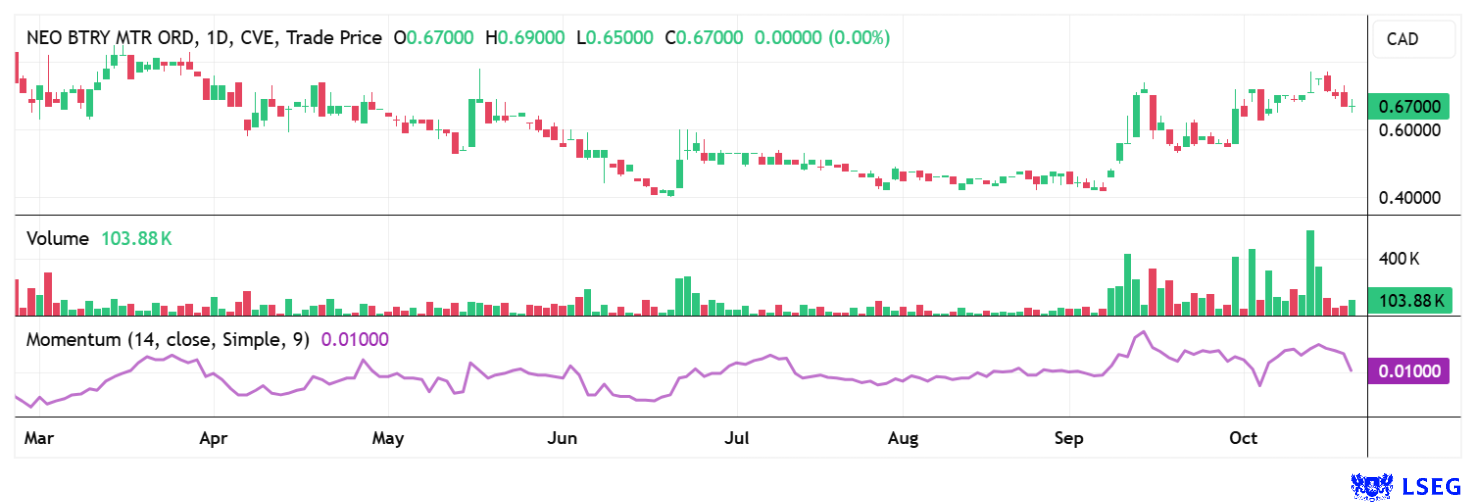
The progress of the energy transition depends heavily on the availability of raw materials. However, innovative technologies that increase the performance of energy storage systems and extend the endurance and life cycle of the units are just as important. There are now many providers on the market for future energy storage solutions. It remains to be seen which ones will ultimately prevail. Canadian company NEO Battery Materials is well-positioned in the race with a still manageable market capitalization of approximately CAD 82 million.
Conflict of interest
Pursuant to §85 of the German Securities Trading Act (WpHG), we point out that Apaton Finance GmbH as well as partners, authors or employees of Apaton Finance GmbH (hereinafter referred to as "Relevant Persons") currently hold or hold shares or other financial instruments of the aforementioned companies and speculate on their price developments. In this respect, they intend to sell or acquire shares or other financial instruments of the companies (hereinafter each referred to as a "Transaction"). Transactions may thereby influence the respective price of the shares or other financial instruments of the Company.
In this respect, there is a concrete conflict of interest in the reporting on the companies.
In addition, Apaton Finance GmbH is active in the context of the preparation and publication of the reporting in paid contractual relationships.
For this reason, there is also a concrete conflict of interest.
The above information on existing conflicts of interest applies to all types and forms of publication used by Apaton Finance GmbH for publications on companies.
Risk notice
Apaton Finance GmbH offers editors, agencies and companies the opportunity to publish commentaries, interviews, summaries, news and the like on news.financial. These contents are exclusively for the information of the readers and do not represent any call to action or recommendations, neither explicitly nor implicitly they are to be understood as an assurance of possible price developments. The contents do not replace individual expert investment advice and do not constitute an offer to sell the discussed share(s) or other financial instruments, nor an invitation to buy or sell such.
The content is expressly not a financial analysis, but a journalistic or advertising text. Readers or users who make investment decisions or carry out transactions on the basis of the information provided here do so entirely at their own risk. No contractual relationship is established between Apaton Finance GmbH and its readers or the users of its offers, as our information only refers to the company and not to the investment decision of the reader or user.
The acquisition of financial instruments involves high risks, which can lead to the total loss of the invested capital. The information published by Apaton Finance GmbH and its authors is based on careful research. Nevertheless, no liability is assumed for financial losses or a content-related guarantee for the topicality, correctness, appropriateness and completeness of the content provided here. Please also note our Terms of use.