March 12th, 2026 | 07:15 CET
Nuclear power comeback in the EU! Solid returns with American Atomics, Amazon, and E.ON
Since the EU nuclear summit in Paris a few days ago, it has become clear that nuclear energy is once again socially acceptable in Europe. At the meeting, the European Commission described the former move away from nuclear power as a strategic mistake and launched a comprehensive offensive for small modular reactors (SMRs). According to the EU strategy, an SMR capacity of up to 53 GW is to be built up by 2050 in order to reduce the persistently high electricity prices and stop the impending exodus of industry. At the same time, a new factor is driving global electricity demand: artificial intelligence (AI). The International Energy Agency (IEA) predicts that the share of nuclear and renewable energy in the global electricity mix will rise to 50% by 2030. Tech giants such as Amazon increasingly want to satisfy the energy hunger of AI data centers themselves. E.ON is also likely to benefit from this historic strategic shift by operating stable grids. However, at the source of the new boom is the up-and-coming exploration company American Atomics, which is searching for urgently needed uranium and closing a strategic gap in the supply chain. We highlight where investors can find the most attractive opportunities.
time to read: 3 minutes | Author: Nico Popp
ISIN: AMERICAN ATOMICS INC | CA0240301089 | CSE: NUKE , AMAZON.COM INC. DL-_01 | US0231351067 , E.ON SE NA O.N. | DE000ENAG999
Table of contents:
Author

Nico Popp
At home in Southern Germany, the passionate stock exchange expert has been accompanying the capital markets for about twenty years. With a soft spot for smaller companies, he is constantly on the lookout for exciting investment stories.
Tag cloud
Shares cloud
Amazon secures nuclear energy for AI data centers
Tech giant Amazon is currently proving that the boundaries between tech and energy companies are blurring. The rapid growth of its AWS cloud division, which posted a 24% increase in revenue to USD 35.6 billion in the fourth quarter of last year, and the insatiable energy demands of AI applications are forcing the company to break new ground. To reliably secure the 24/7 supply of its enormous data centers in the future, management announced massive capital investments of around USD 200 billion for the current year. Amazon is no longer relying solely on contracts for wind and solar energy, but is also investing in gas-fired power plants and nuclear power. In the "Cascade Advanced Energy Facility" project in the US state of Washington, the company is financing the development of twelve high-temperature gas reactors by its partner X-energy with around USD 334 million. This direct financial investment secures Amazon exclusive purchasing rights for the electricity generated and effectively protects it from price fluctuations on the electricity market. The long-term vision is enormous: by 2039, the company plans to bring a total of 5 GW of new nuclear capacity online in the US, which would make Amazon not only a technology heavyweight but also a real energy heavyweight.
E.ON delivers the smart grid for the future
While Amazon is driving demand on the generation side, infrastructure group E.ON faces the Herculean task of rebuilding the European energy architecture for a decentralized, nuclear-powered future. As Europe's largest distribution network operator with around 51 million customers, E.ON acts as the backbone of the energy transition. In the past fiscal year, the group achieved record EBITDA of EUR 9.8 billion, driven by strong network business. To prepare the power grids for the increasing feed-in of thousands of new and decentralized energy sources, such as future SMR fleets, E.ON has increased its investment plan for the coming years to EUR 48 billion. Of this, EUR 40 billion will be invested in the modernization and digitalization of the infrastructure alone. The company is focusing heavily on smart technologies and has already put 30,000 digital local network stations into operation to optimally control complex load flows in real time. For investors, E.ON offers enormous predictability as a pure network operator, as the direct operational risk of its own nuclear power plants no longer weighs on the balance sheet following the group's nuclear phase-out.
American Atomics scores right at the source
American Atomics is positioning itself as more speculative than E.ON, but with significantly more upside potential. At the very beginning of the nuclear value chain is the raw material uranium, demand for which, according to IEA data, will increase by 28% to over 83,000 tons by 2030. The Canadian exploration company is specifically searching for new deposits in politically stable US states such as Utah and Colorado. At the Big Indian project in Utah, management is using state-of-the-art 3D models to explore undiscovered resources in a historic uranium district. The Nuvemco project in Colorado also promises to produce vanadium, which is needed for large stationary batteries. However, American Atomics is much more than a traditional explorer, as the young company is planning to build a state-of-the-art, modular processing plant in cooperation with CVMR. This gas-phase metallurgy-based technology is designed to convert uranium ore directly into high-purity compounds in a hermetically sealed process without toxic waste. This is the crucial and potentially lucrative preliminary step for the production of so-called HALEU fuel, which is essential for the new generation of SMR reactors and for which the West has so far been heavily dependent on Russia.
Low valuation offers entry opportunity
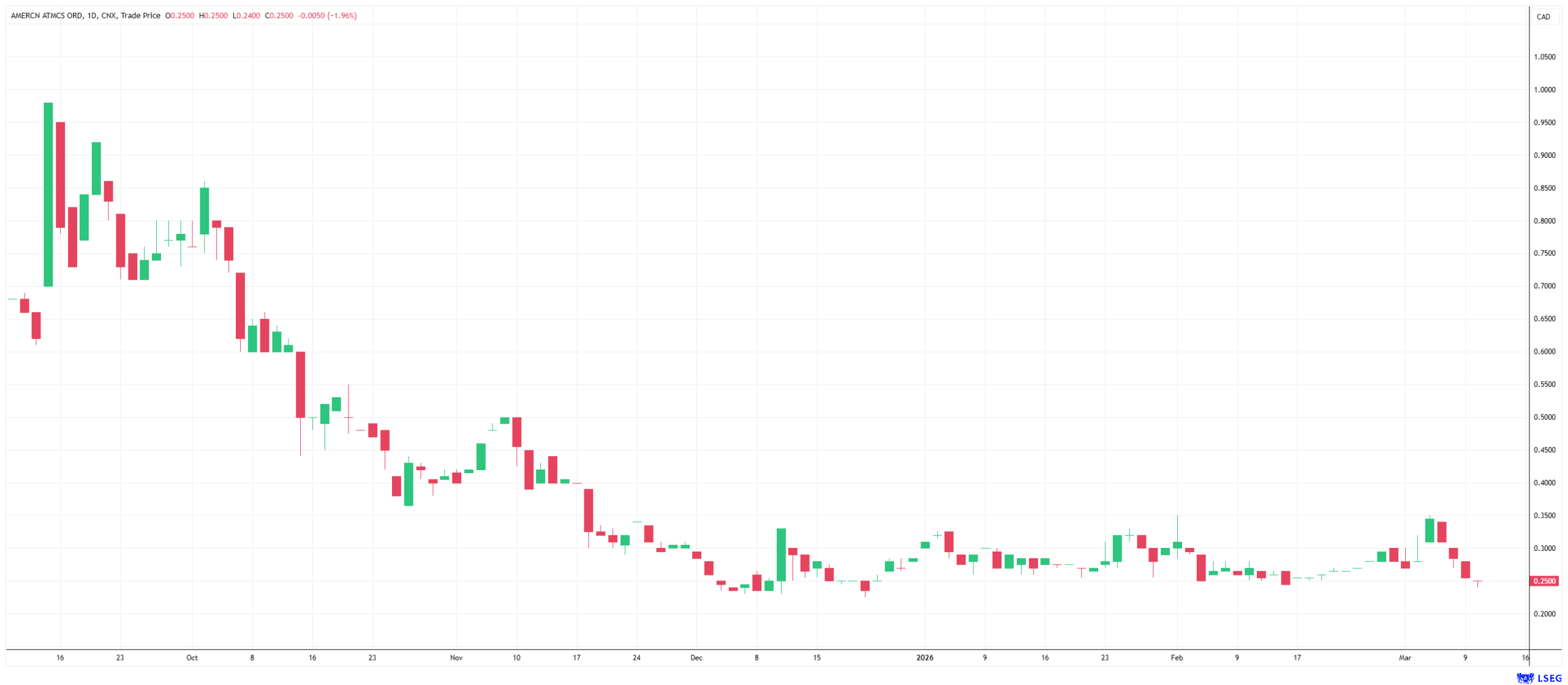
American Atomics currently offers investors a particularly exciting opportunity. While well-known industry giants such as NexGen Energy are already valued at billions on the stock market, American Atomics currently has a market capitalization of only around CAD 15 million. This extremely low valuation reflects the early stage of the projects, but offers significant upside potential for risk-tolerant investors in the current bull market for uranium. After the company raised fresh capital at the beginning of this year and completed an uplisting to the US OTCQB segment, the stock is now increasingly attracting the attention of professional investors. Once the broader market recognizes the enormous strategic potential of purely Western, waste-free uranium enrichment for the upcoming SMR reactors, American Atomics' stock could be in for a revaluation. Together with basic investments such as E.ON and cloud giant Amazon, investors can build a crisis-proof and equally high-yield portfolio centered on the comeback of nuclear energy.
Watch YouTube videoConflict of interest
Pursuant to §85 of the German Securities Trading Act (WpHG), we point out that Apaton Finance GmbH as well as partners, authors or employees of Apaton Finance GmbH (hereinafter referred to as "Relevant Persons") may hold shares or other financial instruments of the aforementioned companies in the future or may bet on rising or falling prices and thus a conflict of interest may arise in the future. The Relevant Persons reserve the right to buy or sell shares or other financial instruments of the Company at any time (hereinafter each a "Transaction"). Transactions may, under certain circumstances, influence the respective price of the shares or other financial instruments of the Company.
In addition, Apaton Finance GmbH is active in the context of the preparation and publication of the reporting in paid contractual relationships.
For this reason, there is a concrete conflict of interest.
The above information on existing conflicts of interest applies to all types and forms of publication used by Apaton Finance GmbH for publications on companies.
Risk notice
Apaton Finance GmbH offers editors, agencies and companies the opportunity to publish commentaries, interviews, summaries, news and the like on news.financial. These contents are exclusively for the information of the readers and do not represent any call to action or recommendations, neither explicitly nor implicitly they are to be understood as an assurance of possible price developments. The contents do not replace individual expert investment advice and do not constitute an offer to sell the discussed share(s) or other financial instruments, nor an invitation to buy or sell such.
The content is expressly not a financial analysis, but a journalistic or advertising text. Readers or users who make investment decisions or carry out transactions on the basis of the information provided here do so entirely at their own risk. No contractual relationship is established between Apaton Finance GmbH and its readers or the users of its offers, as our information only refers to the company and not to the investment decision of the reader or user.
The acquisition of financial instruments involves high risks, which can lead to the total loss of the invested capital. The information published by Apaton Finance GmbH and its authors is based on careful research. Nevertheless, no liability is assumed for financial losses or a content-related guarantee for the topicality, correctness, appropriateness and completeness of the content provided here. Please also note our Terms of use.