July 14th, 2022 | 12:35 CEST
Nel successful in Australia, Rheinmetall recommended by Goldman and Barsele Minerals for the gold comeback
Interest rate fears, a looming recession and war in Ukraine - There are numerous reasons for nervousness on the stock market. But especially in uncertain times, the chances of long-term price gains are high. But where is the safe haven at the moment? Gold, renewable energies or even armaments? Gold is undoubtedly one of the disappointments of the year. The strong US dollar is weighing on the sector. But gold stocks are cheap. Alongside heavyweights, there are also explorers such as Barsele Minerals, and the Canadians bring takeover fantasy. Golden times are predicted for companies in the renewable energy sector. Hydrogen specialist Nel shines with an order from Australia. And defense companies like Rheinmetall are facing a super cycle. At the same time, the MDAX group is also getting involved in fuel cells, and Goldman Sachs advises buying.
time to read: 3 minutes | Author: Fabian Lorenz
ISIN: NEL ASA NK-_20 | NO0010081235 , RHEINMETALL AG | DE0007030009 , BARSELE MINERALS | CA0688921083
Table of contents:
Author

Fabian Lorenz
For more than twenty years, the Cologne native has been intensively involved with the stock market, both professionally and privately. He is particularly passionate about national and international small and micro caps.
Tag cloud
Shares cloud
Barsele Minerals: Will partner Agnico Eagle soon increase its stake?
Has gold had its day as a safe haven? With the price of gold falling from USD 2,050 to USD 1,728 within a few weeks, one might think so. But one should not write gold off too early. The decline is primarily due to the strong US dollar. But that could soon be over when the Fed ends its interest rate hikes due to the threat of recession. Then gold could take off. Because not only shares like Barrick are cheap, but also explorers like Barsele Minerals. The Canadian company is currently focusing on a project in Sweden. This significantly reduces political risks compared to competitors in Eastern Europe, Africa and Asia. The Barsele Gold project is located 600 km north of Stockholm. Several large gold deposits are located nearby, including Bjorkdal (Elgin Mining), Faboliden (Dragon Mining) and Svartliden (Dragon Mining).
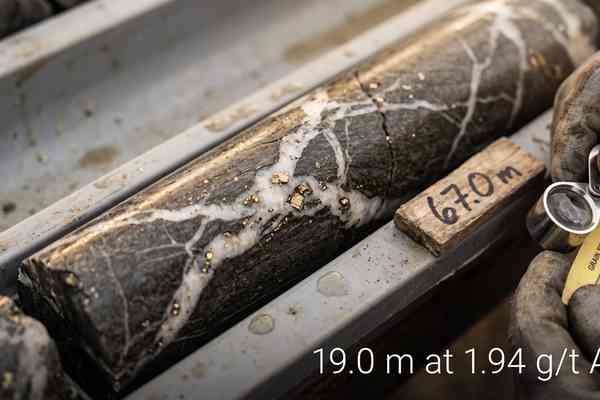
The Barsele Project is 55% owned by Agnico Eagle and 45% by Barsele. The strong partner brings advantages: Barsele does not have to expend cash until a pre-feasibility study is completed. In recent years, 404 drill holes totaling 155,000m have already been drilled at the Barsele project, with gold resources estimated at 2.4 million ounces. In addition, metals such as lead, zinc and nickel are also present. These raw materials, which are essential for the high-tech industry, add value to the property. Currently, the Company is working on an expansion. The next stage is to increase the resource estimate to 3.5 million ounces of gold. Should this succeed, an increase of the shareholding by Agnico would be plausible. A complete takeover of Barsele Minerals would also be possible. Currently, the Barsele share is quoted at around CAD 0.30. That puts the market capitalization at a manageable CAD 40 million. Should there be positive drilling results, significantly higher prices should be possible - in the case of a takeover anyway.
Nel: Success in Australia
Are renewable energy companies the new safe haven for investors? At the very least, the industry is likely to resist a recession. After all, government subsidies to reduce dependence on fossil fuels are massive in Germany, Europe and beyond. Companies like Nel Asa are benefiting from this. The hydrogen specialist from Norway has now landed another order. Nel will supply a PEM electrolyzer worth four million euros to Australia. The customer is the listed Viva Energy Australia. Among other things, the Company operates a refinery in Geelong, near which a new filling station for battery charging and hydrogen refueling is currently being built. Viva Energy plans to use the PEM electrolyzer - reportedly the largest in Australia - to produce green hydrogen for refueling heavy-duty fuel cell vehicles. The system offered by Nel is a containerized solution with a production capacity of up to 1,063 kg per day, directly supplying fuel cell-grade hydrogen to the specialized refueling station. The project received a grant from the Australian Renewable Energy Agency (ARENA) under ARENA's Renewable Energy Assistance Program and funding from the Victorian Government's Renewable Hydrogen Commercialization Pathways Fund.
Rheinmetall: Goldman Sachs sees the share at EUR 290
Unimaginable until a few months ago, but now defense companies are also coming into question as a safe haven. The reason, of course, is Russia's attack on Ukraine at the end of February and the associated turnaround of many countries in terms of armaments. Rheinmetall, among others, is benefiting from this, with the share currently trading at around EUR 187. Goldman Sachs recommended it as a buy on Monday with a price target of EUR 290. Even though the analysts expect Rheinmetall to present relatively weak figures for the second quarter, they say this is mainly due to the automotive supply business. However, the German group has reported an interesting order in this segment. It has received an order in the mid double-digit million euro range for the supply of fuel cell components. A European fuel cell manufacturer has ordered flap systems with integrated bearing electronics. These are used as bypass and shut-off valves in fuel cells. Thanks to their unique design, the components meet the "highest" sealing requirements, according to Rheinmetall. With the first parts to be delivered this year, series production at Rheinmetall's Berlin production site is scheduled to start in 2025/2026. A total of 1.5 million components are then to be delivered by 2030.
All presented stocks offer arguments for an entry. Barsele Minerals is speculative but has already arrived at a low valuation level and has a strong partner for whom a takeover would not be a problem. Nel is one of the most promising hydrogen pure plays, even if the valuation is already sporty. Rheinmetall's order books should continue to fill up. Goldman's sees considerable upside potential here.
Conflict of interest
Pursuant to §85 of the German Securities Trading Act (WpHG), we point out that Apaton Finance GmbH as well as partners, authors or employees of Apaton Finance GmbH (hereinafter referred to as "Relevant Persons") may hold shares or other financial instruments of the aforementioned companies in the future or may bet on rising or falling prices and thus a conflict of interest may arise in the future. The Relevant Persons reserve the right to buy or sell shares or other financial instruments of the Company at any time (hereinafter each a "Transaction"). Transactions may, under certain circumstances, influence the respective price of the shares or other financial instruments of the Company.
In addition, Apaton Finance GmbH is active in the context of the preparation and publication of the reporting in paid contractual relationships.
For this reason, there is a concrete conflict of interest.
The above information on existing conflicts of interest applies to all types and forms of publication used by Apaton Finance GmbH for publications on companies.
Risk notice
Apaton Finance GmbH offers editors, agencies and companies the opportunity to publish commentaries, interviews, summaries, news and the like on news.financial. These contents are exclusively for the information of the readers and do not represent any call to action or recommendations, neither explicitly nor implicitly they are to be understood as an assurance of possible price developments. The contents do not replace individual expert investment advice and do not constitute an offer to sell the discussed share(s) or other financial instruments, nor an invitation to buy or sell such.
The content is expressly not a financial analysis, but a journalistic or advertising text. Readers or users who make investment decisions or carry out transactions on the basis of the information provided here do so entirely at their own risk. No contractual relationship is established between Apaton Finance GmbH and its readers or the users of its offers, as our information only refers to the company and not to the investment decision of the reader or user.
The acquisition of financial instruments involves high risks, which can lead to the total loss of the invested capital. The information published by Apaton Finance GmbH and its authors is based on careful research. Nevertheless, no liability is assumed for financial losses or a content-related guarantee for the topicality, correctness, appropriateness and completeness of the content provided here. Please also note our Terms of use.