February 24th, 2026 | 07:15 CET
MustGrow Biologics and its partnership with Bayer: Why the stock is only just getting started
Global agriculture is facing a paradox. It needs to feed more people, but with fewer chemical inputs. Worldwide, 460 pesticides are now banned or restricted across 162 countries. The era of synthetic active ingredients is coming to an end – but what comes next? A Canadian company believes it has found the answer. It grows in the field, is spicy and yellow: mustard. MustGrow Biologics has developed a technology that uses the natural defenses of the mustard plant to remediate soils and increase yields. What sounds like a niche idea could turn out to be one of the most exciting investments in the agricultural sector.
time to read: 5 minutes | Author: Armin Schulz
ISIN: MUSTGROW BIOLOGICS CORP. | CA62822A1030 , BAYER AG NA O.N. | DE000BAY0017
Table of contents:
Author

Armin Schulz
Born in Mönchengladbach, he studied business administration in the Netherlands. In the course of his studies he came into contact with the stock exchange for the first time. He has more than 25 years of experience in stock market business.
Tag cloud
Shares cloud
The mustard formula: How Corey Giasson plans to solve the agricultural crisis
The figures presented by Corey Giasson, President and CEO of MustGrow, are impressive. "If we look at the US market for our biofertility product TerraSante™, there are 5.6 million acres of high-quality specialty crops – fruit, vegetables, nuts, potatoes," he explains. "With a market penetration of only 3.3% and one application per acre per year, we are talking about USD 100 million in revenue." The key point is that many farmers in California harvest not just one, but up to four crops per year on the same acreage. The demand is correspondingly greater.
MustGrow began commercialization in 2024 and experienced a surprise. "Sales of TerraSante™ began in 2024 on a small area (150 acres) as farmers and retailers began testing the product. Due to the positive results, this was continued in 2025 on an area of approximately 1,000 acres," says Giasson. "In the second half of 2025, we saw an increase in demand as the first field trials proved successful. Due to deliberately conservative inventory planning at the beginning of the year, we were unable to fully meet this demand at the end of the season – a clear sign that market acceptance of TerraSante™ is growing." A sell-out that is a clear signal to any young company that it has struck a chord.
What is behind this momentum? MustGrow has turned the mustard plant into more than just a spice. The company's technology platform is based on isolating the compounds that the plant uses to defend itself against pests in nature. The result is two product lines: TerraSante™, a biofertilizer that nourishes the soil, and TerraMG™, a biocontrol solution against soil-borne diseases.
Hard facts from the field: What field trials really show
The latter in particular is currently causing a stir. In a two-year field trial program covering approximately 100 acres in the Canadian prairie provinces, MustGrow tested TerraMG™ against clubroot, a parasitic disease that poses a massive threat to canola cultivation. "In 2024, clubroot spores were more prevalent due to a wetter growing season, and TerraMG™ performed exceptionally well, reducing clubroot spores by up to 95%," reports Giasson. The yield effects were spectacular with up to 7 bushels more per acre – a 19% increase over the Canadian average. For farmers, this meant an added value of CAD 91 per acre. And that in a market where there is currently not a single registered product against clubroot.
Canola is Canada's most valuable crop, with production reaching around CAD 14 billion in 2025. Farmers have so far been coping with crop rotation, intensive cleaning of machinery, and resistant varieties. But the pathogens are adapting. This is exactly where TerraMG™ comes in as a biological weapon against an enemy that is otherwise almost impossible to stop.
From the lab to the market: The Bayer partnership as a seal of approval
What makes MustGrow's approach so special is its combination of scientific depth and commercial acumen. The company holds around 110 patents. At the same time, it sought out strategic partners at an early stage. The cooperation with Bayer for the Europe, Middle East, and Africa regions is more than just a prestige project. "We estimate that Bayer will spend USD 35 to 40 million in its territories to generate all the local data required for product registrations," explains Giasson. In return, the company receives upfront payments, milestone payments, and later royalties on revenue.
But MustGrow is not only thinking in terms of partnerships. Through the NexusBioAg distribution platform, the company already sells a broad portfolio of third-party products in Canada, from micronutrients to foliar fertilizers. This not only generates revenue, but also builds relationships with the farmers who will later buy its own products. In the third quarter of 2025, MustGrow already achieved CAD 0.8 million in revenue with a gross margin of 22.9%, which are encouraging figures for a company in the process of being established.
Smart strategy: Why MustGrow does not build its own factories
The production strategy follows a clear asset-light approach. Instead of building expensive factories of its own, MustGrow relies on contract manufacturers in Canada and Asia. "In terms of production, MustGrow is currently pursuing a strategy of having products manufactured by contract manufacturers. We have already manufactured products in Canada and Asia. Our manufacturing partners are currently expanding their production capacity (they are investing), which is great because it will allow for increased production without MustGrow having to make capital expenditures," says Giasson. The transition from batch production to continuous manufacturing will also improve margins.
In January 2026, MustGrow raised fresh capital: CAD 2 million from a LIFE financing at CAD 0.70 per unit. The money will go toward TerraSante™ production, NexusBioAg inventory, and working capital. The capital structure remains manageable with approximately 62.9 million shares outstanding. And insiders, management, and advisors hold about 20%, which is a good sign.
There is an interesting interview with the CEO by GBC Research, which can be found here.
What farmers really want: Effectiveness meets sustainability
"Ultimately, farmers need solutions to feed a growing population, but they also want products that are both effective and safe for the soil and the soil microbiome," Giasson summarizes. "That is what MustGrow has to offer: a natural, biological technology with the effectiveness of synthetic chemicals and fertilizers, combined with the safety profile of food."
The path from patent portfolio to product is known to be the graveyard of many promising technologies. MustGrow has already passed some crucial milestones. Initial revenue, a sell-out, a world-class strategic partner, field data that convinces farmers, and a production strategy that allows scaling without capital destruction show that the company is on the right track. And all this with a raw material that everyone knows: mustard.
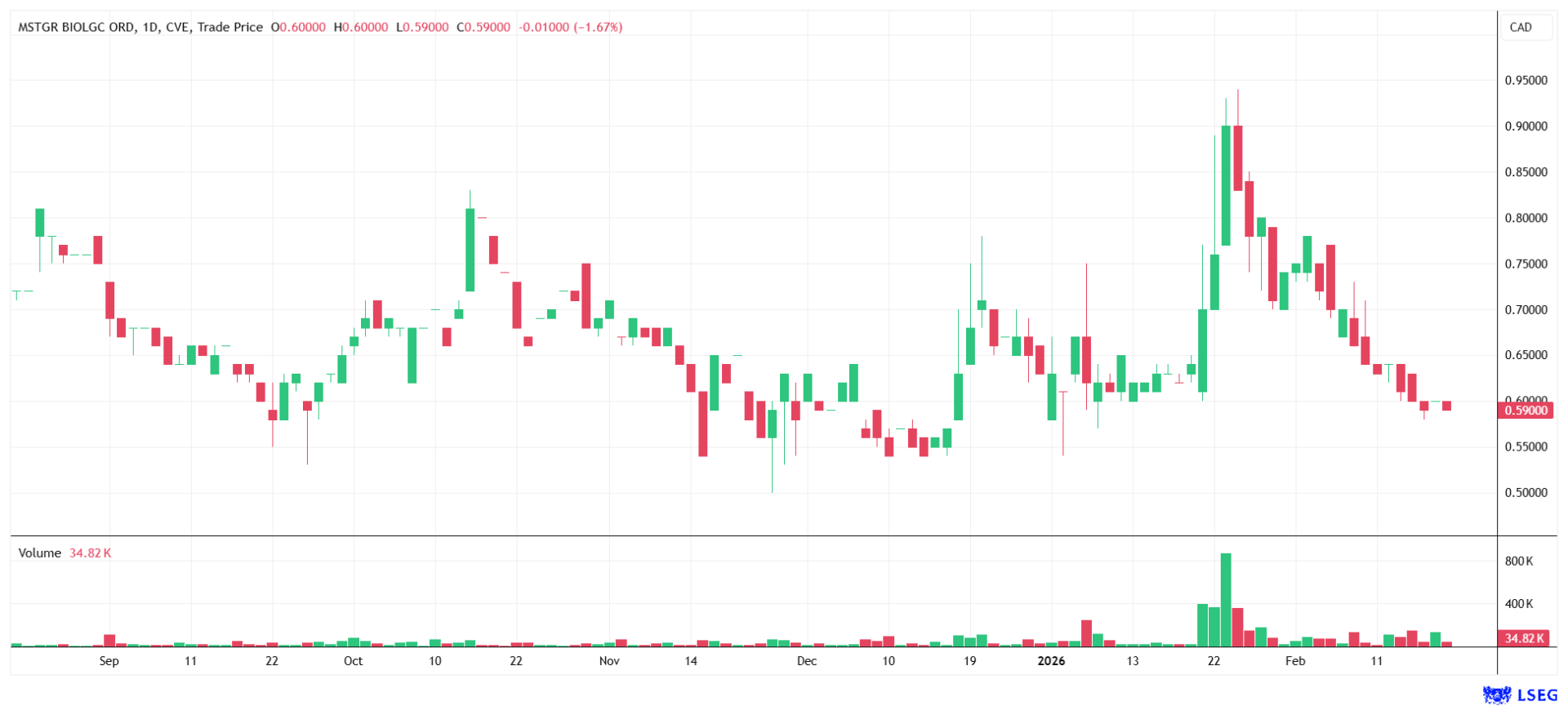
The stock is currently trading at CAD 0.59, well above the price of the last financing round, which is a good sign.
For growth-oriented investors, MustGrow Biologics offers a rare combination of a structural megatrend, initial commercial successes, validated technology, and a strategic partner such as Bayer. The market opportunities are enormous, with even small market shares promising revenues in the hundreds of millions. Anyone looking to invest in the transformation of agriculture will find an exciting investment opportunity here with real progress. The direction is right - now the implementation must deliver on what the field trials promise.
Conflict of interest
Pursuant to §85 of the German Securities Trading Act (WpHG), we point out that Apaton Finance GmbH as well as partners, authors or employees of Apaton Finance GmbH (hereinafter referred to as "Relevant Persons") currently hold or hold shares or other financial instruments of the aforementioned companies and speculate on their price developments. In this respect, they intend to sell or acquire shares or other financial instruments of the companies (hereinafter each referred to as a "Transaction"). Transactions may thereby influence the respective price of the shares or other financial instruments of the Company.
In this respect, there is a concrete conflict of interest in the reporting on the companies.
In addition, Apaton Finance GmbH is active in the context of the preparation and publication of the reporting in paid contractual relationships.
For this reason, there is also a concrete conflict of interest.
The above information on existing conflicts of interest applies to all types and forms of publication used by Apaton Finance GmbH for publications on companies.
Risk notice
Apaton Finance GmbH offers editors, agencies and companies the opportunity to publish commentaries, interviews, summaries, news and the like on news.financial. These contents are exclusively for the information of the readers and do not represent any call to action or recommendations, neither explicitly nor implicitly they are to be understood as an assurance of possible price developments. The contents do not replace individual expert investment advice and do not constitute an offer to sell the discussed share(s) or other financial instruments, nor an invitation to buy or sell such.
The content is expressly not a financial analysis, but a journalistic or advertising text. Readers or users who make investment decisions or carry out transactions on the basis of the information provided here do so entirely at their own risk. No contractual relationship is established between Apaton Finance GmbH and its readers or the users of its offers, as our information only refers to the company and not to the investment decision of the reader or user.
The acquisition of financial instruments involves high risks, which can lead to the total loss of the invested capital. The information published by Apaton Finance GmbH and its authors is based on careful research. Nevertheless, no liability is assumed for financial losses or a content-related guarantee for the topicality, correctness, appropriateness and completeness of the content provided here. Please also note our Terms of use.