May 14th, 2026 | 07:55 CEST
Bayer and BASF on a Performance High — and MustGrow Biologics as a Secret Weapon Against World Hunger!
Created and published on behalf of MustGrow Biologics Corp.
The world's population is growing inexorably, and with it the demand for efficient—but above all sustainable—solutions in agriculture. While the German heavyweights Bayer and BASF have recently impressed markets with strong performance and further cemented their dominant positions, a smaller player is preparing to emerge from the slipstream of the industry giants and join the major leagues. Hardly anyone is likely to have this stock on their radar yet, but it would be worth at least adding it to the watchlist. MustGrow Biologics may have endured a difficult stretch on the stock market, but recent strategic decisions and regulatory successes suggest that the company could be delivering the right answers to pressing global food security challenges at exactly the right time. The market currently appears to be bottoming out, which could mark an attractive entry point for risk-tolerant investors before the biological agriculture trend gains further momentum. In this report, we examine the latest developments at these three companies in the battle for the farmland of the future.
time to read: 5 minutes | Author: Matthias Schomber
ISIN: MUSTGROW BIOLOGICS CORP. | CA62822A1030 | TSXV: MGRO , OTCQB: MGROF , BAYER AG NA O.N. | DE000BAY0017 , BASF SE NA O.N. | DE000BASF111
Table of contents:
Author

Matthias Schomber
Raised in Giessen, Hesse, Matthias Schomber discovered his passion for the financial markets as early as the 1990s—at a time when stock trading was still largely the domain of true, die-hard traders. After completing his banking apprenticeship, he worked for a private bank there and witnessed the rise and fall of the Neuer Markt firsthand on the trading floor of the Frankfurt Stock Exchange, drawing lessons from the experience that continue to shape his thinking as a trader, author, and trading system developer to this day.
Tag cloud
Shares cloud
Bayer and BASF in Top Form
When discussing the future of agriculture, there is no getting around the German industry leaders Bayer and BASF. Both companies have demonstrated in recent months that they are capable of delivering above-average performance despite a challenging market environment. Bayer has recently scored points with positive news that has restored investor confidence. In particular, progress in the product pipeline and a more efficient cost structure have boosted the stock. This is also evident in the share price, as in April 2025, it was still around EUR 20. A year later, the share hit a high of approximately EUR 50, more than doubling in that time. Currently, following a "necessary" consolidation of the rise, the stock is trading at EUR 38.30. The Leverkusen-based group thus remains an indispensable pillar in the global supply chain, as it not only supplies seeds and crop protection products but is also increasingly investing in digital solutions to maximize yield per hectare.
Meanwhile, BASF caused a stir with a far-reaching structural decision. The planned IPO of the agricultural division is a clear signal to the market that the Ludwigshafen-based company intends to fully capitalize on the value of this business unit. This spin-off could not only inject fresh capital into the company's coffers but also give the division the flexibility it needs to be more agile in a rapidly changing environment. Investors have responded to these plans, most recently following an update on the planned IPO, by buying shares, catapulting the stock to the top of the performance charts. The stock rose from around EUR 45 to just under EUR 55 over a few weeks and is now hovering at, or just below, the breakout line, as a rise above EUR 55 would open up technical upside potential in the EUR 70–75 range. Both Bayer and BASF are benefiting massively from the fact that nutrition is a top global priority and that their technological base and expertise are currently virtually irreplaceable.
The Search for the Organic Solution
But the dominance of the big players is no guarantee of security, as the call for organic alternatives grows ever louder. Chemical crop protection is under pressure worldwide, and a gap is emerging here that must be filled. The transition from purely chemical solutions to regenerative approaches is no longer a niche market but a megatrend. Bayer recognized this early on and is already collaborating with specialists in regions such as Europe, the Middle East, and Africa to integrate biological solutions into the portfolio. It is precisely at this intersection between the immense market power of established corporations and the innovative spirit of small biotech specialists that the industry leaders will ultimately be determined.
MustGrow Biologics: The Pivot to Success
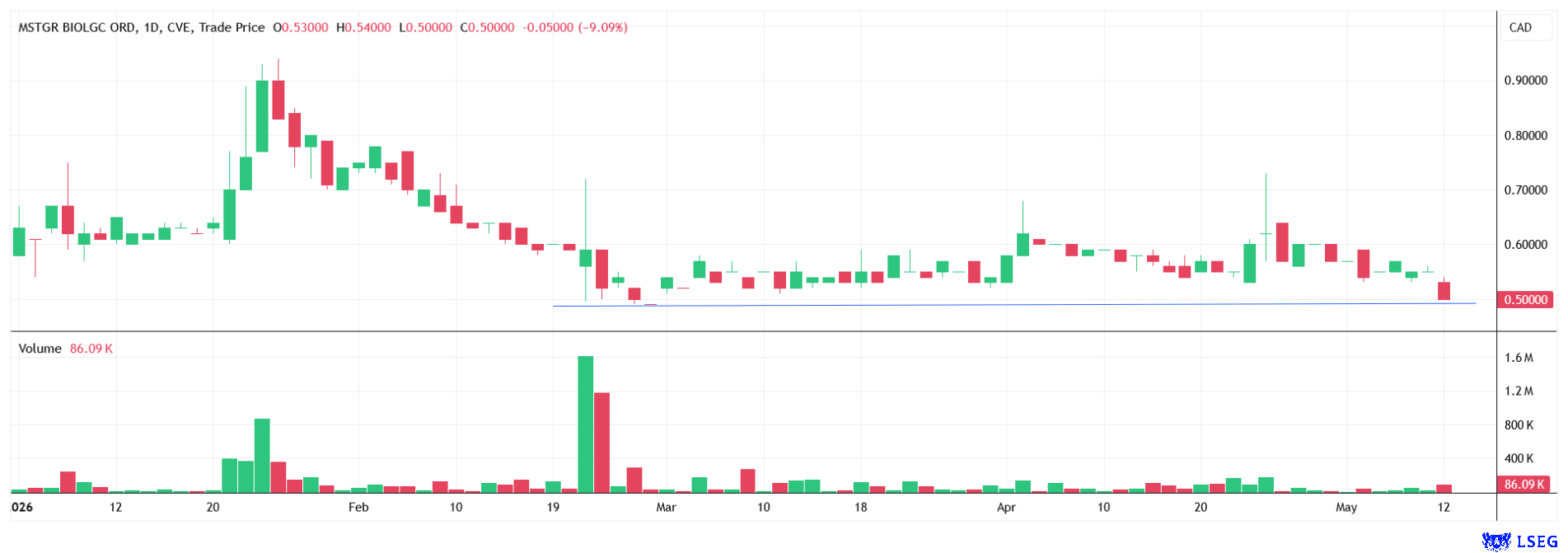
MustGrow Biologics is navigating this dynamic landscape. While the stock recently weakened somewhat, a highly intriguing picture is now emerging on the chart. At around CAD 0.50, the stock appears to have initially formed a solid double bottom. From a technical analysis perspective, this is often the foundation for a trend reversal that could drive the price back toward the CAD 0.60 to 0.70 range. This optimism is fueled not by vague hopes, but by a strategic realignment the company announced at the end of March 2026.
MustGrow closed its Canadian distribution arm, NexusBioAg, effective April 15, 2026. At first glance, the downsizing of a company may seem discouraging, but on closer inspection, this move could prove to be a strategic game-changer. NexusBioAg primarily distributed third-party products—a business that generated revenue but yielded little profit and required significant logistical effort. By closing the division, MustGrow is freeing up vital capital and personnel resources to scale its proprietary patented biofertility product, TerraSante™. The company is now concentrating its commercial strategy on expanding its higher-margin core business in the US while exiting the price-sensitive Canadian distribution market.
Approval Boom and Operational Milestones
The effectiveness of this strategic pivot is already evident in part from the latest success stories. On April 28, 2026, the company announced approval for TerraSante™ in the US state of Georgia. Georgia is not just any market; it is a leader in the production of peanuts, pecans, and blueberries. The fact that TerraSante™ can now be sold there gives MustGrow access to high-quality farmland where the mustard-derived product can fully demonstrate its strengths. It is designed not only to improve yields but also to protect the soil microbiome. This is a key selling point at a time when farmers are desperately seeking ways to keep their soil fertile in the long term.
Just one day later, on April 29, 2026, MustGrow presented its 2025 financial results, delivering an impressive growth outlook. Revenue skyrocketed from USD 0.4 million in the previous year to an impressive USD 8.3 million. Particularly noteworthy is TerraSante's™ success in the US, where sales rose by a whopping 377%. The fact that the bottom line still shows a net loss of USD 7.3 million is virtually normal for a biotech company at this stage, especially since high one-time costs—i.e., one-time effects—were incurred for restructuring the company and building up inventory. With a fresh capital increase of USD 2 million in January 2026 and a secured credit line, the company is financially positioned to meet the rising demand in the US.
Mustard as a Lifesaver: The MustGrow Vision
When looking at MustGrow's development, one must also consider the bigger picture. We live on a planet that will soon have to feed ten billion people, while arable land is shrinking due to erosion and climate change. Food security is an absolute priority for the coming decades. This is where MustGrow's technology comes into play, leveraging the mustard seed's natural defence mechanisms. It is a fascinating idea that a plant as simple as mustard could form the basis for a new era of regenerative agriculture. MustGrow offers solutions that do not deplete the soil but heal it, while simultaneously securing harvests. This is precisely the approach that industry giants like Bayer and BASF are seeking to achieve their own sustainability goals and overcome regulatory hurdles.
Conclusion: Three Paths with the Same Goal
In summary, Bayer and BASF remain two of the leading established players for investors seeking exposure to the long-term strength of the agricultural sector. Their global market presence and recent operational developments continue to support their strategic importance within the industry. MustGrow Biologics, by contrast, represents a more speculative opportunity focused on the growing market for biological agricultural solutions. Following the streamlining of its portfolio and its increased focus on the highly profitable US market with TerraSante™, the company is poised for a potential revaluation. The combination of strong sales growth of its proprietary products, combined with the clearing of key regulatory hurdles, makes the stock particularly exciting right now. If the share price holds steady at CAD 0.50, MustGrow could be the next small-cap stock to cause quite a stir in the wake of the major German giants. Investors who believe in the necessity of sustainable global food security should have this trio on their watchlist—or perhaps even in their portfolio.
Conflict of interest
Pursuant to §85 of the German Securities Trading Act (WpHG), we point out that Apaton Finance GmbH as well as partners, authors or employees of Apaton Finance GmbH (hereinafter referred to as "Relevant Persons") may hold shares or other financial instruments of the aforementioned companies in the future or may bet on rising or falling prices and thus a conflict of interest may arise in the future. The Relevant Persons reserve the right to buy or sell shares or other financial instruments of the Company at any time (hereinafter each a "Transaction"). Transactions may, under certain circumstances, influence the respective price of the shares or other financial instruments of the Company.
In addition, Apaton Finance GmbH is active in the context of the preparation and publication of the reporting in paid contractual relationships.
For this reason, there is a concrete conflict of interest.
The above information on existing conflicts of interest applies to all types and forms of publication used by Apaton Finance GmbH for publications on companies.
Risk notice
Apaton Finance GmbH offers editors, agencies and companies the opportunity to publish commentaries, interviews, summaries, news and the like on news.financial. These contents are exclusively for the information of the readers and do not represent any call to action or recommendations, neither explicitly nor implicitly they are to be understood as an assurance of possible price developments. The contents do not replace individual expert investment advice and do not constitute an offer to sell the discussed share(s) or other financial instruments, nor an invitation to buy or sell such.
The content is expressly not a financial analysis, but a journalistic or advertising text. Readers or users who make investment decisions or carry out transactions on the basis of the information provided here do so entirely at their own risk. No contractual relationship is established between Apaton Finance GmbH and its readers or the users of its offers, as our information only refers to the company and not to the investment decision of the reader or user.
The acquisition of financial instruments involves high risks, which can lead to the total loss of the invested capital. The information published by Apaton Finance GmbH and its authors is based on careful research. Nevertheless, no liability is assumed for financial losses or a content-related guarantee for the topicality, correctness, appropriateness and completeness of the content provided here. Please also note our Terms of use.